Portfolio Margin Crypto: How It Works, Benefits And Risks

Summary
Portfolio margin crypto sets your margin from the worst loss of the whole account, not from each position alone. Hedged books can need far less margin. One-directional books can need far more, as published OKX examples show.
Portfolio margin crypto accounts set your collateral requirement from the worst-case loss of the whole account, not from each position on its own. A hedged book can need far less margin than under classic rules, but a one-directional book can need far more. In this article, Backcom.io explains how the mode works at OKX and Binance, shows published figures, and covers the risks that traders tend to miss.
1. What Is Portfolio Margin Crypto Trading?
Portfolio margin explained in one line: it is an account mode that measures risk across all your positions together. Instead of charging each futures contract its own margin, the exchange models how the whole portfolio could lose money and sets the requirement from that result. Positions that offset each other, such as a long spot holding and a short perpetual, reduce each other's risk.
Classic margin works position by position. As the guide on initial margin vs maintenance margin shows, each contract gets its own requirement from its size and leverage. Portfolio margin replaces that sum of parts with one number for the book.
Binance describes its version as a mode that consolidates the USDⓈ-M, COIN-M and Cross Margin wallets and supports more than 360 coins as one joint collateral pool, according to its collateral page. Assets in the Isolated Margin wallet are left out. See the Binance Portfolio Margin introduction (updated 5 January 2026) and the trading overview (updated 19 May 2026).
2. Portfolio Margin Vs Cross Margin: How Do They Differ?
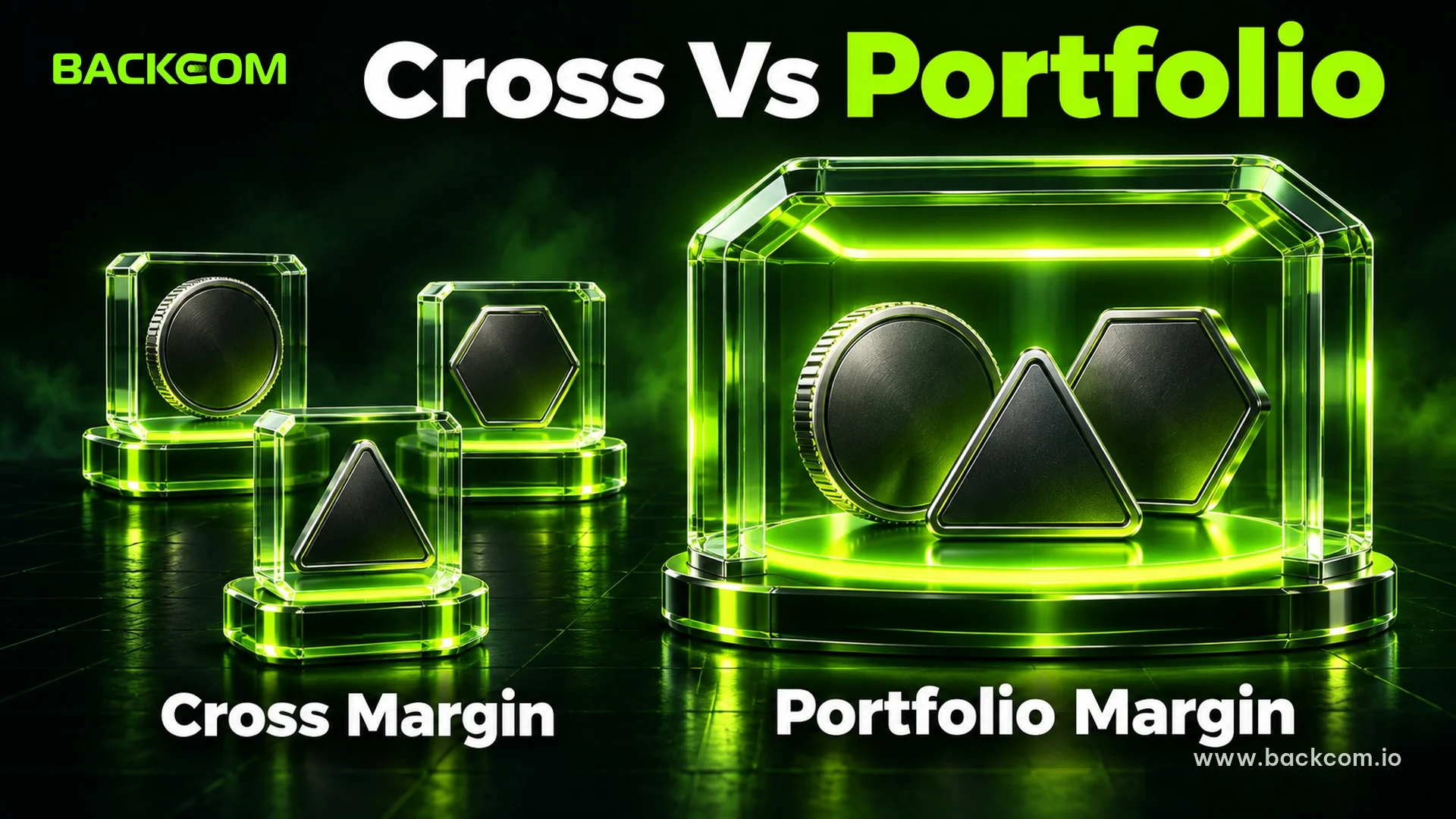
Portfolio margin vs cross margin comes down to how the requirement is built. Cross margin shares one balance across positions but still charges each position its own maintenance margin. Portfolio margin shares the balance and also nets the risk between positions.
| Feature | Isolated margin | Cross margin | Portfolio margin |
|---|---|---|---|
| Collateral | Assigned per position | Whole account balance | Whole account, often several asset types |
| Requirement built from | Each position alone | Each position alone | Worst loss of the whole book |
| Hedges reduce margin | No | Usually not | Yes, if the model recognises the hedge |
| Typical user | Beginners, single trades | Active futures traders | Larger, hedged or multi-asset accounts |
| Complexity | Low | Medium | High |
If you are still choosing between the first two, read cross margin vs isolated margin first. Portfolio margin builds on the same idea of a shared balance, then adds a risk model on top.
Why Exchanges Offer It
Exchanges offer the mode to attract professional and market-making flow, where positions are often hedged. A trader who holds spot BTC and shorts a BTC perpetual against it has little net price risk. Charging full margin on both legs ties up capital for no good reason.
3. How Do Exchanges Calculate Portfolio Margin?
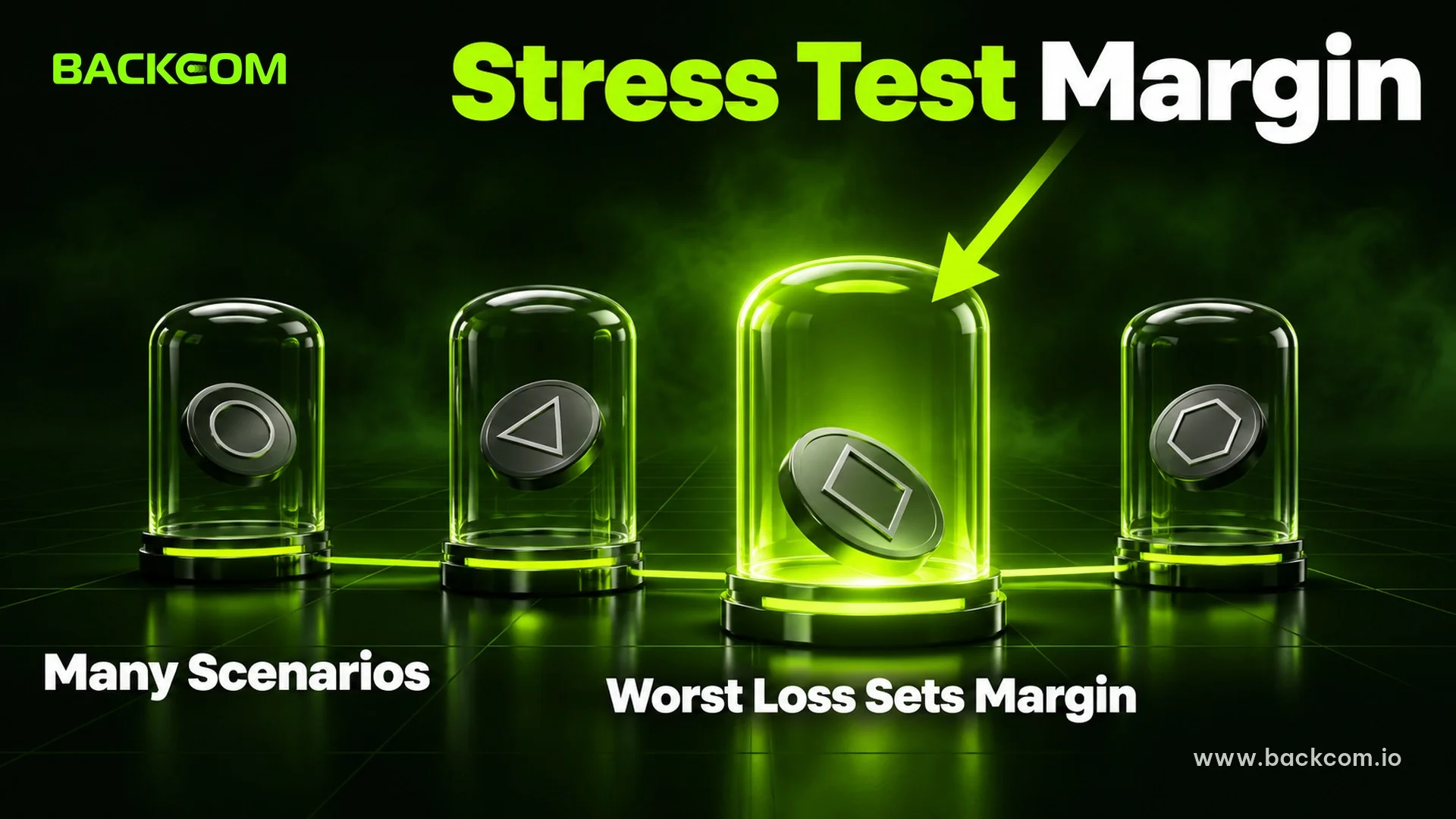
Most exchanges run a stress test: they reprice your whole portfolio under a set of market scenarios and take the largest loss as the requirement. The exact scenarios, shocks and add-on charges differ by exchange and change over time, so the figures below are examples from OKX's documentation, not universal rules.
OKX states that maintenance margin is determined using risk units, where futures, options and spot (if used for hedging) are grouped by the underlying coin. Its documentation gives this structure for derivatives:
Derivatives MMR = Max(Max(Spot shock, Theta decay risk, Extreme move) + Basis risk + Vega risk + Interest rate risk + Stablecoin depegging risk, Adjusted minimum charge)
The spot shock term is the largest loss across 21 simulations: 7 price moves multiplied by 3 implied volatility changes. For BTC and ETH the price moves are 0%, ±4%, ±8% and ±12%. The extreme move term uses ±24% for the same two coins. See OKX's Risk Unit Merge guide (updated 5 August 2026).
OKX sets the initial requirement from the maintenance figure: IMR = 1.3 × MMR for derivatives, plus borrowing requirements. In its simulated examples, a derivatives IMR of 168,947 USD sits against an MMR of 129,959 USD, a ratio of 1.3.
Portfolio Margin Explained: A Simplified Scenario Example
The table below uses only OKX's published BTC price steps to show the principle. It is hypothetical, ignores volatility, extreme moves and fees, and is not any exchange's live requirement. Take a 1 BTC position with BTC at 100,000 USDT.
| BTC move | Long 1 BTC only | Long 1 BTC spot + short 1 BTC perpetual |
|---|---|---|
| +12% | +12,000 | 0 |
| +8% | +8,000 | 0 |
| +4% | +4,000 | 0 |
| 0% | 0 | 0 |
| −4% | −4,000 | 0 |
| −8% | −8,000 | 0 |
| −12% | −12,000 | 0 |
| Worst case | −12,000 | 0 before basis |
Illustrative figures in USDT. Real models add basis, volatility, fee and minimum charges.
The long-only book has a worst case of 12,000 USDT, so a stress test sets its requirement near that level. The hedged book shows no price loss in this simple grid, so its requirement collapses to the add-on charges. That is the core idea of the mode, and the add-ons are why a real hedged requirement never falls to zero.
4. How Much Can Portfolio Margin Reduce Margin? OKX Figures
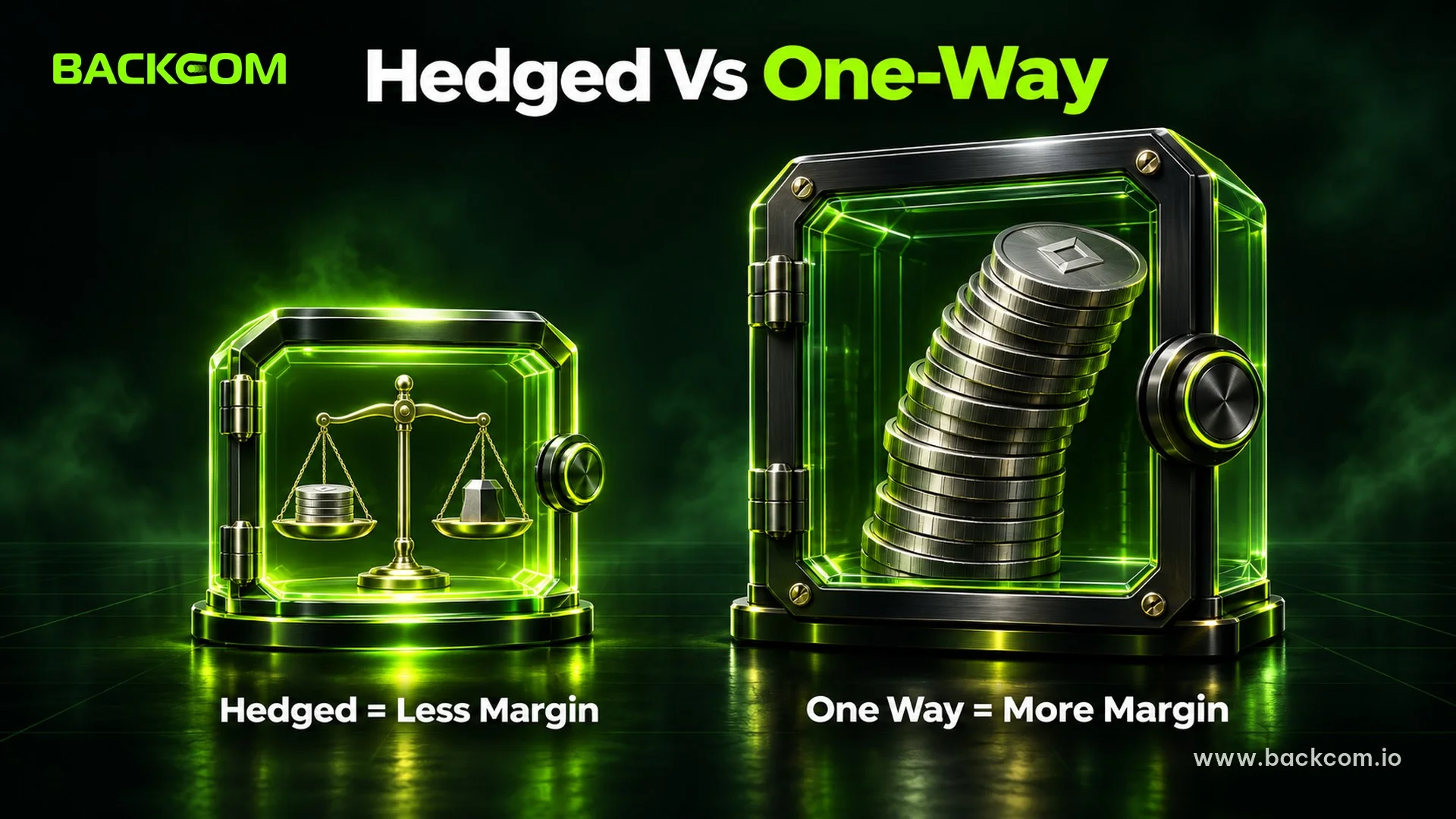
OKX publishes simulated comparisons between its multi-currency margin mode and its portfolio margin mode. The numbers come from its position builder tool on 6 February 2025, so they show structure, not today's live requirement. See the OKX comparison page (updated 14 August 2026).
| Book | Mode | Initial margin (USD) | Maintenance margin (USD) |
|---|---|---|---|
| Large delta-neutral, 10 BTC spot | Multi-currency (10x) | 961,956 | 192,371 |
| Large delta-neutral, 10 BTC spot | Portfolio | 168,947 | 129,959 |
| Small delta-neutral, 1 BTC spot | Multi-currency (10x) | 106,374 | 5,503 |
| Small delta-neutral, 1 BTC spot | Portfolio | 8,132 | 6,035 |
| One-directional, no spot | Multi-currency (10x) | 154,651 | 7,775 |
| One-directional, no spot | Portfolio | 284,621 | 218,939 |
Source: OKX position builder simulation of 6 February 2025, published on OKX's help centre. Check the live tool before relying on any figure.
Three lessons stand out:
- Large hedged book: initial margin falls by about 82% (961,956 to 168,947) and maintenance margin by about 32% (192,371 to 129,959).
- Small hedged book: initial margin falls sharply, yet maintenance margin is slightly higher under portfolio margin (6,035 vs 5,503). OKX notes the difference is generally small.
- One-directional book: maintenance margin under portfolio margin is about 28 times higher (218,939 vs 7,775), and initial margin is about 1.8 times higher.
The last row is the warning. OKX says portfolio margin maintenance calculation is only capital efficient for a hedged portfolio, and for single-directional portfolios it is inefficient. The mode is not a free upgrade. It rewards hedging and penalises one-way bets.
5. How Does Binance Portfolio Margin Work?
Binance Portfolio Margin measures account health with one ratio called uniMMR, the unified maintenance margin ratio. It combines the adjusted equity of the wallets in the program and divides it by the combined maintenance margin of all positions.
uniMMR = Unified Account Adjusted Equity ÷ Unified Maintenance Margin Amount
Binance's uniMMR FAQ (updated 17 November 2026) lists the account states:
| uniMMR | What happens |
|---|---|
| Above 1.5 | You can trade freely |
| 1.2 to 1.5 | Reminder to add funds, repay a loan or reduce futures positions |
| 1.05 to 1.2 | New orders are refused; reduce-only orders are still accepted |
| 1.05 or below | Liquidation takes place |
Binance's liquidation FAQ (updated 13 January 2026) adds that the margin call level of 1.5 can be customised between 1.2 and 2.
Collateral Is Tiered, Not Taken At Face Value
Binance does not count every coin at 100% of its market value. Collateral is valued in tiers, each with its own collateral rate. Binance's collateral page (updated 17 November 2026) gives an example. Three wallets each hold 1 BTC at 10,000 USD, with a 100% rate on the first 10,000 USD and 90% above that:
10,000 USD × 100% + 20,000 USD × 90% = 28,000 USD
So 30,000 USD of BTC counts as 28,000 USD of collateral. Collateral rates change, so read the current table for any coin you plan to post.
The Initial Margin Check
Binance still runs an initial margin check on new orders. A new order is placed only if its initial margin is lower than your virtual available balance. For futures, the page gives initial margin = position size × mark price ÷ leverage, the same logic described in the guide to how to calculate your liquidation price.
6. Which Portfolio Margin Exchanges Offer It, And Who Can Use It?
Portfolio margin exchanges restrict the mode, because they want users who understand the risk model. The entry conditions differ:
- OKX tier: the comparison page lists a user tier of VIP 3 or above as a prerequisite.
- OKX equity: its settings demo says net equity must be above 10,000 USD.
- Binance wallets: the Cross Margin, USDⓈ-M and COIN-M wallets are combined, while Isolated Margin assets are not counted.
- Binance: it describes the mode as one for experienced traders seeking more leverage and flexibility.
Binance does not publish a minimum account size on its Portfolio Margin pages, so check the current terms in your account before assuming you qualify. Some features, such as Lite trading, are unavailable in the mode.
7. What Are The Benefits Of Portfolio Margin?
The main benefit is capital efficiency for hedged strategies. Less margin is locked, so the same balance can support larger or additional positions. Three situations show it best:
- Delta-neutral books: a long spot or futures leg against a short leg. The funding rate arbitrage strategy is a typical case.
- Multi-asset accounts: collateral can sit in several coins, and unrealised profit on one position can support another.
- Options and futures together: offsetting exposures are measured together rather than separately.
A second benefit is one risk number for the account. On Binance that is uniMMR, and on OKX it is the maintenance margin ratio, so you monitor one figure instead of many.
8. What Are The Main Portfolio Margin Risk Factors?
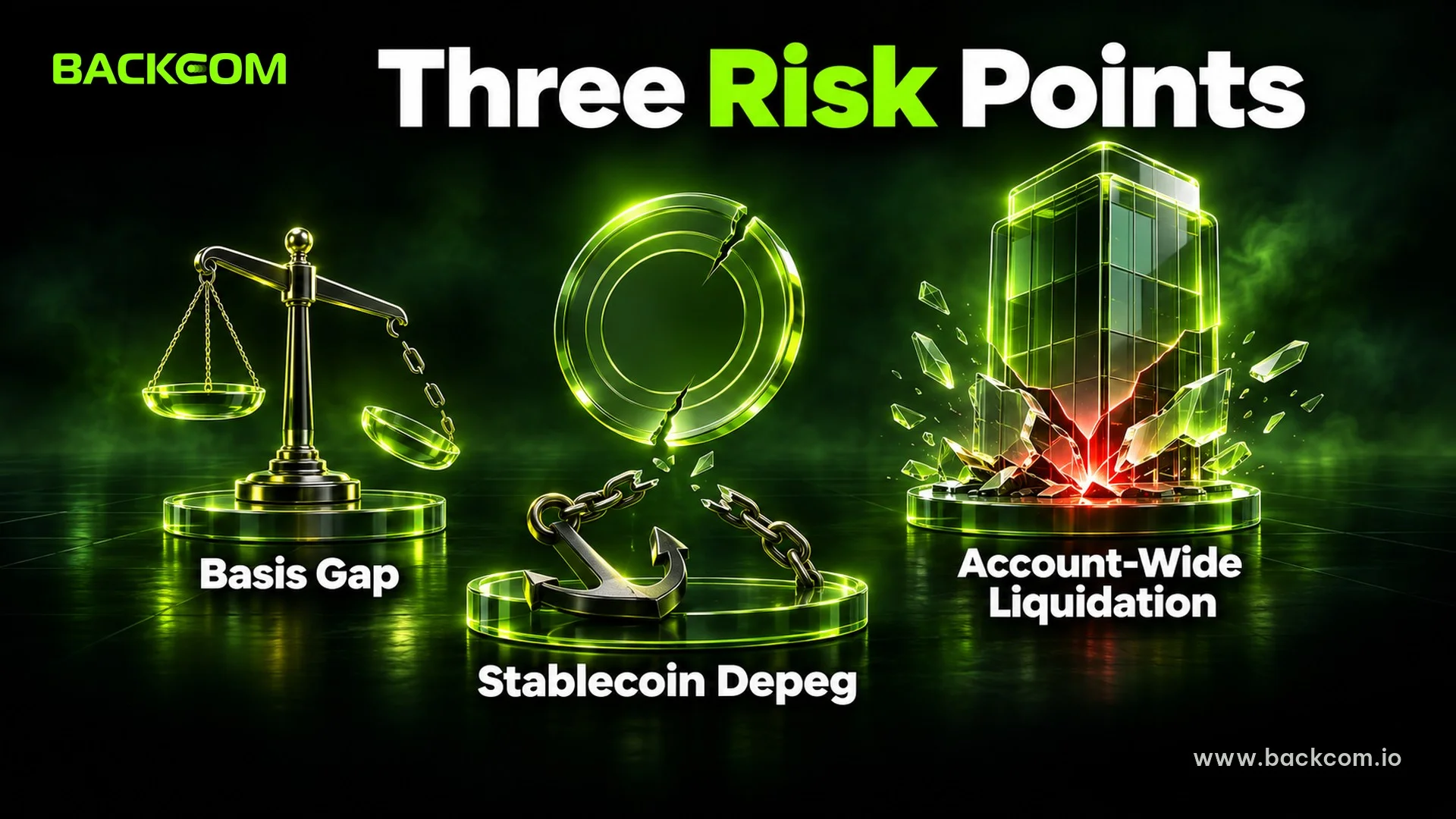
Portfolio margin risk comes from the same netting that saves you capital. The mode removes some safety rails along with some cost, and several risks are specific to it.
Hedges Are Not Perfect
A hedge only holds if both legs move together. OKX defines basis risk as the risk when the spot price and the perpetual or expiry futures price do not move in sync. A widening basis can create losses on a book that looked neutral. The model charges for this risk, but the charge is an estimate.
Stablecoin Depeg Risk
OKX includes a stablecoin depegging term in its formula. If your collateral or hedge relies on USDT or USDC and that coin trades below 1 USD, the requirement can rise at the same moment your collateral falls in value.
One-Directional Positions Can Cost More
As the OKX table shows, a one-way book can need many times more maintenance margin under portfolio margin. Switching modes without checking the new requirement can leave you close to a liquidation level on day one.
Liquidation Is Account-Wide
When uniMMR falls to 1.05 on Binance, liquidation covers the unified account. Binance warns the process continues until it completes, and it uses immediate-or-cancel orders. Remaining positions can pass to position assumption and, in some cases, auto-deleveraging. Negative balances also accrue interest. Binance notes liquidation can occur even without open positions when adjusted equity turns negative because of exchange-rate moves.
OKX's process is staged. It sends a liquidation alert when the maintenance margin ratio is below a set level, with 300% given as an example, and triggers liquidation when the ratio drops to 100%. It then applies dynamic hedging and basis hedging steps before it reduces positions tier by tier.
Model Changes Can Move Your Requirement
Exchanges update risk parameters, collateral rates and tiers. A position that was safe last week can need more margin after a change. Fast markets also feed liquidation cascades, which hit leveraged accounts hardest.
9. How Can You Use Portfolio Margin More Safely?
The goal is to keep the benefits of netting without relying on it to rescue a weak plan. Use this checklist:
- Compare modes with real numbers. Use the exchange's position builder or margin calculator before you switch.
- Keep a buffer well above the liquidation level. On Binance, do not run near 1.2 or 1.5.
- Size for a stress move. Test your book against a 12% price move and a depeg, not only today's price.
- Watch the basis. Review hedged pairs when the spread between spot and futures widens.
- Know your leverage. Read how much leverage to use and keep it below what the model allows.
- Understand the exit plan. Learn what a margin call looks like on your platform before you need it.
- Re-check after every update. Exchanges change collateral rates and tiers, so review your requirement after each notice.
If you hold two-sided positions in one-way mode, the hedge mode vs one-way mode guide explains how the account records them. The futures leverage calculator guide shows how to combine margin, size and liquidation in one worksheet.
Frequently Asked Questions (FAQ) About Portfolio Margin
Is Portfolio Margin Safer Than Cross Margin?
Not by default. It lowers margin for hedged books, but it does not reduce price risk. A one-directional book can need much more margin, and liquidation covers the whole account. Safety depends on how well your positions offset each other and how large your buffer is.
Can Beginners Use Portfolio Margin?
Exchanges restrict it. OKX lists a VIP 3 tier requirement, and its demo settings require net equity above 10,000 USD. Binance calls it a mode for experienced traders. Beginners are usually better served by isolated or cross margin until they understand liquidation maths.
Does Portfolio Margin Increase Leverage?
It can raise effective leverage on hedged positions because less margin is locked. That does not make the market safer. More leverage means a smaller buffer, so a move the hedge does not cover can liquidate the account faster.
What Is The Difference Between Portfolio Margin And Multi-Currency Margin?
Multi-currency margin is OKX's other cross-collateral mode. Portfolio margin groups positions into risk units and applies scenario tests. OKX's comparison shows portfolio margin is better for hedged books and worse for one-way books.
Conclusion: Portfolio Margin Rewards Hedging, Not Hope
Portfolio margin in crypto sets your requirement from the worst loss of the whole account. In OKX's published example, a large delta-neutral book needed about 82% less initial margin, while a one-directional book needed about 28 times more maintenance margin. The mode is a tool for managing risk across offsetting positions, not a way to get more leverage for free.
Before you switch, compare the requirement under both modes, stress test the book, and keep a wide buffer. Then re-check after each rule or collateral update.
Disclaimer: This content is compiled by Backcom.io for information only and is not investment advice. Crypto futures and margin trading carry a high risk of loss, and liquidation can wipe out your collateral. The figures above come from exchange documentation or are illustrative, and they do not predict future results.
Was this article helpful?
Join The Backcom.io Community
Get the latest on trading rebates, trading tips, and broker deals — and connect with thousands of traders worldwide.

Backcom App
Track Your Rebates Every Day
Every rebate is visible by broker and by day. Manage your wallet and withdrawals in one place.
Open Backcom App