Bitget Funding Rate: How It Is Calculated And Settled On Perpetual Futures

Summary
Bitget settles perpetual funding every 8 hours by default, at 00:00, 08:00 and 16:00 UTC, with 2- or 4-hour intervals on some contracts, and the fee is position value times the funding rate. A positive rate means longs pay shorts and a negative one the reverse, and only positions open at settlement pay or receive.
The Bitget funding rate is the periodic payment that long and short traders on a Bitget perpetual contract exchange with each other, and it decides whether holding a position overnight costs you money or pays you. The general mechanism is covered in our funding rate guide. This article stays on Bitget and covers the settlement times, the formula in the help center, how the premium index is sampled after the July 2026 change and where to read the live and past numbers. In this article, Backcom.io also shows what a trading-fee rebate does and does not cover.
All Bitget rules below were read from the Bitget help center and the public futures funding page on 27 November 2026. Bitget can change these parameters at any time, so confirm the current terms on the exchange before you trade.
Bitget Funding Rate At A Glance
A Bitget funding rate is a percentage applied to the position value of your open perpetual futures at fixed settlement moments. It exists to keep the perpetual price close to the index price. The table lists the settings that matter most for USDT-M perpetual contracts.
| Item | Bitget setting |
|---|---|
| Default settlement times | 00:00, 08:00 and 16:00 UTC (every 8 hours) |
| Other intervals | 2 or 4 hours on certain contracts |
| Fee formula | Funding fee = Position value × Funding rate |
| Position value | Futures position size × Mark price |
| Interest rate (I) | Fixed at 0.01% per 8-hour interval (0.03% per day) |
| Premium clamp | Plus or minus 0.05% |
| Who pays whom | Positive rate: longs pay shorts. Negative rate: shorts pay longs |
| Service fee charged by Bitget | None |
Reference settings as at 27 November 2026. Bitget can adjust funding parameters, so check the live contract page before you trade.
Two points deserve attention. The payment goes between traders and not to Bitget, and it is charged on the full position value, not on your margin.
Bitget Funding Fee Time: When The Payment Happens
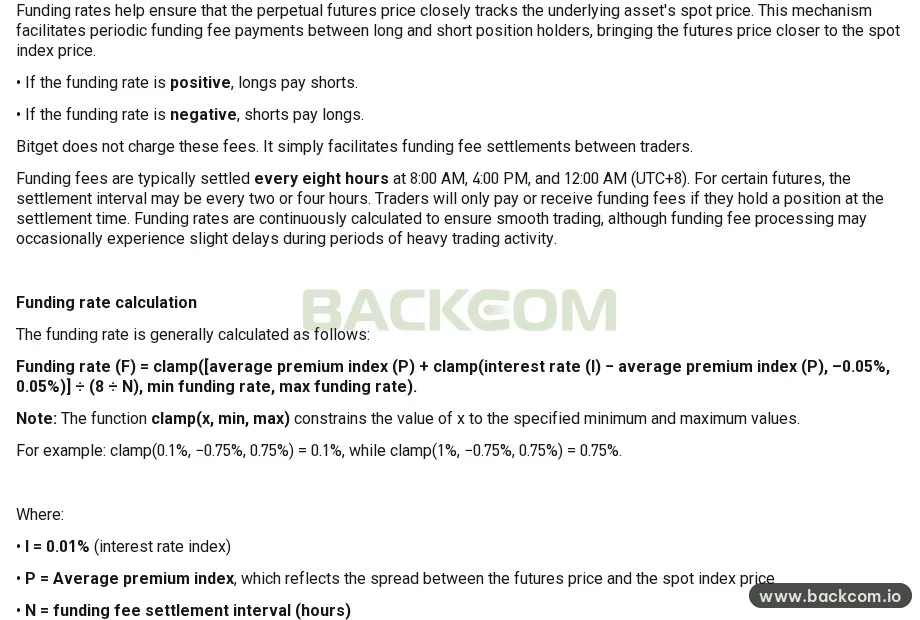
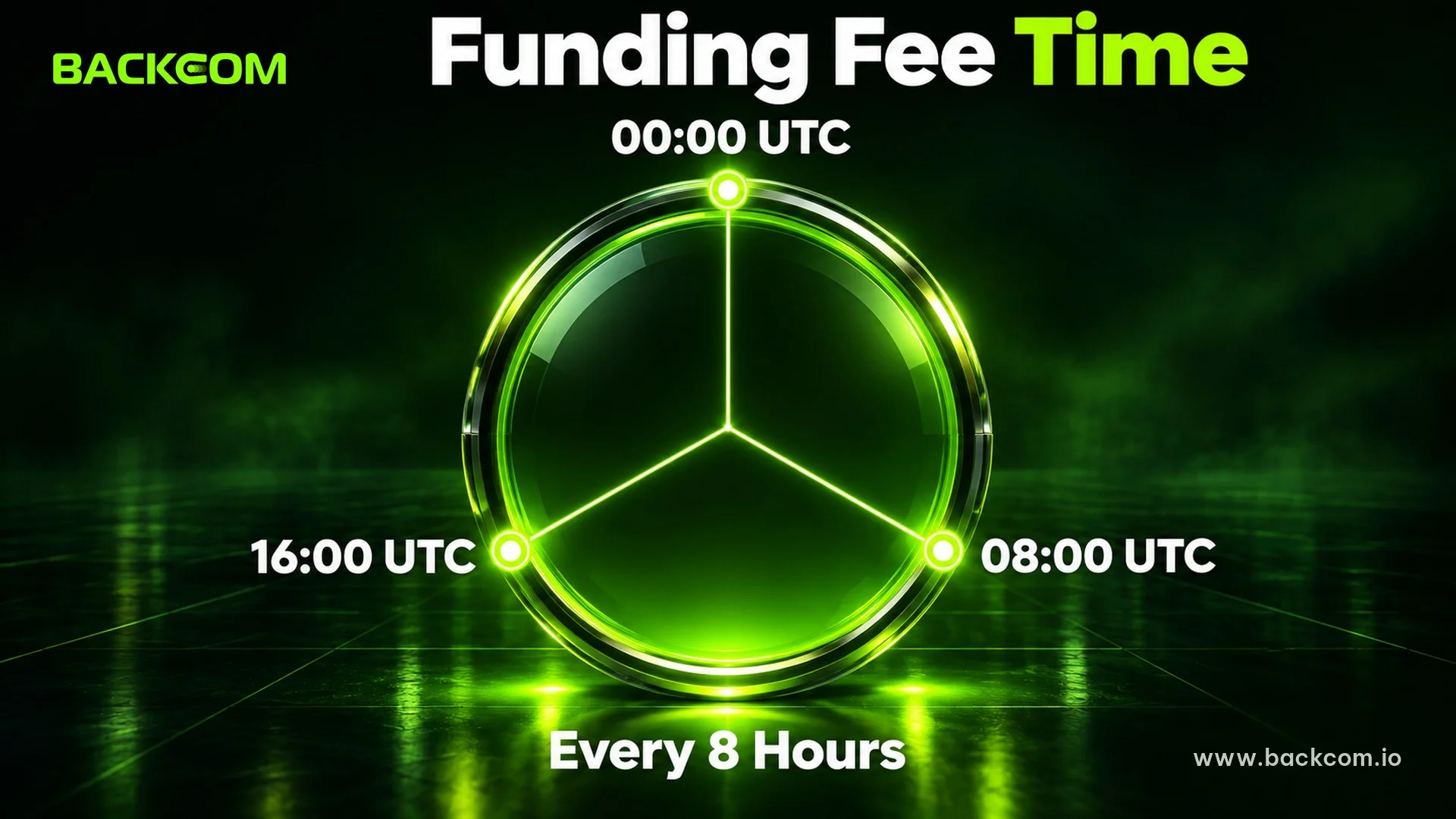
Bitget funding fee time follows a simple default. According to the Bitget funding rate help article, funding is typically settled every eight hours at 8:00 AM, 4:00 PM and 12:00 AM in UTC+8. Converted to UTC, those moments are 00:00, 08:00 and 16:00 UTC.
The same article states that for certain futures the settlement interval may be every two or four hours. The settlement frequency can also be adjusted by Bitget, so the interval shown on the contract page is the one that counts.
The rule that catches new traders is about timing:
- You only pay or receive funding if your position is open at the settlement moment. Close it a minute before the settlement and you neither pay nor receive anything for that interval.
- Opening a position just before settlement makes you liable for the whole interval's payment, even though you held it for a few seconds.
- Your local clock differs from UTC. Convert the three times to your own time zone once and keep them handy.
If you are new to the contract type itself, the explainer on perpetual futures shows why this payment exists in the first place.
Bitget Funding Rate Calculation: The Formula Step By Step
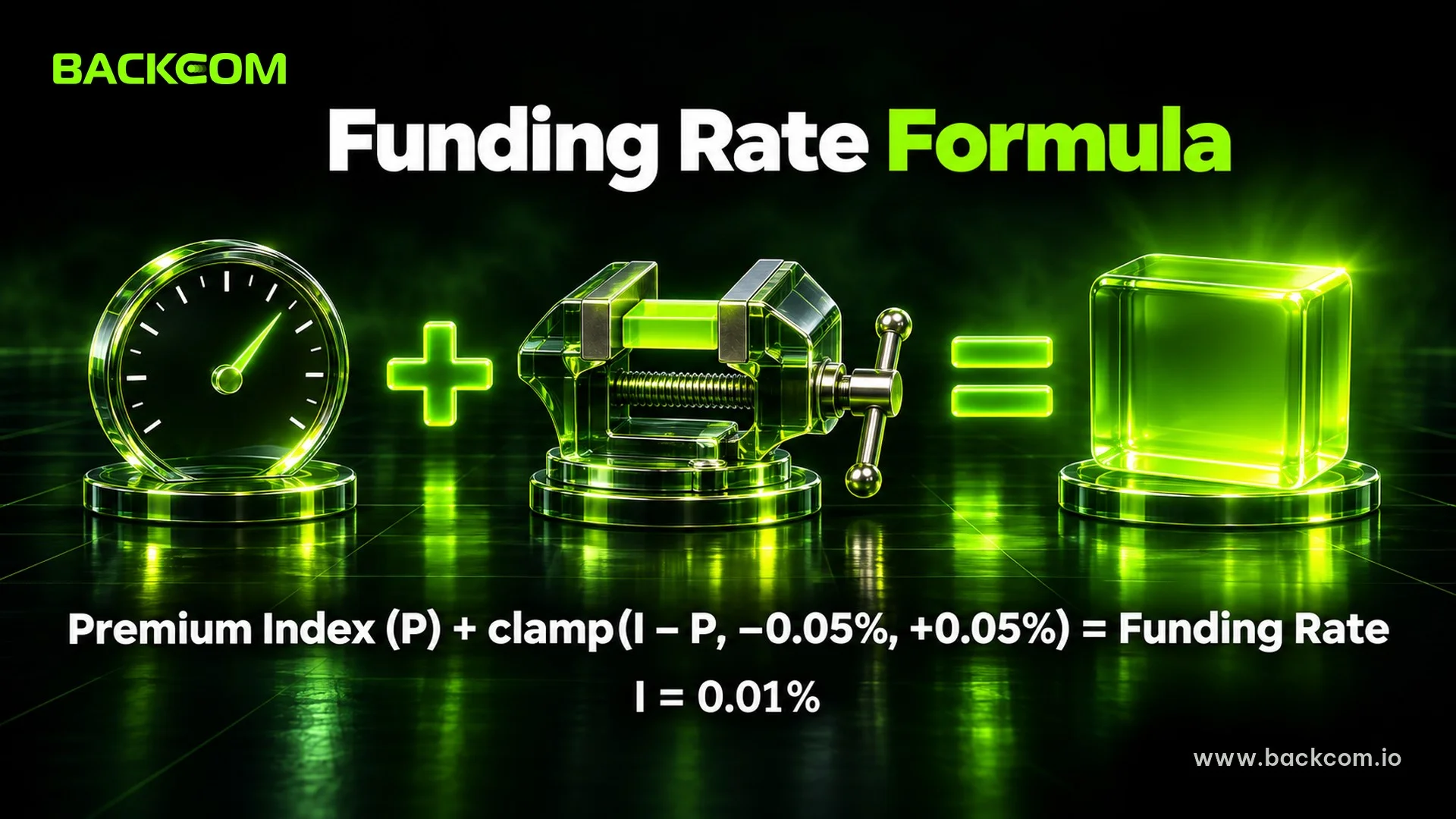
Bitget funding rate calculation has three parts: a premium index that measures how far the perpetual trades from the index price, a fixed interest rate and a final cap. The help center gives the formula as:
Funding Rate (F) = clamp([P + clamp(I − P, −0.05%, 0.05%)] ÷ (8 ÷ N), min funding rate, max funding rate)
Here P is the average premium index, I is the interest rate and N is the funding interval in hours. For the default 8-hour interval, 8 ÷ N equals 1 and the division changes nothing. Bitget announced the version with the 8 ÷ N term and a fixed 0.01% interest rate in an official formula notice published on 18 September 2025, effective 22 September 2025.
The pieces work like this:
- Premium index (P): compares the order book with the index price using an impact bid and an impact ask, so a perpetual trading above the index gives a positive premium. The impact margin notional is 200 USDT multiplied by the maximum leverage of the contract.
- Interest rate (I): fixed at 0.01% for an 8-hour interval and set by Bitget, so it does not move with the market.
- Inner clamp: the term clamp(I − P, −0.05%, 0.05%) limits the interest correction to plus or minus 0.05%.
- Outer clamp: the final rate cannot go beyond the minimum and maximum funding rate of the contract.
Because the interest rate is only 0.01%, a market with no premium settles at a small positive rate. That is why a quiet market often shows a rate near 0.0100%.
The averaging method changed in July 2026. In a notice published on 2 July 2026, Bitget said that from 10 July 2026 (UTC+8) the premium index is sampled once every 5 seconds instead of once every minute, and that samples from the previous cycle are added to the current one. The notice adds that the exact release time depends on the deployment schedule.
In the help article, an 8-hour cycle holds 5,760 samples and the average is a weighted average, so samples nearer to settlement count more than older ones. A rate calculated at 04:00 UTC therefore draws on samples from 20:00 UTC the previous day to 04:00 UTC, not only from 00:00 UTC onward. For you, the practical effect is that one short price spike moves the rate less than it used to, because it is averaged with the samples around it.
Worked Funding Rate Calculations
To keep the arithmetic readable, the examples treat the average premium index as one number. These are illustrative inputs, not live data, and they use an 8-hour interval.
| Premium Index (P) | I − P | After inner clamp | Funding rate (8h) |
|---|---|---|---|
| 0.00% | 0.01% | 0.01% | 0.0100% |
| 0.03% | −0.02% | −0.02% | 0.0100% |
| 0.10% | −0.09% | −0.05% | 0.0500% |
| −0.08% | 0.09% | 0.05% | −0.0300% |
| 0.50% | −0.49% | −0.05% | 0.3000% (capped, example max 0.3%) |
Illustrative inputs only. Real values depend on the order book at each moment.
Read the rows from the top. At a 0.03% premium, the correction brings the rate back to the 0.01% baseline. At 0.10%, the correction hits the 0.05% limit and the result is 0.05%. In the fourth row, a negative premium produces a negative funding rate, so shorts pay longs. In the last row the formula would give 0.45%, but the contract's maximum of 0.3% cuts it back.
For a 4-hour contract the same inputs are divided by 8 ÷ 4 = 2. A premium of 0.10% gives 0.05% ÷ 2 = 0.025% per settlement, so the rate stated for one settlement is smaller when settlements are more frequent.
Bitget Perpetual Funding: Who Pays Whom, And How Much
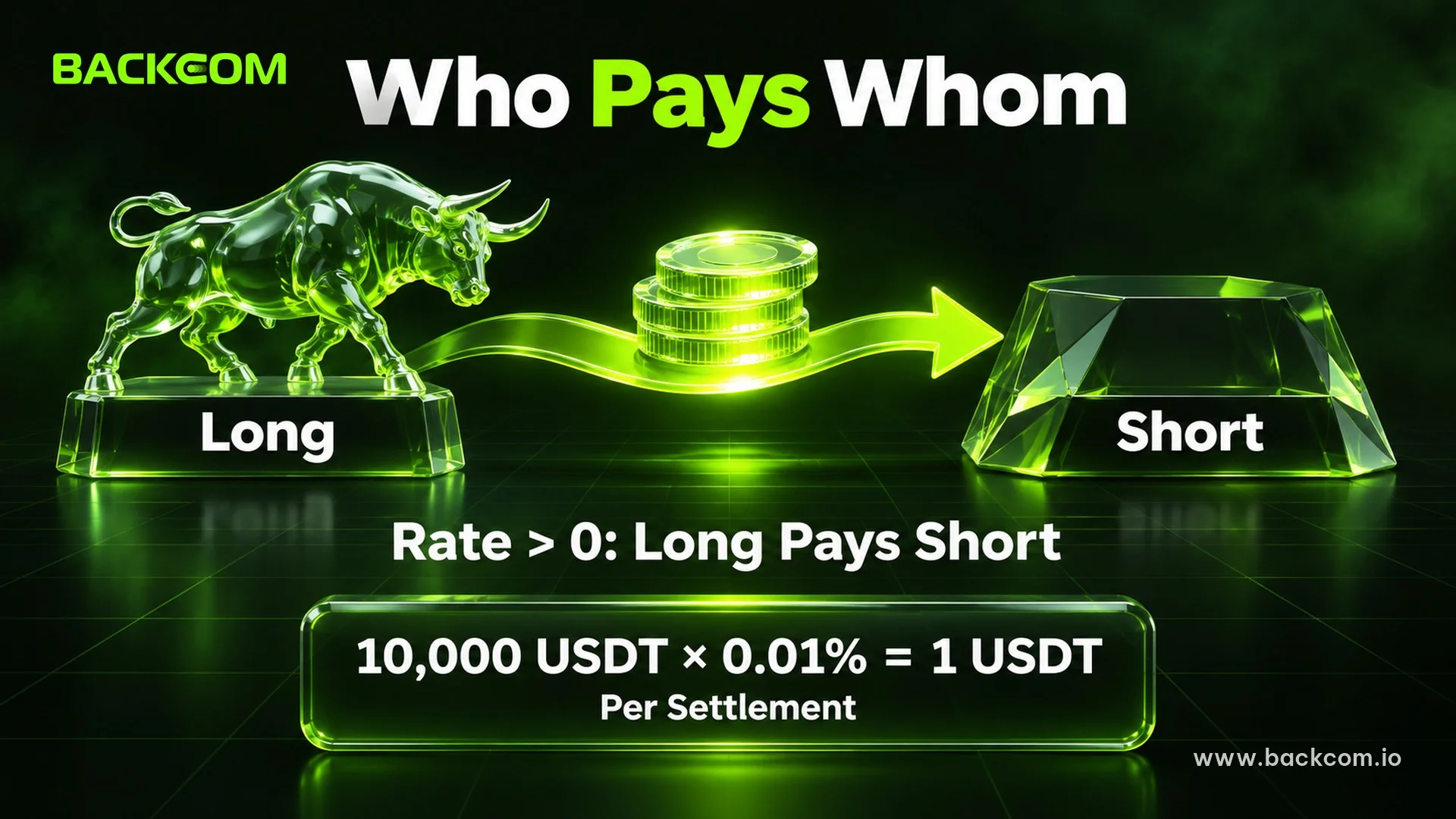
Bitget perpetual funding is a transfer between the two sides of the market. According to the help article, when the rate is positive, traders long on the perpetual pay shorts. When the rate is negative, shorts pay longs.
Funding Fee = Position Value × Funding Rate
The help article gives a worked case: a long of 10 BTC at a mark price of 70,000 USDT has a position value of 700,000 USDT. At a funding rate of 0.01%, the fee is 700,000 × 0.0001 = 70 USDT for that settlement. A smaller position shows the scale for most traders. Take 10,000 USDT of position value at +0.0100%:
- Per settlement: 10,000 × 0.0001 = 1 USDT paid.
- Per day (3 settlements): 3 USDT.
- Per 30 days, if the rate stayed the same: about 90 USDT.
The rate rarely stays still, so treat the 90 USDT as an arithmetic illustration rather than a forecast. A short position in the same market would receive the 1 USDT each interval.
Leverage changes how that cost feels. At 10x leverage, the 10,000 USDT position needs about 1,000 USDT of margin, so 3 USDT a day is roughly 0.3% of your margin per day. Funding is based on position value, so the higher your leverage, the larger the share of your margin that funding consumes. To see how margin and liquidation interact, read the guides to cross vs isolated margin and how to calculate liquidation price.
One more caution comes from the help article. If the paying side is liquidated or runs short of margin in isolated mode, the receiving side may not get the full amount. You can also read funding as an annual figure: 0.01% × 3 × 365 = 10.95% a year on position value, and Bitget annualises the same way: a 0.0052% rate on BTCUSDT was shown as 5.69% APR (0.0052% × 3 × 365).
Bitget Funding Rate History: Where To Read It
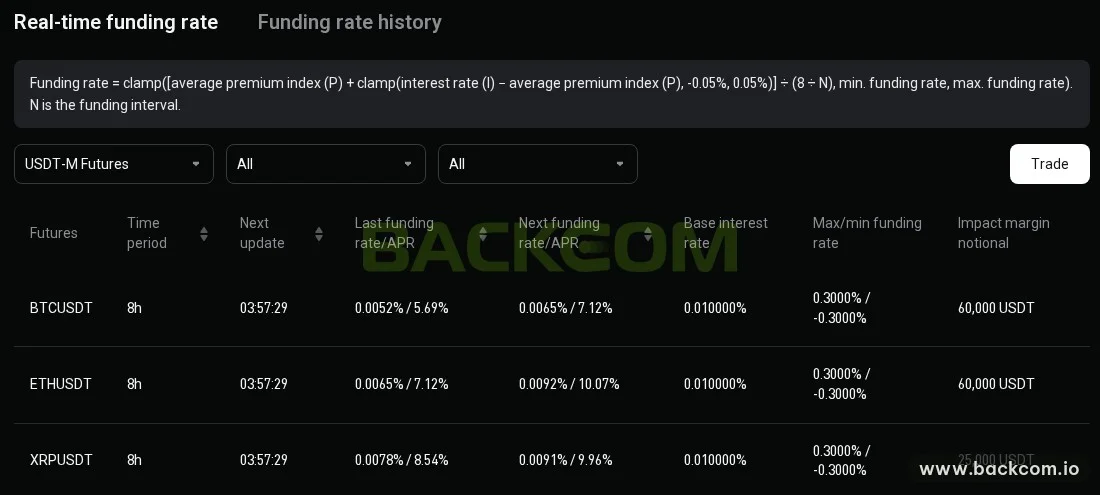
Bitget funding rate history and the current rate are published on the exchange without an extra tool. You have three places to look:
- The futures trading screen. The current rate and a countdown to the next settlement sit next to the price of the contract.
- The Bitget funding rate page. The public real-time funding rate page has two tabs, one for the real-time rate and one for the rate history of each contract.
- The contract details. Each contract shows its own interval, base interest rate and maximum and minimum funding rate.
The real-time table is worth reading column by column. On 27 November 2026 it listed an 8-hour period for BTCUSDT, ETHUSDT and XRPUSDT, a base interest rate of 0.010000% and a maximum and minimum funding rate of 0.3000% and −0.3000%. Other contracts carry different limits, so never assume one set of numbers for every symbol.
History answers a more useful question than the current figure. Add up the last 30 days of settlements for the symbol you trade, multiply by your position value and you get what funding actually cost or paid in that period. A rate that looks tiny on one settlement can be significant after 90 of them. For a strategy that tries to collect this payment on purpose, see the guide to funding rate arbitrage, and for how crowded positions build up behind it, the explainer on open interest in crypto futures.
Bitget Funding Rate And Rebates: What A Rebate Covers
A rebate on a trading fee does not reduce funding, and it helps to be clear about why. Bitget says it takes no service fee on funding, because the payment passes between traders. A fee rebate applies to the trading fees that Bitget charges, so a funding payment falls outside it.
What a rebate can lower is the fee you pay each time you open or close the position. The Bitget Rebates page lists a total of 50% of your trading fees, made up of 20% credited by Bitget every day and 30% paid by Backcom.io every Monday (rates updated 21 November 2026). As an illustration, if you paid 100 USDT in trading fees in a month, the listed rebate would return up to 50 USDT. Funding is a separate line on top of it.
The conditions on the rebate page are short:
- Register through the link on the rebate page before your first trade.
- Link your account UID in the rebate app so trades are tracked.
- Check an existing account first. An older account may already belong to another referrer, and the page explains the options.
You can read the current terms on the Bitget Rebates page. Backcom.io is an independent introducing broker (IB/affiliate) of Bitget, and rebates are paid from the commission Bitget pays it, as explained in the risk disclaimer. A rebate lowers the cost of trading but does not make a losing strategy profitable.
For the fee side of the same exchange, the guides to Bitget trading fees and the Binance vs Bitget fees comparison go through the maker and taker tables.
Frequently Asked Questions (FAQ) About The Bitget Funding Rate
What Time Does Bitget Charge Funding?
On default 8-hour contracts, funding settles at 00:00, 08:00 and 16:00 UTC, which is 8:00 AM, 4:00 PM and 12:00 AM in UTC+8. Some contracts settle every two or four hours, so check the interval on the contract you trade.
Do I Pay Funding If I Close My Position Before Settlement?
No. You pay or receive funding only if you hold an open position at the settlement time. Closing before that moment means nothing is charged for that interval.
Does Bitget Take A Cut Of The Funding Payment?
According to the help center, funding is exchanged between long and short holders and Bitget charges no service fee on it. Your normal trading fees for opening and closing the position still apply.
Is The Bitget Funding Rate Always Positive?
No. The rate is positive when the perpetual trades above the index and negative when it trades below. With no premium at all, the fixed 0.01% interest rate leaves a small positive rate, so quiet markets often sit near 0.0100% per 8 hours.
Conclusion: Read The Rate Before You Hold Through A Settlement
The Bitget funding rate is a cost or a credit that depends on the side you hold, the value of your position and the exact moment you hold it. Bitget publishes the schedule, the formula and the contract limits, so you can check every part of the number yourself. Before you hold a perpetual position past a settlement, run through three checks:
- Which side pays. A positive rate means longs pay; a negative rate means shorts pay.
- How often the contract settles. Look for the 8-hour, 4-hour or 2-hour interval on the contract page.
- What it costs in total. Multiply the position value by the rate for each settlement you expect to hold through.
Funding is only one part of the cost of a leveraged trade, so keep it next to your fees, your margin and your liquidation price.
Disclaimer: This content is compiled by Backcom.io for information only and is not investment advice. Crypto and leveraged trading carry a high risk of loss, including the loss of your whole deposit. Funding rates, fees and rebates change, so verify the current terms before you trade.
Was this article helpful?
Join The Backcom.io Community
Get the latest on trading rebates, trading tips, and broker deals — and connect with thousands of traders worldwide.

Backcom App
Track Your Rebates Every Day
Every rebate is visible by broker and by day. Manage your wallet and withdrawals in one place.
Open Backcom App