Bitget Trading Fees: What You Pay On Spot, Futures And Copy Trading

Bitget trading fees look simple on the fee page, yet the amount you actually pay depends on three separate things: the product you trade, whether your order is a maker or a taker, and a copy trading profit share that is not a trading fee at all. In this article, Backcom.io sets out the published Bitget rates as at 19 November 2026, prices them on worked examples, and shows which costs sit outside the fee schedule.
1. What Are Bitget Maker Taker Fees On Spot And Futures?

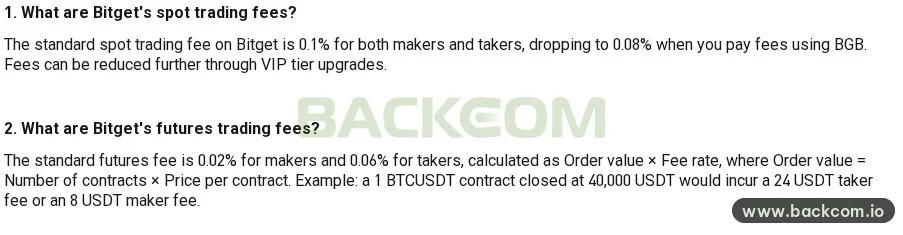
Bitget maker taker fees are the standard rates a regular account pays before any VIP level, token discount or promotion. According to Bitget's official trading fees FAQ, dated 20 August 2026, spot trading costs 0.1% for both makers and takers, and futures trading costs 0.02% for makers and 0.06% for takers.
| Product | Maker | Taker |
|---|---|---|
| Spot | 0.1% | 0.1% |
| Futures | 0.02% | 0.06% |
Reference rates as at 19 November 2026. They can change, so check the live fee schedule before trading.
The two roles differ like this:
- Maker: adds liquidity with an order that does not fill straight away, such as a limit order resting on the book;
- Taker: removes liquidity by filling an order that is already there, which is what a market order does.
On spot the two cost the same. On futures a taker pays three times the maker rate, so the way you enter matters. Our guide to maker vs taker fees in crypto explains the mechanics in more detail.
The same FAQ says Bitget charges no maintenance or custody fee for holding crypto. All fees are listed in the Fee Center, so that page is the reference to check before you rely on any number here.
2. How Do Bitget Futures Fees Work On A Real Position?
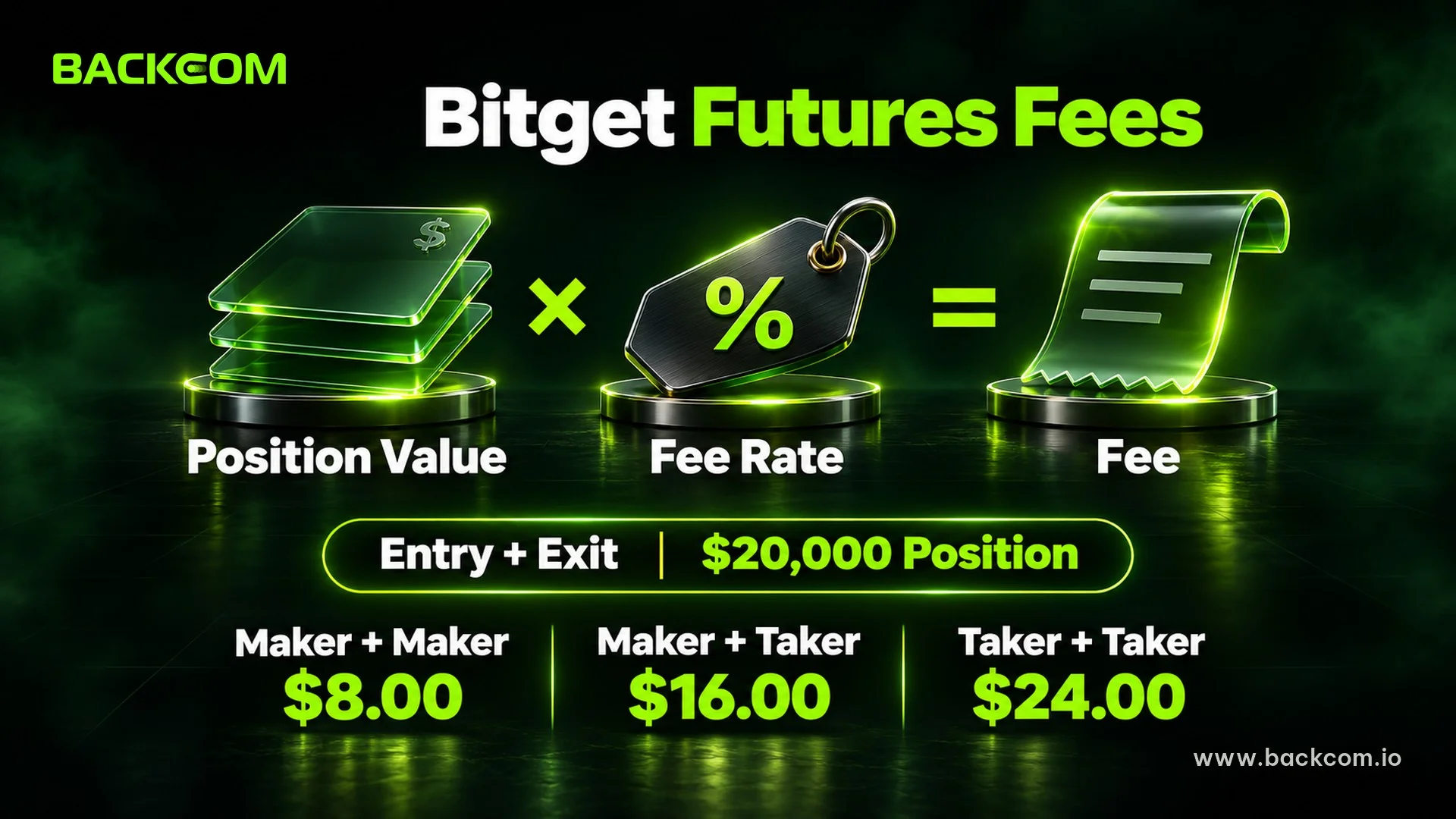
Bitget futures fees are charged on the full position value, not on your margin, and you pay them on entry and again on exit. A leveraged position therefore costs the same fee as an unleveraged position of the same size.
Fee = Position Value × Fee Rate, charged on entry and again on exit
Take a $20,000 futures position at the standard rates. These are assumptions for illustration, not forecasts:
| Round trip | Entry fee | Exit fee | Total |
|---|---|---|---|
| Maker entry, maker exit | $4.00 | $4.00 | $8.00 |
| Maker entry, taker exit | $4.00 | $12.00 | $16.00 |
| Taker entry, taker exit | $12.00 | $12.00 | $24.00 |
Figures calculated from the base rates as at 19 November 2026, before any VIP level, token discount or rebate. Rates can change, so check the live schedule before trading.
The arithmetic is short: a taker leg is $20,000 × 0.06% = $12, and a maker leg is $20,000 × 0.02% = $4. Two taker legs cost three times as much as two maker legs on the same position. Bitget's own example in its product fees FAQ follows the same logic: a 1 BTCUSDT contract closed at 40,000 USDT incurs a 24 USDT taker fee or an 8 USDT maker fee.
Spot is more modest. Buying and then selling $10,000 of a coin at 0.1% per leg costs $10 + $10 = $20. If you are unsure which market suits your plan, see our comparison of spot vs futures trading in crypto, and for a reusable method see how to calculate crypto futures trading fees.
3. What Are Bitget Copy Trading Fees?

Bitget copy trading fees have two layers. Followers pay the normal spot or futures trading fee on every copied order, and they also pay a profit-sharing fee to the lead trader they copy. Bitget's product fees FAQ, dated 20 August 2026, states that this share is 10% to 20% of realised profit, that each lead trader sets their own percentage, and that it applies on top of standard trading fees and, for futures copy trading, funding fees.
Two details from the same FAQ change how the cost behaves:
- Only profitable trades are charged. The fee applies when a copied trade closes in profit, and no fee is deducted from a losing trade;
- The percentage belongs to the trader. It differs from one lead trader to the next, so read the figure on the trader's profile before you copy anyone.
Here is what that means in numbers. Suppose you copy two trades. The first closes with a $500 profit and the second closes with a $300 loss, so your net result before fees is +$200. At a 10% profit share the lead trader's fee on the winning trade is $50, and at 20% it is $100. Your take-home is then $150 or $100, before trading fees. These are assumptions for illustration, and the exact settlement rules, such as timing and how losses offset gains, can differ by product, so confirm them in the Bitget app.
The practical lesson is that a profit share charged only on winners makes your net result smaller than the headline trader return. If you want the wider picture of what copying involves, read our guide to crypto copy trading platforms, fees and risks.
Bitget's FAQ also covers self-configured trading bots. Spot Grid, Futures Grid and Position Grid have no separate subscription fee, so only the standard trading fee applies. That FAQ does not cover other bot types, so check those individually.
4. How Does A Bitget Fee Discount Work: VIP And BGB?
A Bitget fee discount comes from two separate mechanisms, a VIP level and the BGB fee offset, and the official FAQ says both can apply at the same time.
- VIP level: fees fall as your trading volume, account assets or BGB holdings rise. The FAQ does not publish the thresholds or the lower rates, so this article does not quote them;
- BGB offset: in the dashboard you can enable "Use BGB to offset fees", which deducts the fee from your BGB balance at a discounted rate. According to the FAQ this applies to spot trading and is not described for futures. Bitget's product fees FAQ puts the discounted spot rate at 0.08% instead of 0.1%. If your BGB balance is too low, the fee is charged through the original payment method.
On a $10,000 spot trade, 0.08% costs $8 per leg instead of $10, so a round trip falls from $20 to $16. That is a saving of $4, and it only exists while you hold BGB.
For a retail trader at modest volume, the VIP tiers are usually out of reach, which means the base rates in section 1 are the rates you will most likely pay. The BGB offset is the only discount you can switch on yourself, but it requires holding a token whose price moves. Holding BGB to save a fraction of a spot fee is itself a market risk, and no fee saving offsets a falling token price.
Discount percentages and tier schedules can change with promotions, so read the live Fee Schedule inside your own account before you rely on any figure here.
5. Which Costs Sit Outside The Bitget Trading Fee?
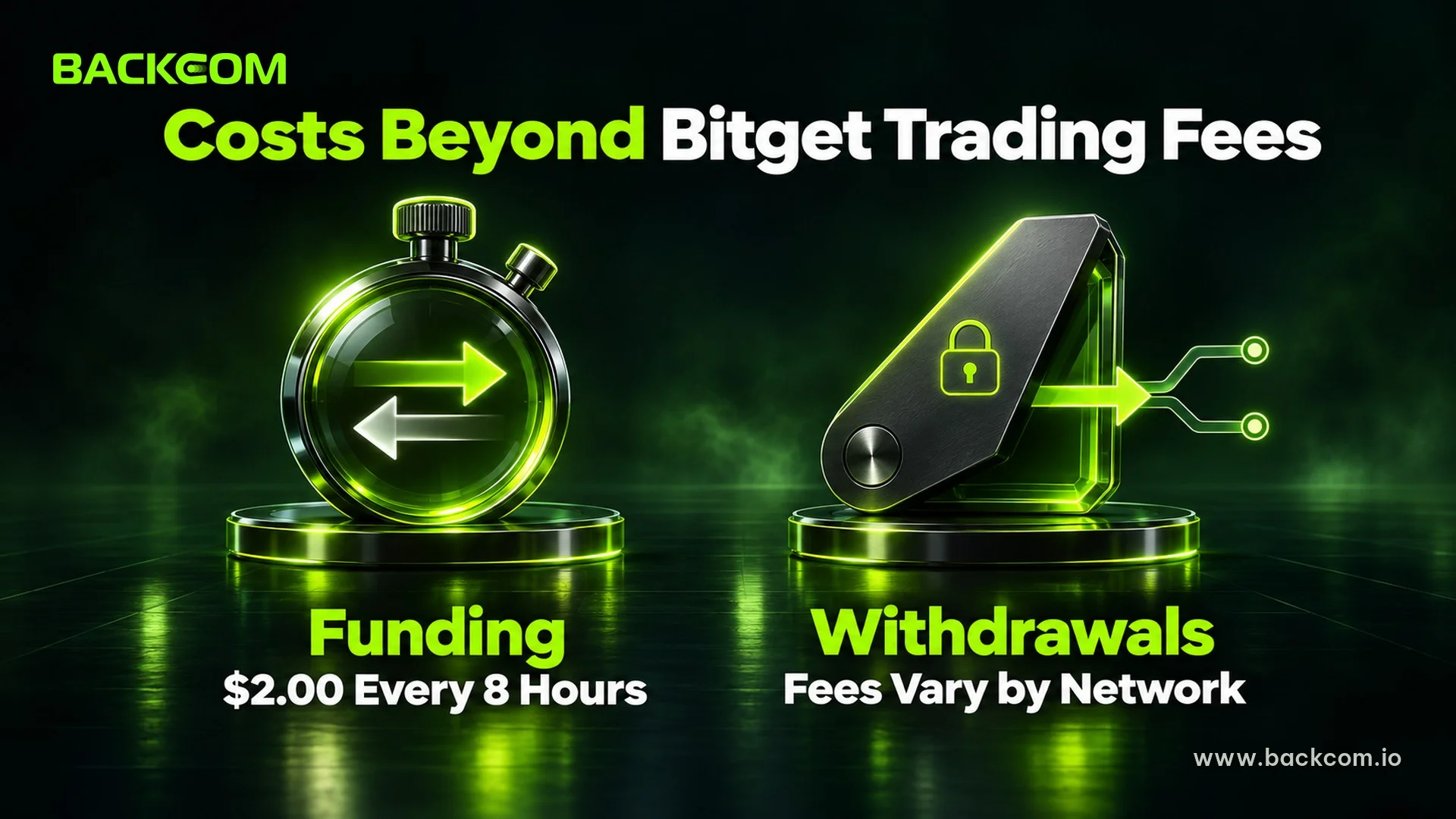
Funding and withdrawals are not part of the trading fee, and over time they can matter more than the maker and taker rates.
Funding fees apply only to perpetual futures and are exchanged every 8 hours between long and short holders. Bitget's FAQ gives the formula as position value × funding rate, and when the rate is positive, longs pay shorts. Because it moves between traders rather than to the exchange, it is not a trading fee.
Funding Fee = Position Value × Funding Rate
Assume a $20,000 long position and a funding rate of 0.01% at each settlement. The cost is $20,000 × 0.01% = $2.00 per settlement, or $6.00 a day, so holding for five days costs about $30. That is more than the $24 round trip in section 2, even at a small assumed rate. Our guide to the funding rate and how to calculate funding fees shows how to read the live number.
Deposits and withdrawals follow different rules. The FAQ says Bitget charges no fee for crypto deposits, although the blockchain network fee still applies. Withdrawal fees depend on the coin and the network, for example USDT on TRC20 versus ERC20, and the exact amount appears on the withdrawal confirmation page. See our explainer on crypto withdrawal fees for how to keep that cost low.
Two further costs never appear on a fee page:
- Slippage: a market order on a thin contract can fill away from the price you saw, which can cost more than the fee itself. Our guide to liquidity in crypto explains why;
- Losses: no fee level, discount or rebate offsets a leveraged position moving against you. Before sizing a trade, learn to calculate your liquidation price.
6. How Does A Rebate Change Your Net Bitget Fees?
A rebate returns a share of the trading fees you have already paid, so it lowers your net cost without changing the fee on the order. The Bitget exchange page on this site lists a 50% total fee rebate on spot and futures, split into 20% paid daily by the exchange and 30% paid every Monday by the partner, with no minimum volume and terms last updated on 23 October 2026.
Apply 50% to the worked figures from section 2:
| Example | Fees paid | 50% rebate | Net cost |
|---|---|---|---|
| Spot, $10,000 round trip | $20.00 | $10.00 | $10.00 |
| Futures, $20,000 maker and taker | $16.00 | $8.00 | $8.00 |
| Futures, $20,000 taker and taker | $24.00 | $12.00 | $12.00 |
Illustration only, using terms last updated on 23 October 2026. A rebate is a share of fees paid, not of volume or profit, and it does not return funding payments or trading losses.
Three limits matter:
- Linked account only. You register through the partner link before your first trade and link your UID in the partner's rebate app, and sub-accounts are linked separately;
- Existing accounts. They are usually tied to another referrer, so a new registration is normally needed;
- Copy trading. This guide does not assume that a profit share is covered, so check the exchange page before you count on a rebate there.
You can read the full Bitget Rebates terms on the Bitget exchange page. Backcom.io is an independent introducing broker (IB/affiliate) of the exchanges it lists, including Bitget; rebates are paid from the commission the exchange pays Backcom.io. See the risk disclaimer for the full disclosure. A rebate is not a reason to open an account, deposit funds or trade more than you planned.
7. How Can You Check Your Own Bitget Fees?
The fair way to price Bitget is to use your own order mix, product and volume rather than a headline rate. Five checks cover it:
- Order type. Count how many of your futures orders fill as maker and how many as taker, because that split decides most of the cost.
- Product. Confirm whether you trade spot, futures or copy trading, since each has its own fee logic.
- Holding time. On perpetual futures, estimate funding for the days you hold, not just the entry and exit fee.
- Discounts. Decide whether holding BGB is worth the market risk to you, and read your VIP status in your account.
- Copy trader terms. Read the profit-share percentage on the lead trader's profile before you copy.
For the non-fee side, such as regulation and security, see our review is Bitget legit, and for a comparison with another exchange see Bitget vs Bybit fees.
Frequently Asked Questions (FAQ) About Bitget Trading Fees
What Are Bitget Spot And Futures Fees?
At the standard level, Bitget charges 0.1% for both makers and takers on spot. On futures it charges 0.02% for makers and 0.06% for takers. These figures come from Bitget's fee FAQ dated 20 August 2026 and can be lower with a VIP level or BGB offset.
How Much Is The Bitget Copy Trading Fee?
Followers pay a profit-sharing fee of 10% to 20% of realised profit, set by each lead trader, on top of normal trading fees. The FAQ says no fee is deducted from a losing trade. Check the percentage on the trader's profile before you copy.
Does BGB Lower Bitget Futures Fees?
Bitget's FAQ describes the BGB offset for spot trading, where the rate drops from 0.1% to 0.08%, and does not describe it for futures. Read the live fee schedule in your account before assuming any futures discount.
Does Bitget Charge Deposit Or Withdrawal Fees?
Crypto deposits carry no Bitget fee, but the blockchain network fee applies. Withdrawal fees depend on the coin and network, and the exact amount shows on the withdrawal confirmation page before you confirm.
Is A Rebate Added To The Fee Or Taken From It?
Neither. A rebate returns a share of fees you have already paid, so the fee on the order stays the same and your net cost falls. It is paid only on linked accounts and does not cover funding or trading losses.
Conclusion: Price Your Order Type And Holding Time First
Bitget trading fees start at 0.1% on spot and 0.02% maker or 0.06% taker on futures, but your result depends more on order type, funding and any copy trading profit share than on the base rate. Before you trade, count your maker and taker orders, estimate the funding for your holding period, and treat any BGB discount or rebate as a smaller adjustment on top.
Disclaimer: This content is compiled by Backcom.io for information only and is not investment advice. Crypto trading carries a high risk of loss, and fee terms and rebate terms can change. Nothing here encourages you to open an account, deposit funds or trade more because of a fee difference.
Was this article helpful?
Join The Backcom.io Community
Get the latest on trading rebates, trading tips, and broker deals — and connect with thousands of traders worldwide.

Backcom App
Track Your Rebates Every Day
Every rebate is visible by broker and by day. Manage your wallet and withdrawals in one place.
Open Backcom App