Binance Vs OKX Futures Fees: Which Platform Costs Less In 2026?

Trading costs decide more of a futures trader's long-term result than most people expect. That is why Binance vs OKX futures fees deserve a proper comparison: both exchanges run large perpetual markets, yet their fee structures differ once you look past the headline rates.
The useful questions are practical ones:
- Which platform's futures fees are actually lower for a regular user?
- Which fee structure suits which kind of trader: scalpers, swing traders or high-volume accounts?
- Which hidden costs move your PnL even though they never appear in the fee table?
In this article, Backcom.io compares Binance Futures and OKX Futures purely on cost as at 20 November 2026, using each exchange's own help pages, so you can judge the fee edge from numbers rather than popularity.
Binance Futures And OKX Futures At A Glance
Binance Futures and OKX Futures are the derivatives platforms of two large crypto exchanges, and both use the maker–taker model.
Binance Futures is often chosen for:
- deep liquidity on major pairs
- a long list of contracts across USDⓈ-M and COIN-M markets
- a broad ecosystem, so spot, futures and earn products sit in one account.
OKX Futures is often chosen for:
- a flexible fee structure with VIP tiers based on volume or assets
- cost control, by traders who manage fees and capital closely.
What the two have in common:
- USDT-margined and coin-margined contracts (Binance calls the first group USDⓈ-M)
- long and short positions with leverage
- funding payments on perpetual contracts.
If you are still choosing between the two markets, see spot vs futures trading.
With products this close, the long-term difference is rarely the interface. It is the fee rate and how it is calculated.
Binance Futures Fees: Maker, Taker And BNB Discount
Binance futures fees follow the maker–taker model: the rate depends on whether your order adds liquidity or takes it, on the contract type and on your account tier.
Basic Fee Structure On Binance
- Maker fee: charged when a resting limit order is filled and adds liquidity.
- Taker fee: charged when an order fills immediately against the order book.
Binance's futures fee structure FAQ, updated on 1 May 2026, uses 0.02% maker and 0.05% taker for a regular user. The commission is the notional value multiplied by the fee rate, so it is charged on the full position, not on your margin.
What Changes Your Binance Futures Fee
Your rate can fall below the regular level through:
- VIP levels, set from 30-day trading volume and BNB balance, where futures volume counts both USDⓈ-M and COIN-M contracts
- paying fees in BNB, which gives 10% off standard USDⓈ-M fees when the BNB sits in the USDⓈ-M Futures account, turning 0.02% and 0.05% into 0.018% and 0.045%
- Binance Rebates through a partner, which return part of the fee after the trade.
Other Costs To Watch On Binance
Binance's futures fee types FAQ lists three charges: the commission, the funding fee exchanged between longs and shorts, and an insurance clearance fee taken when a position is liquidated. Funding is usually settled every 8 hours at 00:00, 08:00 and 16:00 UTC, with some pairs on a 4-hour cycle.
For the full schedule and more examples, see our guide to Binance futures fees.
OKX Futures Fees: Maker, Taker And VIP Tiers
OKX futures fees use the same maker–taker logic, but the way OKX tiers its fees and handles discounts differs from Binance in a few points that matter.
Basic Fee Structure On OKX
OKX's contract fee guide, updated on 26 August 2026, states that at fee level Lv1 the taker rate is 0.05% and the maker rate is 0.02%. The fee is the contract value times the number of contracts, the price and the fee rate. In OKX's own example, 100 contracts of 0.01 BTC at 10,000 USDT with a 0.05% taker fee cost 5 USDT to open.
How To Lower OKX Futures Fees
OKX's trading fee rules FAQ, updated on 9 September 2026, makes two points:
- VIP tiers are based on 30-day trading volume or asset balance, with tiers updated daily
- no OKB discount: the platform does not currently let you offset trading fees by holding OKB.
The same FAQ's spot example shows a negative maker fee, where a maker is paid a small amount per fill; it applies only at specific VIP levels. Separately, partner rebates can return part of the fee after the trade.
Costs Traders Overlook On OKX
As on Binance, funding is paid or received on perpetual contracts at each settlement, and the rate and interval are shown per contract. Our guide to OKX trading fees covers the spot side and the VIP table in more detail.
Binance Vs OKX Futures Fees Compared
Put side by side, the Binance vs OKX futures fees gap at the regular level is zero on the published rates. The differences come from discounts, tiers and what happens after the trade.
| Item | Binance Futures (USDⓈ-M) | OKX Futures (USDT-margined) |
|---|---|---|
| Regular maker / taker | 0.02% / 0.05% | 0.02% / 0.05% (Lv1) |
| Token discount | 10% with BNB in the futures account (0.018% / 0.045%) | No OKB discount on trading fees |
| VIP basis | 30-day volume and BNB balance | 30-day volume or asset balance, updated daily |
| Funding | Usually every 8 hours, some pairs every 4 hours | Rate and interval shown per contract |
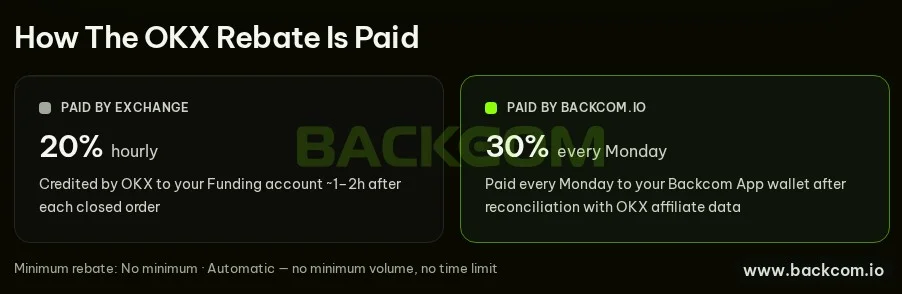
| Rebates listed on 20 November 2026 | Up to 30% of fees, paid every Monday | Up to 50%: 20% from OKX within hours, 30% paid every Monday |
Fee data from the exchanges' help pages and rebate terms from the Backcom.io exchange pages, as at 20 November 2026. Rates and terms can change, so check them before you trade.
You can read the current Binance terms and use the calculator on the Binance rebate page. Backcom.io is an independent introducing broker (IB/affiliate) of Binance and OKX; rebates come from the commission each exchange pays it — see the risk disclaimer.
Worked Example: 100 Round Trips Of 10,000 USDT
Take 100 round trips a month on a 10,000 USDT position:
Fee per round trip = position value × fee rate × 2
- All taker orders: 10,000 × 0.05% × 2 = 10 USDT per round trip, so 1,000 USDT a month on either exchange, or 900 USDT on Binance with BNB.
- All maker orders: 10,000 × 0.02% × 2 = 4 USDT per round trip, so 400 USDT a month, or 360 USDT on Binance with BNB.
If the full headline rebate applied to the taker case, the net cost would be about 500 USDT on OKX (1,000 less 50%) and 630 USDT on Binance with BNB (900 less 30%). That is arithmetic on published terms, not a guaranteed outcome.
Comparison By Trading Style
- Scalping and frequent market orders: the taker rate dominates. Binance's BNB discount lowers it by 10%, while rebate terms move the net cost more than the base rate does.
- Swing trading with limit orders: the maker rate dominates, and both platforms start at 0.02%.
- High-volume accounts: compare the VIP tables at your own volume, because the tier you reach outweighs the regular rate.
Differences Traders Often Miss
- Funding varies by contract and over time, and on a position held for days it can exceed the trading fee.
- Spread and slippage depend on liquidity in the pair you trade, not on the fee table.
- Small fees compound: hundreds of fills a month turn fractions of a percent into a real line on your statement.
The short version: no platform is cheapest for everyone. For a third reference point, see our OKX vs Bybit fee comparison.
Which Platform Has The Fee Edge In 2026?
The fee edge between Binance Futures and OKX Futures in 2026 comes less from the base schedule and more from how a trader lowers costs after the trade.
Looking Only At The Fee Schedule
On the published regular rates, the two platforms are level. Binance pulls ahead on the rate once you pay in BNB, and OKX can pull ahead at tiers that suit your volume or assets.
Where Rebates Change The Picture
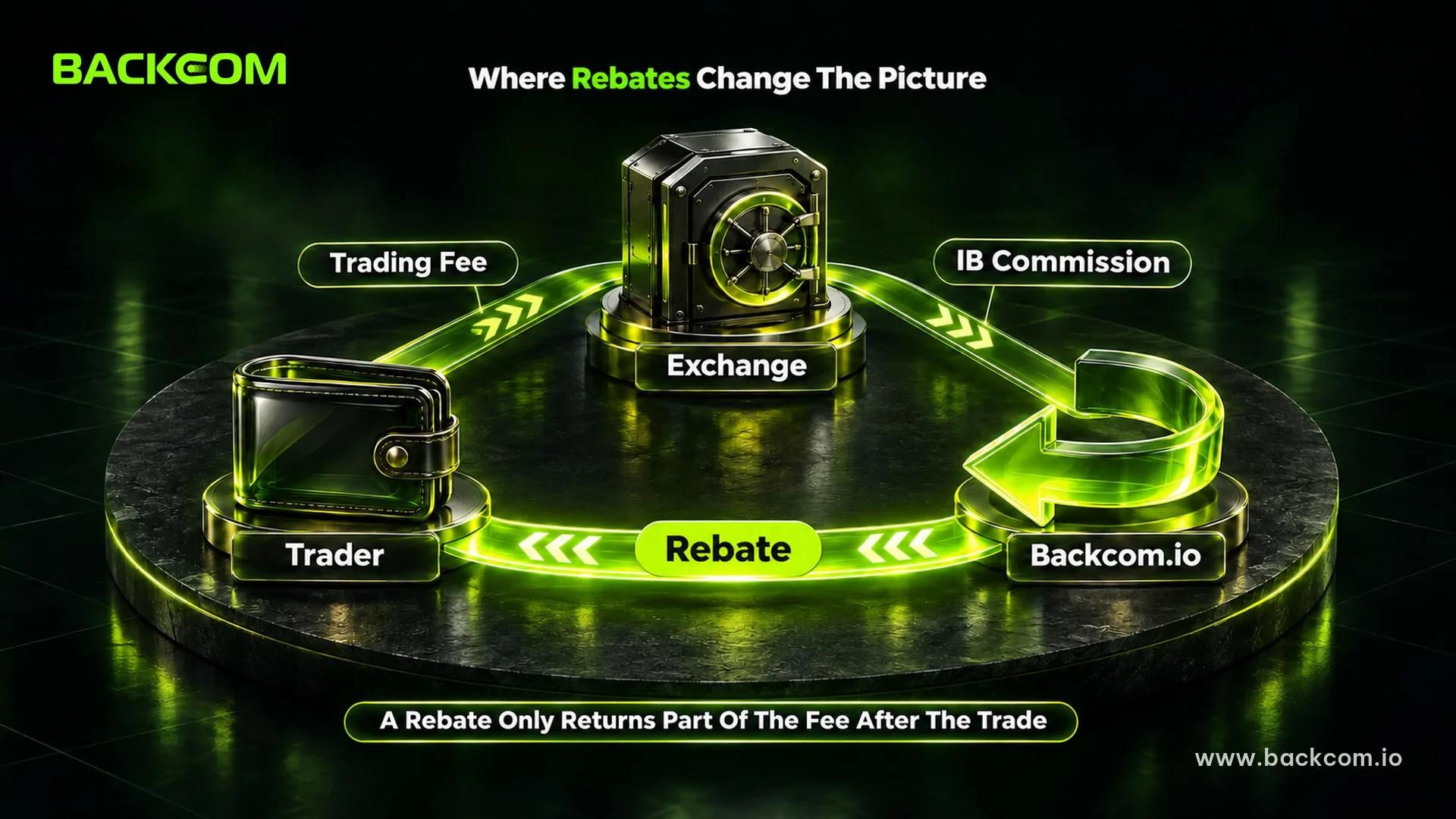
Many active traders also use a fee rebate. As at 20 November 2026, the Binance rebate terms listed up to 30% of spot and futures fees, and the OKX terms listed up to 50%, split between 20% credited by OKX and 30% paid weekly. A rebate never changes your order or your risk: it only returns part of the fee afterwards.
A Practical View For Futures Traders
- The more you trade, the more fee structure matters, both the rate and any rebate.
- The edge comes from optimising costs, not simply from picking Binance or OKX.
- Match the platform to your style: maker-heavy, taker-heavy or high volume.
The review of Binance vs Bybit and the explainer on funding rates cover the non-fee factors.
Frequently Asked Questions (FAQ) About Binance Vs OKX Futures Fees
Is OKX Futures Cheaper Than Binance Futures?
Not on the regular schedule: both list 0.02% maker and 0.05% taker. Binance becomes cheaper per fill if you pay in BNB on USDⓈ-M contracts, while OKX can come out ahead once rebates or higher VIP tiers are included. Compare the net cost at your own volume.
Does Holding OKB Lower OKX Futures Fees?
No. OKX's trading fee rules FAQ, updated on 9 September 2026, states that the platform does not currently offer a way to offset trading fees by holding OKB. Lower OKX rates come from VIP tiers based on 30-day volume or asset balance; partner rebates, paid after the trade, are a separate route.
How Much Does BNB Save On Binance Futures?
Paying fees in BNB gives 10% off the standard USDⓈ-M futures fee, so a regular user pays 0.018% maker and 0.045% taker instead of 0.02% and 0.05%. The BNB must sit in the USDⓈ-M Futures account; otherwise Binance charges the fee in USDT without the discount.
Are Funding Fees Part Of The Trading Fee?
No. Funding is a periodic payment between long and short holders of perpetual contracts, settled at fixed times, and it can be positive or negative for you. It is separate from the maker or taker commission, and neither the BNB discount nor a fee rebate applies to it.
Conclusion: Choosing Between Binance And OKX Futures On Cost
At the regular level, Binance vs OKX futures fees start from the same 0.02% maker and 0.05% taker. The real differences are Binance's 10% BNB discount on USDⓈ-M contracts, the way each exchange builds its VIP tiers, funding on the contracts you hold and the rebate terms available after the trade.
Instead of searching for a platform that is "cheaper" in every case, start from your own trading frequency and order type and estimate the total monthly cost. The fee edge comes from managing costs consistently, not from the name on the exchange.
Disclaimer: This content is compiled by Backcom.io for information only and is not investment advice. Futures trading with leverage carries a high risk of loss, fees and rebate terms can change at any time, and the products available to you depend on your country of residence.
Was this article helpful?
Join The Backcom.io Community
Get the latest on trading rebates, trading tips, and broker deals — and connect with thousands of traders worldwide.

Backcom App
Track Your Rebates Every Day
Every rebate is visible by broker and by day. Manage your wallet and withdrawals in one place.
Open Backcom App