Binance Vs Bitget Fees: Spot, Futures And VIP Tier Comparison

Binance and Bitget look almost identical on the first fee screen, and then the numbers drift apart the moment you trade futures, hold the exchange token or grow your monthly volume. This guide lines up Binance vs Bitget fees from each exchange's own published schedule, so you can see where the cost really differs. In this article, Backcom.io also prices one month of volume on both platforms, with and without rebates, using plain arithmetic you can repeat with your own numbers.
Every rate below was read from the public fee pages on 24 November 2026. Neither exchange guarantees these rates will stay the same, and promotions come and go, so check your own account before you rely on a figure.
Binance Vs Bitget Fees At A Glance
Binance vs Bitget fees come down to five items: the base spot rate, the base futures rate, the token discount, the VIP ladder and any rebate on top. The table shows the base rates for a regular user, with no VIP level and no discount applied.
| Item | Binance | Bitget |
|---|---|---|
| Spot maker / taker | 0.100% / 0.100% | 0.100% / 0.100% |
| Spot with token discount | 0.075% / 0.075% (BNB, 25% off) | 0.080% / 0.080% (BGB, 20% off) |
| USDT-margined futures maker / taker | 0.020% / 0.050% | 0.020% / 0.060% |
| Futures token discount | 10% off with BNB | Not confirmed on the public fee pages |
| VIP entry point (spot) | 1,000,000 USD 30-day volume and 5 BNB | 500,000 USDT 30-day volume |
Reference rates as at 24 November 2026. Fees can change, so check the live schedule before you trade.
Two facts stand out. Spot is a tie at the base level, and the futures taker fee is 0.01 percentage points higher on Bitget. Everything else depends on how you trade and how much you trade.
Binance Vs Bitget Spot Fees: Base Rate And Token Discount
Binance vs Bitget spot fees start from the same place. According to the Binance fee schedule, a regular user pays 0.100% as both maker and taker. The Bitget fee overview shows the same 0.1% / 0.1% at its lowest level, which matches the Bitget trading fees FAQ dated 20 August 2026.
The first difference is the discount for paying fees in the exchange's own token:
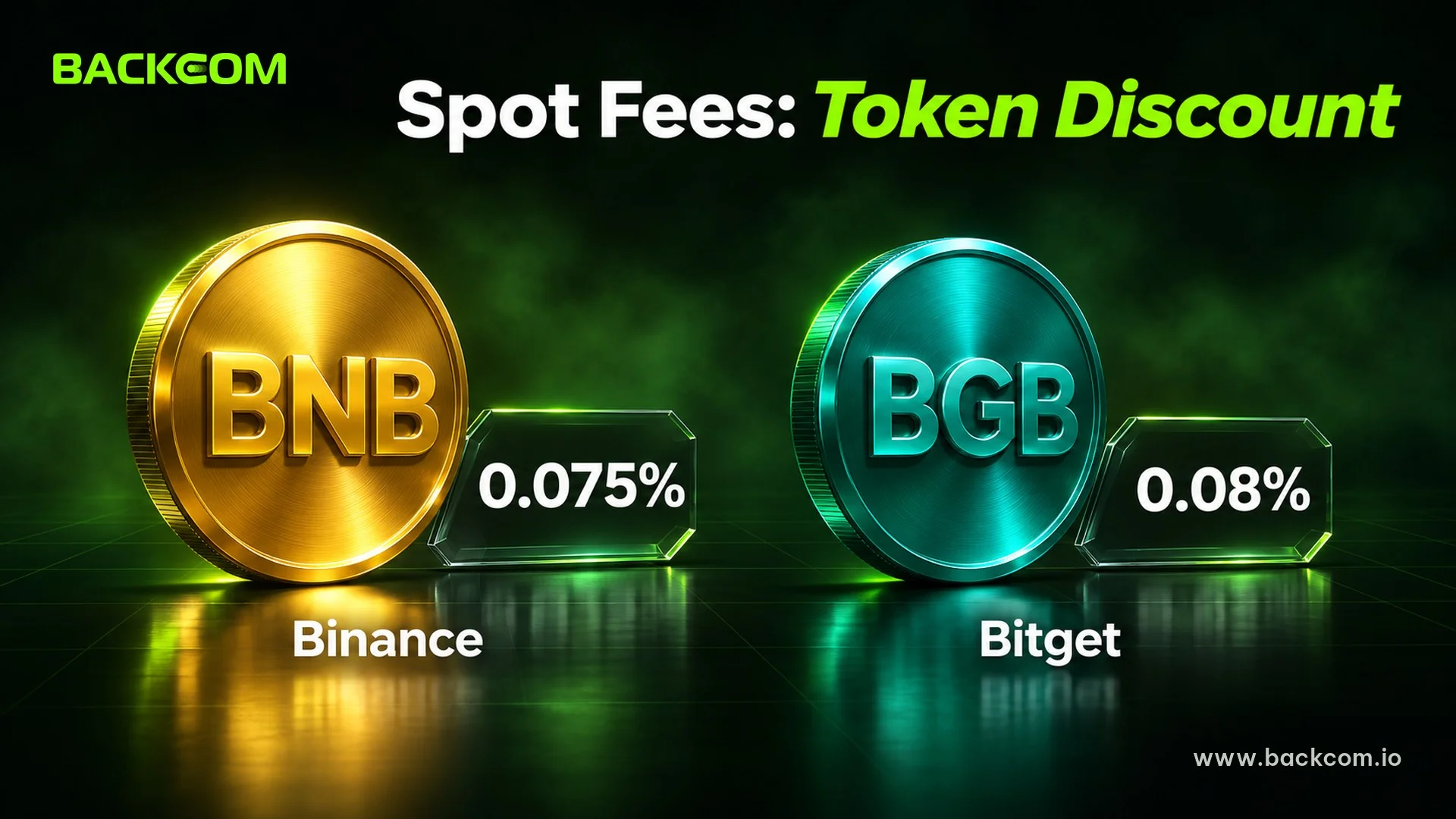
- Binance: paying with BNB cuts the spot fee by 25%, so 0.100% becomes 0.075%.
- Bitget: paying with BGB cuts the spot fee by 20%, so 0.1% becomes 0.08%, as the Bitget product fees FAQ shows.
On a spot trade worth 1,000 USDT, that is 0.75 USDT on Binance and 0.80 USDT on Bitget. The gap is small per trade, but it grows with volume, and it only exists if you hold the token and choose to pay with it. A trader who keeps no BNB or BGB pays 1.00 USDT on both.
For a refresher on what the two columns mean, read the guide to maker vs taker fees in crypto. If you are still deciding between the two markets, see spot vs futures trading in crypto.
Binance Vs Bitget Futures Fees: Maker, Taker And Discounts
Binance vs Bitget futures fees show the clearest gap at the base level. On the Binance USDⓈ-M futures table, a regular user pays 0.0200% maker and 0.0500% taker. Bitget lists 0.02% maker and 0.06% taker for USDT-margined futures.
That makes the maker side identical and the taker side 20% more expensive on Bitget (0.06% against 0.05%). Taker orders fill immediately against the order book, which is how market orders and stop orders usually execute, so active traders who rely on market orders feel the gap most.
Discounts work differently too:
- Binance: the official futures FAQ, updated on 1 May 2026, says paying with BNB gives a 10% discount on USDⓈ-M futures fees. The BNB must be held in the futures wallet, and the table then shows 0.0180% maker and 0.0450% taker.
- Bitget: the public fee pages confirm a BGB discount for spot. This guide does not quote a futures BGB discount, because the pages read for this article do not state a percentage.
Binance also shows a banner on its futures fee page advertising a temporary promotion with zero maker fees and reduced taker fees. Treat a banner like that as time-limited: it is not part of the standing schedule, and it can end without notice.
Funding is a separate cost on perpetual contracts. The guide on how funding fees are calculated covers it, and the walk-through of how to calculate crypto futures trading fees shows the trading-fee part step by step.
Bitget Vs Binance Maker Taker: How VIP Tiers Change The Rate
Bitget vs Binance maker taker rates move down as your 30-day volume rises. The two ladders are built differently, so comparing "VIP 1 with VIP 1" is not a fair test. Compare the volume you actually trade instead.
Spot VIP Rates Side By Side
The table pairs the rows by approximate volume, not by level name. From VIP 1 upward, Binance requires both a 30-day spot volume and a minimum BNB balance. Bitget uses 30-day spot volume, asset balance or BGB holdings, and gives you the highest level you qualify for.
| Binance level | 30-day spot volume | Binance maker / taker | Bitget level | 30-day spot volume | Bitget maker / taker |
|---|---|---|---|---|---|
| Regular | Under 1M USD | 0.100% / 0.100% | VIP 0 | From 0 | 0.1% / 0.1% |
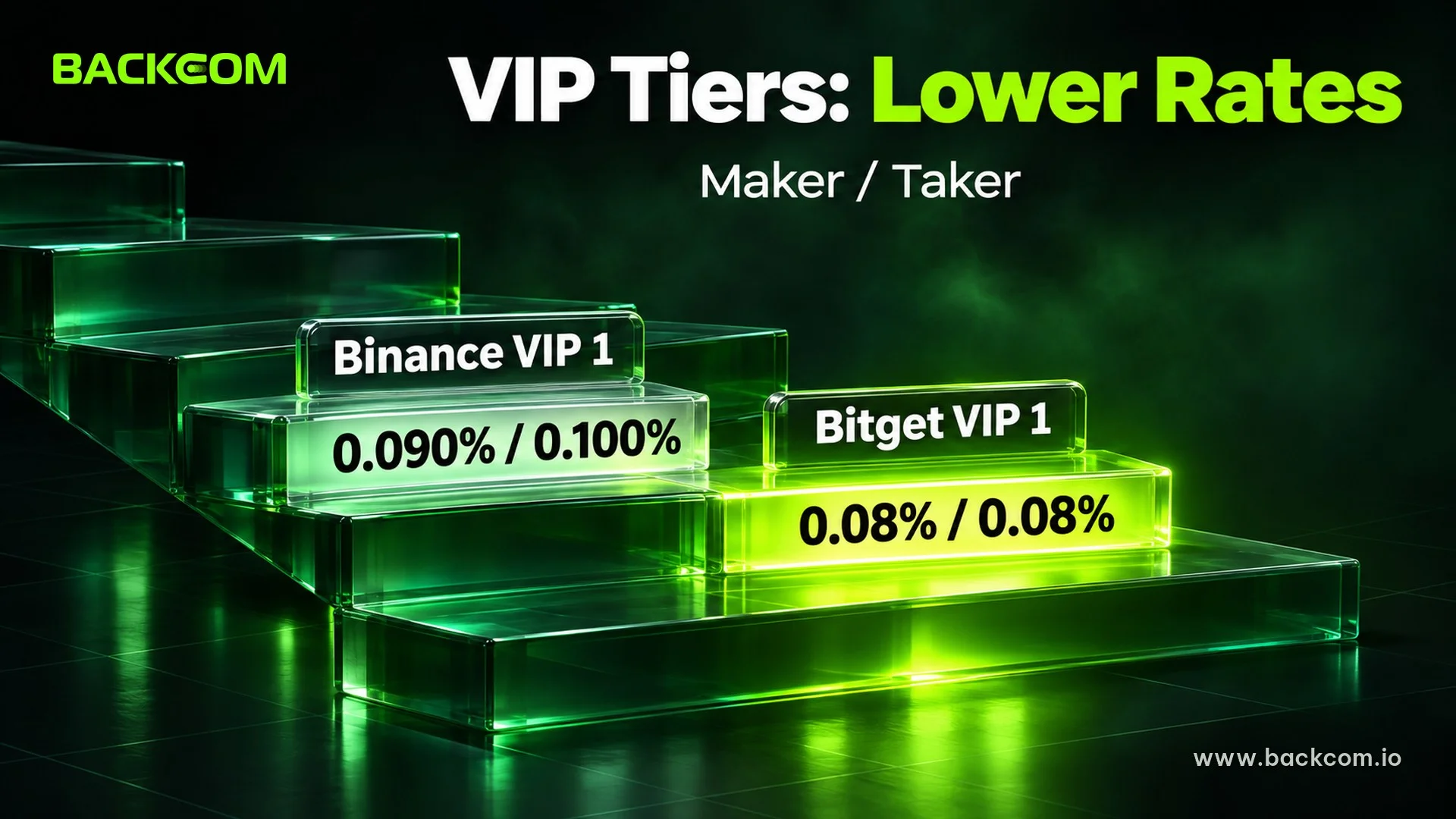
| VIP 1 | 1M USD and 5 BNB | 0.090% / 0.100% | VIP 1 | 500,000 USDT | 0.08% / 0.08% |
| VIP 2 | 5M USD and 25 BNB | 0.080% / 0.100% | VIP 2 | 2M USDT | 0.065% / 0.07% |
| VIP 3 | 20M USD and 100 BNB | 0.040% / 0.060% | VIP 3 | 8M USDT | 0.05% / 0.06% |
| VIP 4 | 75M USD and 500 BNB | 0.040% / 0.052% | VIP 4 | 30M USDT | 0.04% / 0.05% |
| VIP 5 | 150M USD and 1,000 BNB | 0.025% / 0.031% | VIP 5 | 50M USDT | 0.03% / 0.04% |
Reference rates as at 24 November 2026. Thresholds and rates can change, so check each fee page before you plan around a tier.
The pattern is clear. Bitget reaches lower rates at lower volume: its 0.08% / 0.08% sits at a 500,000 USDT threshold, while Binance needs 1 million USD plus a BNB balance for 0.090% / 0.100%. At the high end, Binance's VIP 5 (0.025% / 0.031%) beats Bitget's VIP 5 (0.03% / 0.04%), though Bitget's VIP 7 reaches 0% maker at 100 million USDT.
Futures VIP Rates Side By Side
For USDT-margined futures, both exchanges list tiers by 30-day futures volume. Binance adds a BNB balance for each level, and Bitget adds balance and BGB criteria.
| 30-day futures volume | Binance maker / taker | Bitget maker / taker |
|---|---|---|
| Regular / VIP 0 | 0.0200% / 0.0500% | 0.02% / 0.06% |
| 5M | 0.0180% / 0.0500% | 0.019% / 0.06% |
| 10M | 0.0160% / 0.0400% | 0.016% / 0.04% |
| 20M | 0.0160% / 0.0400% | 0.014% / 0.0375% |
| 50M | 0.0120% / 0.0320% | 0.012% / 0.035% |
| 1,000M | 0.0080% / 0.0270% | 0% / 0.02% |
Reference rates as at 24 November 2026. Binance requires a BNB balance as well as volume, so the volume column alone does not guarantee the tier.
For futures, the two schedules stay within a few thousandths of a percent of each other from 10 million up to 50 million of monthly volume. The taker gap at the bottom of the ladder (0.05% against 0.06%) is the main reason they diverge for smaller accounts, and Bitget's top tier is lower at 1 billion.
Worked Example: What 1,000,000 USDT Of Volume Costs
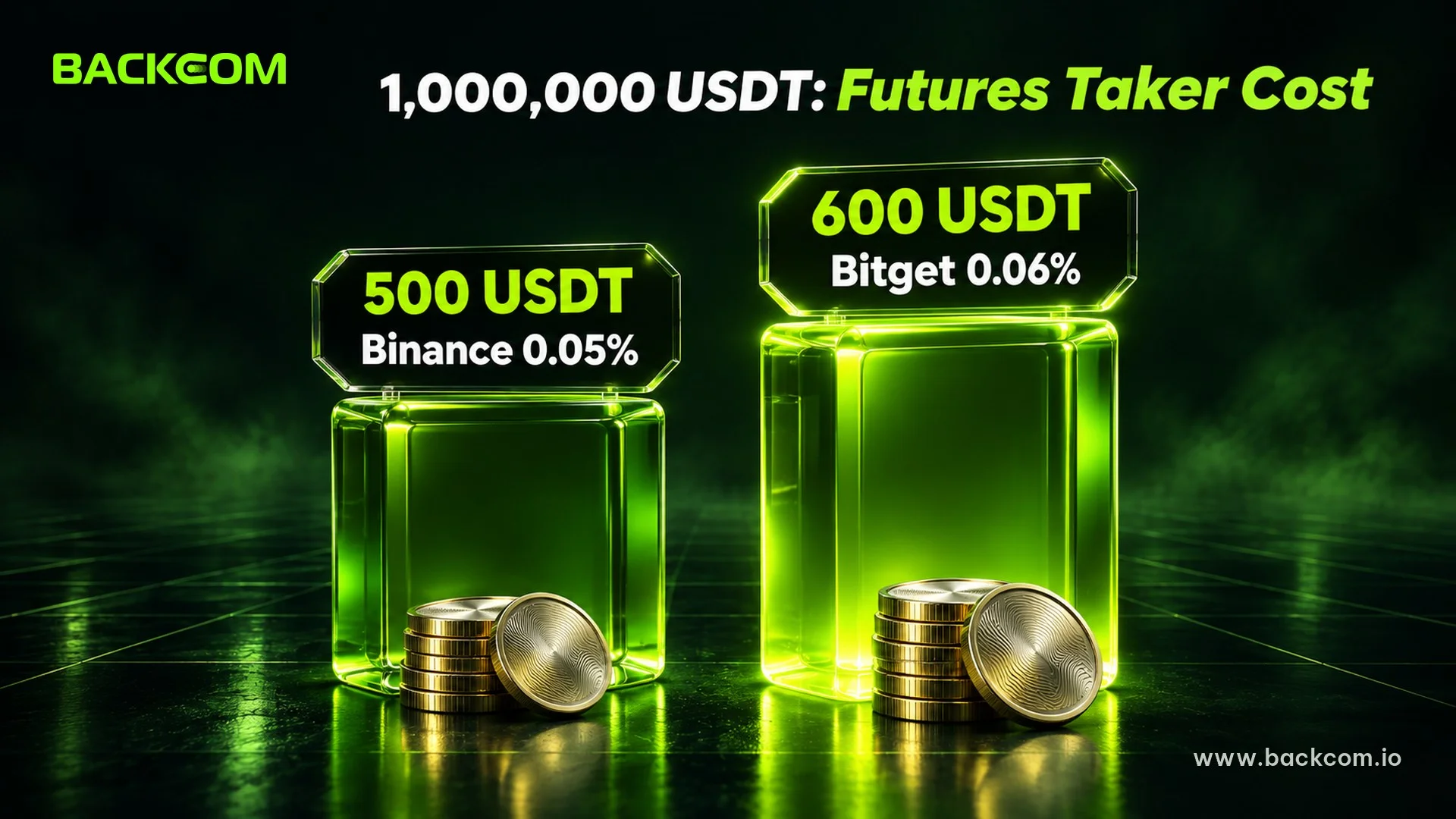
A concrete month makes the difference easy to see. Assume a trader trades 1,000,000 USDT of volume in a month, at regular level on both exchanges. These are illustrative figures, not a forecast.
Fee = Traded volume × Fee rate
Spot Trading
At 0.1% on both exchanges, the fee is 1,000 USDT on each. With the token discount, it drops to 750 USDT on Binance (BNB) and 800 USDT on Bitget (BGB). That 50 USDT difference exists only for a trader who holds and spends the token.
Futures Trading
On the same volume, the maker and taker cases differ:
- All taker: 0.05% on Binance is 500 USDT; 0.06% on Bitget is 600 USDT.
- All maker: 0.02% on both is 200 USDT.
- Binance with BNB: 450 USDT taker, 180 USDT maker.
Most traders use a mix. If 70% of the volume is taker and 30% is maker, Binance costs 0.7 × 500 + 0.3 × 200 = 410 USDT, and Bitget costs 0.7 × 600 + 0.3 × 200 = 480 USDT. The mix matters more than the headline rate, which is why you should check your own taker share in your trade history before comparing.
Cheaper Exchange Binance Bitget: Where Rebates Change The Picture
The honest answer to which is the cheaper exchange, Binance or Bitget, is that it depends on volume, order type and whether you hold the token. On the published schedules alone, Bitget is cheaper at lower spot volume, Binance is cheaper on regular futures taker fees, and the two converge in the middle.
A rebate can change the result. On the rebate pages, the listed rebate is up to 30% of fees for Binance (page dated 16 November 2026) and 50% for Bitget (page dated 21 November 2026), made up of 20% credited daily by Bitget and 30% paid every Monday by Backcom.io. The conditions are short:
- Register through the right link before the first trade.
- Link your account UID so every trade is tracked.
- Check existing accounts first. Bitget accounts registered earlier are usually tied to another referrer, and Binance accepts an existing account only in the few cases listed on its rebate page.
- Know Bitget's volume cap. Its fee page says users with 30-day spot volume of 50 million USDT or more, futures volume of 100 million USDT or more, or 20% or more API volume are not eligible for the platform rebate program.
Applied to the regular-level futures example above, all taker, and using the maximum listed Binance rate:
- Binance: 500 USDT minus the full 30% rebate (150 USDT) leaves 350 USDT.
- Bitget: 600 USDT minus a 50% rebate of 300 USDT leaves 300 USDT.
On the same volume at the all-maker level, Binance leaves 140 USDT and Bitget leaves 100 USDT. The rebate pages do not say whether a rebate stacks with a token discount, so the figures above exclude discounts. Ask support before you assume both apply.
You can read the current terms on the Binance Rebates page. Backcom.io is an independent introducing broker (IB/affiliate) of Binance and Bitget, and its rebates come from the commission the exchange pays it, as explained in the risk disclaimer. For a wider view of how rebate programs differ, see the crypto exchange rebate comparison. Rebates reduce the cost of trading but do not make a losing strategy profitable.
For single-exchange detail, the guides to Binance trading fees and Bitget trading fees go further, and Bitget vs Bybit fees and Binance vs OKX futures fees cover other pairs.
Frequently Asked Questions (FAQ) About Binance Vs Bitget Fees
Which Has Lower Spot Fees, Binance Or Bitget?
At the regular level they are equal at 0.1% maker and taker. With the token discount, Binance's BNB (25% off) gives 0.075% and Bitget's BGB (20% off) gives 0.08%. At low VIP levels Bitget's thresholds are lower, so it reaches cheaper rates sooner.
Are Binance Futures Fees Lower Than Bitget Futures Fees?
At the regular level, the maker fee is 0.02% on both, and the taker fee is 0.05% on Binance against 0.06% on Bitget. Between 10 million and 50 million of monthly volume the two schedules stay within a few thousandths of a percent, with Bitget slightly lower at 20 million, so the gap matters mainly for smaller accounts that trade with market orders.
Do Funding Fees Count As Part Of The Trading Fee?
No. Funding is exchanged between long and short traders on perpetual contracts and is not part of the maker or taker fee. It can add to or reduce your cost depending on the position, so compare it separately from the fee schedule.
Do I Need To Hold BNB Or BGB To Get A Discount?
Yes. Both discounts require paying the fee in the exchange token. On Binance futures the BNB must sit in the futures wallet. If you hold no token, you pay the standard rate.
Conclusion: Compare Your Own Trading Pattern, Not The Headline Rate
Binance vs Bitget fees are close enough that no single number settles it. Spot starts at a tie, Binance has the lower regular futures taker fee, Bitget reaches lower VIP spot rates at lower volume, and the token discounts favour Binance by a small margin. Before you choose, collect three numbers:
- Your 30-day volume, split between spot and futures.
- Your taker share, from your trade history.
- Your token holdings, since BNB and BGB discounts need them.
Run the arithmetic from the worked example with those numbers, then check the live schedule on each exchange.
Disclaimer: This content is compiled by Backcom.io for information only and is not investment advice. Crypto and leveraged trading carry a high risk of loss, including the loss of your whole deposit. Rates and rebates change, so verify the current terms before you trade.
Was this article helpful?
Join The Backcom.io Community
Get the latest on trading rebates, trading tips, and broker deals — and connect with thousands of traders worldwide.

Backcom App
Track Your Rebates Every Day
Every rebate is visible by broker and by day. Manage your wallet and withdrawals in one place.
Open Backcom App