Inverse Vs Linear Futures: Differences, Margin And PnL Explained

Summary
Linear futures are margined and settled in a stablecoin such as USDT, with straight-line PnL, while inverse futures are quoted in USD but margined and settled in the coin itself. Inverse PnL is curved and the margin's USD value moves with the coin, so a 10x Bitcoin long carries different risk in each.

Two traders can open a "$10,000 long on Bitcoin" and end up holding very different risks, because the contract is quoted in dollars but margined and settled in different assets. That is the heart of inverse vs linear futures: one pays profit and loss in the coin itself, the other in a stablecoin. In this article, Backcom.io explains how each type works, how the PnL formulas differ, why liquidation prices are not the same and which contract fits which job, using one hypothetical 10x Bitcoin example.
What Are Linear And Inverse Futures In Crypto?

Linear futures are contracts whose profit and loss grow in a straight line with price and are paid in a stablecoin, which is why they are also called USDT margined futures. Inverse futures are contracts quoted in a currency such as USD but margined and settled in the underlying coin, so they are also called coin margined futures. A linear perpetual vs inverse comparison is therefore really a comparison of margin assets. An inverse perpetual contract is the same idea with no expiry date. If you are starting from zero, our beginner guide to crypto covers the basics first.
Exchanges use different labels for the same split. Binance calls them USDⓈ-M and COIN-M contracts, and its own help page on the two types says COIN-margined contracts are denominated and settled in the underlying cryptocurrency, while USDⓈ-margined contracts are settled in USDT or USDC. Other venues use "linear" and "inverse" directly.
Linear Perpetual Vs Inverse: The Differences At A Glance
| Feature | Linear (USDT-margined) | Inverse (coin-margined) |
|---|---|---|
| Margin asset | Stablecoin such as USDT or USDC | The coin itself, such as BTC |
| PnL paid in | Stablecoin | The coin |
| Contract unit | A fixed amount of the coin | A fixed amount of USD |
| PnL versus price | Straight line | Curved (based on 1 divided by price) |
| Value of your margin | Stays near its face value | Moves with the coin's USD price |
On Binance, according to the same help page, one BTC COIN-M contract represents 100 USD and one ETH contract represents 10 USD, while BTCUSDT and ETHUSDT linear contracts represent one unit of the coin, like the spot market. Contract sizes differ by venue, so read the specification of the exact contract before you trade it. If perpetual contracts are new to you, start with our guide to perpetual futures.
How Does Margin Work In USDT Margined Futures And Coin Margined Futures?
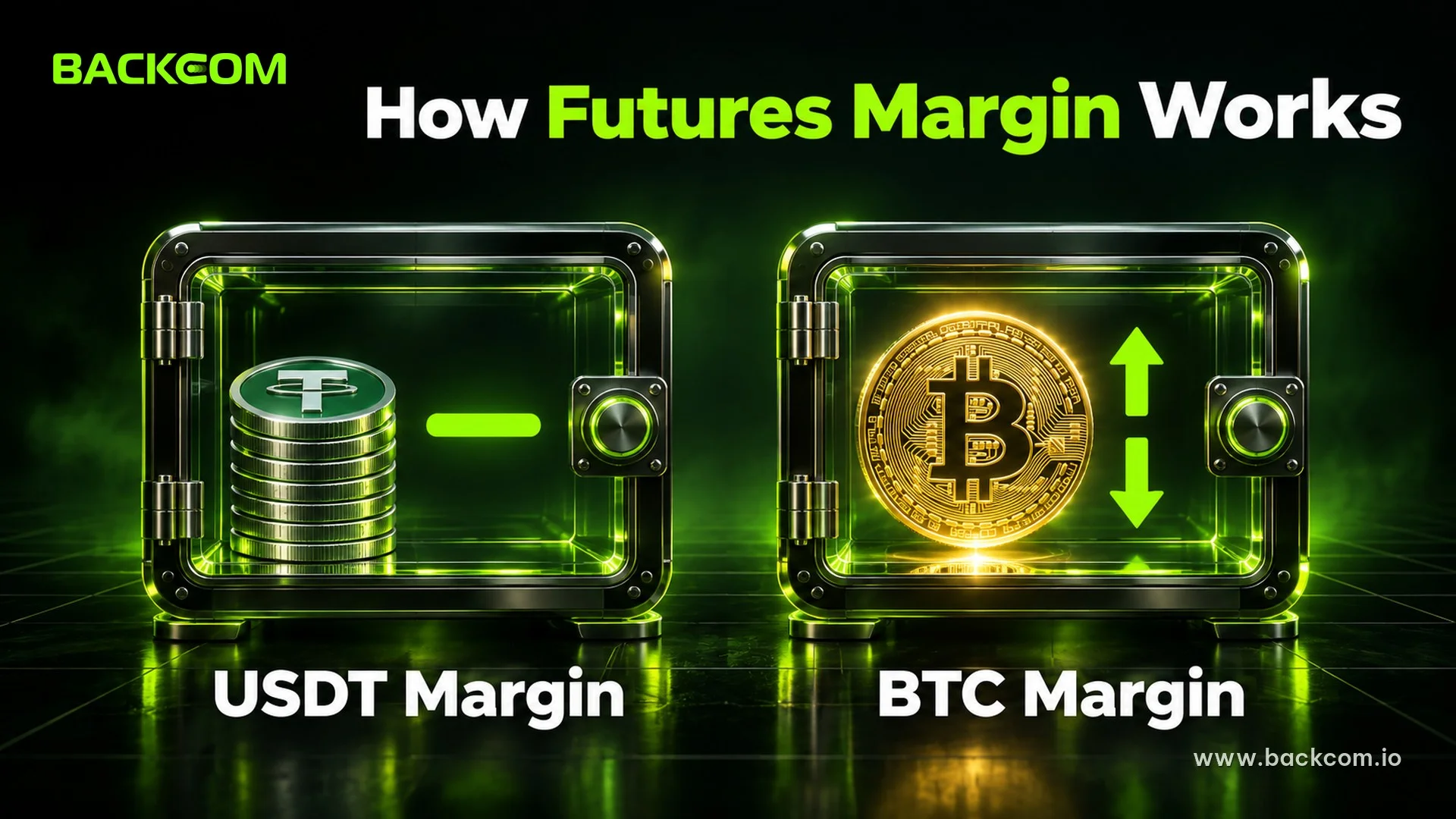
Margin is the collateral you post to open and hold a leveraged position, and the asset it is posted in is the first real difference between the two types. In a linear contract you post USDT or USDC. In an inverse contract you post BTC to trade a BTC contract. Initial margin is the position size divided by leverage in both cases; only the unit changes.
Margin In A Linear Contract
Your collateral is a stablecoin, so its dollar value barely moves while the trade is open. A 10x position on a 10,000 USD notional needs about 1,000 USDT of initial margin. If Bitcoin falls, the only thing that shrinks is your unrealised PnL. Stablecoins carry their own risk, which our guides to USDT versus USDC and what a stablecoin is cover in detail.
Margin In An Inverse Contract
Your collateral is the coin, so its dollar value moves at the same time as your trade. At an entry price of 50,000, the same 10x position on 10,000 USD needs 10,000 / 50,000 / 10 = 0.02 BTC. That is worth 1,000 USD at entry, but if Bitcoin drops to 45,000 the 0.02 BTC is worth only 900 USD, even before any trading loss.
This is why inverse contracts have been popular with people who already hold the coin: the margin is something they already own. It is also why a long position in an inverse contract carries a hidden second exposure. Your collateral and your bet point the same way.
Isolated or cross margin works on both types, as the Binance page notes. Our guide to cross margin versus isolated margin explains how that choice changes what is at risk.
How Is PnL Calculated In Linear Versus Inverse Contracts?
PnL in a linear contract is a simple price difference times quantity, while PnL in an inverse contract is based on the reciprocal of price and is paid in the coin. Binance's PnL calculation page shows both, and it states that profit and loss follow the contract's collateral: USDT for a USDⓈ-M contract and BTC for a BTC COIN-M contract.
The Linear Formula
For a long position:
PnL (USDT) = (Exit Price − Entry Price) × Quantity
Binance's own example is a 1 BTC long opened at 50,000 USDT and closed at 55,000, which gives (55,000 − 50,000) × 1 = 5,000 USDT. Double the move and you double the profit.
The Inverse Perpetual Contract Formula
For a long position:
PnL (BTC) = (1 / Entry Price − 1 / Exit Price) × Contract Value In USD
Binance's example uses 100 contracts of 100 USD each, entry at 50,000 and exit at 55,000. Its page shows ((1 / 50,000) − (1 / 55,000)) × (100 × 100) = 0.0182 BTC. Deribit's education page on inverse contract profit in BTC and USD has a worked example of profit in both units. For a short, the sign flips.
Two details are easy to miss. First, because the formula uses 1 / price, the coin value of a long's profit slows down as price rises, while its losses speed up as price falls. Second, the answer comes out in BTC, so converting it to dollars needs a price, and which price you use matters.
Inverse Vs Linear Futures: A Worked 10x Bitcoin Example
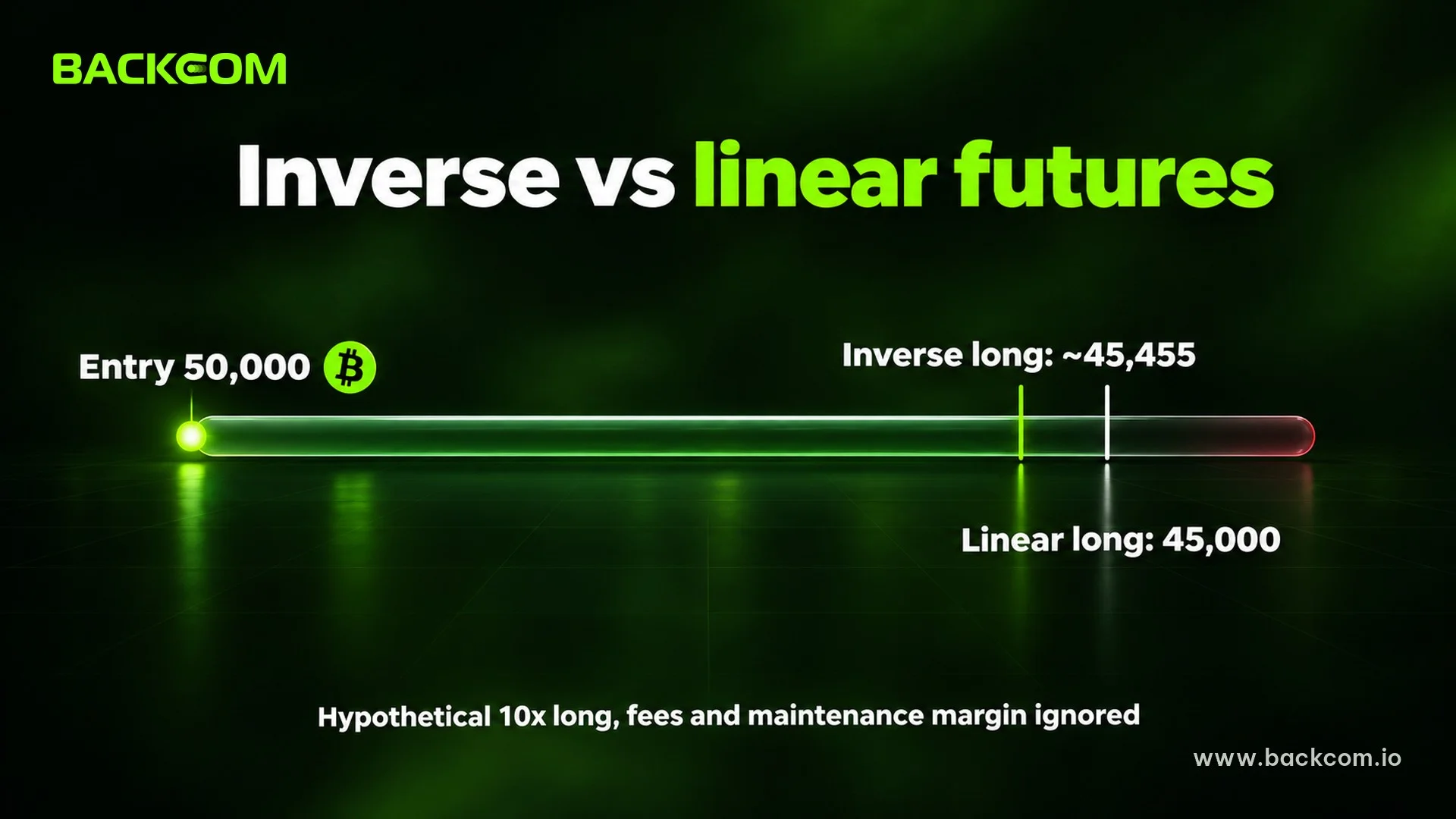
The cleanest way to see the difference is to run the same dollar bet through both contracts. The numbers below are hypothetical, not market data. Assume a long on 10,000 USD of Bitcoin, entry at 50,000, 10x leverage, and ignore fees, funding and maintenance margin.
| Item | Linear (USDT-margined) | Inverse (coin-margined) |
|---|---|---|
| Position | 0.2 BTC | 100 contracts × 100 USD |
| Initial margin | 1,000 USDT | 0.02 BTC |
| Price rises to 55,000 | +1,000 USDT | +0.01818 BTC (about 1,000 USD at 55,000) |
| Price falls to 45,000 | −1,000 USDT | −0.02222 BTC (about 1,000 USD at 45,000) |
| Long liquidation price | 45,000 | about 45,454.55 |
| Short liquidation price | 55,000 | about 55,555.56 |
Illustrative figures only, calculated from the formulas above. Real liquidation prices include maintenance margin, fees and each exchange's own rules.
What The Table Shows
Measured in dollars at the exit price, the profit and loss are the same in both contracts: about 1,000 USD each way. The difference is in the unit and in the margin. On the inverse long, a 10% rise earns 0.01818 BTC but a 10% fall loses 0.02222 BTC, so the coin-denominated result is lopsided.
The liquidation prices follow from the margin. A 10x linear long is wiped out when price falls 10%, to 45,000. The inverse long has only 0.02 BTC of margin, and its loss in BTC at 45,000 is 0.02222 BTC, which is more than the margin, so it is liquidated earlier, near 45,454.55. For a short the effect reverses: the inverse short survives slightly longer, to about 55,555.56. A deeper walk-through of that arithmetic is in our guide on how to calculate liquidation price, and the gap between starting and maintenance margin is covered in initial vs maintenance margin.
Takeaway: at the same leverage, an inverse long is slightly more fragile than a linear long, and an inverse short is slightly sturdier than a linear short, before maintenance margin and fees.
Which Is Riskier: Coin Margined Futures Or USDT Margined Futures?
Neither is safer in general: they move the risk to different places. Leverage itself is the larger danger in both, and our overview of leverage in crypto trading covers how fast a position can be liquidated. The structural differences are narrower, and they fall into three groups:
- Where the margin sits: a stablecoin in linear contracts, the coin in inverse contracts.
- How the PnL curve bends: straight in linear contracts, curved in inverse contracts.
- Which side is more fragile: the inverse long, as the example above showed.
Risks Specific To Linear Contracts
- Stablecoin risk: your margin and profit are a stablecoin, so a depeg of USDT or USDC affects the account.
- Cash-like accounting: profit and loss are simple, which is easier for beginners but also makes oversized positions feel small.
- Exchange limits: which stablecoins can be used as margin depends on the venue.
Risks Specific To Inverse Contracts
- Collateral that moves: if you are long and the coin falls, the position loses and the margin loses value together.
- Non-linear PnL: a mental model built on "10% up, 10% down" is wrong in coin terms, as the example showed.
- Harder bookkeeping: every result is in the coin, so tracking dollar profit needs conversion at the right price.
Costs That Apply To Both
Trading fees, funding payments and the spread are charged on both types, and the asset they are charged in can differ by contract, so check the specification. Our funding rate guide explains the periodic payment, and the guide to calculating crypto futures trading fees shows worked examples.
When Do People Use Inverse Contracts Instead Of Linear Ones?

Inverse contracts are mostly chosen by people whose wealth is already in the coin and who think in the coin. Linear contracts are the default for people who think in dollars. Neither choice is a recommendation; the point is to match the contract to the problem you are trying to solve.
Hedging A Coin Holding
Suppose you hold 0.2 BTC bought at 50,000 and short 100 contracts of 100 USD on an inverse contract. If price falls to 40,000, the short gains 10,000 × (1 / 40,000 − 1 / 50,000) = 0.05 BTC. Your holding is then 0.25 BTC, which is worth 10,000 USD at 40,000. If price rises to 62,500 instead, the short loses 0.04 BTC and your 0.16 BTC is again worth 10,000 USD. The dollar value stays flat, which is the point of a hedge.
That example ignores fees, funding and the margin you must post, and a real hedge needs ongoing management. It simply shows why holders of the coin often reach for inverse contracts. For a general look at the first step, see our comparison of spot and futures trading.
Dollar-Based Strategies
If you track results in dollars, a linear contract is usually simpler: the PnL formula is a straight line, position sizing is easy to compute and your margin does not change value on its own. Many traders also prefer to keep the account in a stablecoin so that a drop in the coin does not shrink the collateral.
Questions To Ask Before Choosing
- What asset do I want my profit paid in? The coin or a stablecoin.
- Do I already hold the coin? If so, inverse margin uses what you own.
- Can I tolerate collateral that falls in value? Inverse long positions have this built in.
- Which unit do I track? Switching units mid-trade makes results hard to read.
- Have I read the contract specification? Size, margin asset and fee asset vary by exchange.
Frequently Asked Questions (FAQ) About Inverse And Linear Futures
Is An Inverse Perpetual The Same As A COIN-M Contract?
In practice, yes. An inverse perpetual contract is quoted in a currency like USD and margined in the coin, which matches how Binance describes COIN-margined contracts. Perpetual means there is no expiry date. Some venues also sell dated inverse contracts, so check the product page for the exact name and terms.
Why Does An Inverse Position Have Non-Linear PnL?
Because the profit is paid in the coin and the formula uses 1 divided by price. A fixed dollar position is worth fewer coins at a higher price, so each extra dollar of price adds less coin profit, and each dollar lost costs more. In dollar terms measured at the exit price, the result is the same as a linear contract.
Which Contract Has The Higher Liquidation Risk For Longs?
At the same leverage and ignoring maintenance margin and fees, an inverse long liquidates slightly earlier than a linear long. In the 10x example, a linear long liquidates at 45,000 and an inverse long near 45,454.55. Real values depend on the exchange's margin rules, so use its own calculator.
Can I Use USDT-Margined Futures If I Hold Bitcoin?
Usually you would need to post a stablecoin or an eligible asset as margin, and some exchanges accept other coins as collateral. The rules differ by venue and account mode. Check which assets count as margin, how they are valued and whether a haircut applies before you open a position.
Conclusion: Pick The Margin Asset Before You Pick The Leverage
Inverse vs linear futures is mainly a decision about which asset carries your risk. Linear contracts keep margin and PnL in a stablecoin with a straight-line formula. Inverse contracts keep both in the coin, which suits holders and hedgers but adds curved PnL and collateral that moves with the market. Whichever you use, read the contract specification, size positions from the loss you can afford and treat every liquidation price in this article as an estimate. For the exchange-level details, always rely on the venue's own documentation.
Disclaimer: This content is compiled by Backcom.io for information only and is not investment advice. Crypto futures are leveraged, can lose the whole margin and are not suitable for everyone. All figures in the worked examples are hypothetical.
Was this article helpful?
Join The Backcom.io Community
Get the latest on trading rebates, trading tips, and broker deals — and connect with thousands of traders worldwide.

Backcom App
Track Your Rebates Every Day
Every rebate is visible by broker and by day. Manage your wallet and withdrawals in one place.
Open Backcom App