How Much Leverage To Use In Crypto Futures: A Risk-Based Framework

Most traders pick leverage first and ask questions later: 10x because a friend uses it, 50x because the exchange offers it. That order is backwards. The question of how much leverage to use in crypto futures has no single correct number, because leverage does not decide how much you can lose. Your position size and your stop-loss distance do. Leverage only decides how close your liquidation price sits to your entry. In this article, Backcom.io builds a risk-based framework, tests it against a year of real BTC daily candles and shows a worked example with clearly hypothetical numbers.
1. How Much Leverage To Use In Crypto Futures: What Is The Short Answer?
The honest answer is "as little as your trade needs", and the amount follows from your stop, not the other way round. Kraken's educational guide on position sizing with leverage states it plainly: leverage does not change how much you should risk per trade, it changes how small your position needs to be to keep that risk constant. The same guide describes 0.5% to 2% of the account per trade as a common approach.
That gives a sizing order worth memorising:
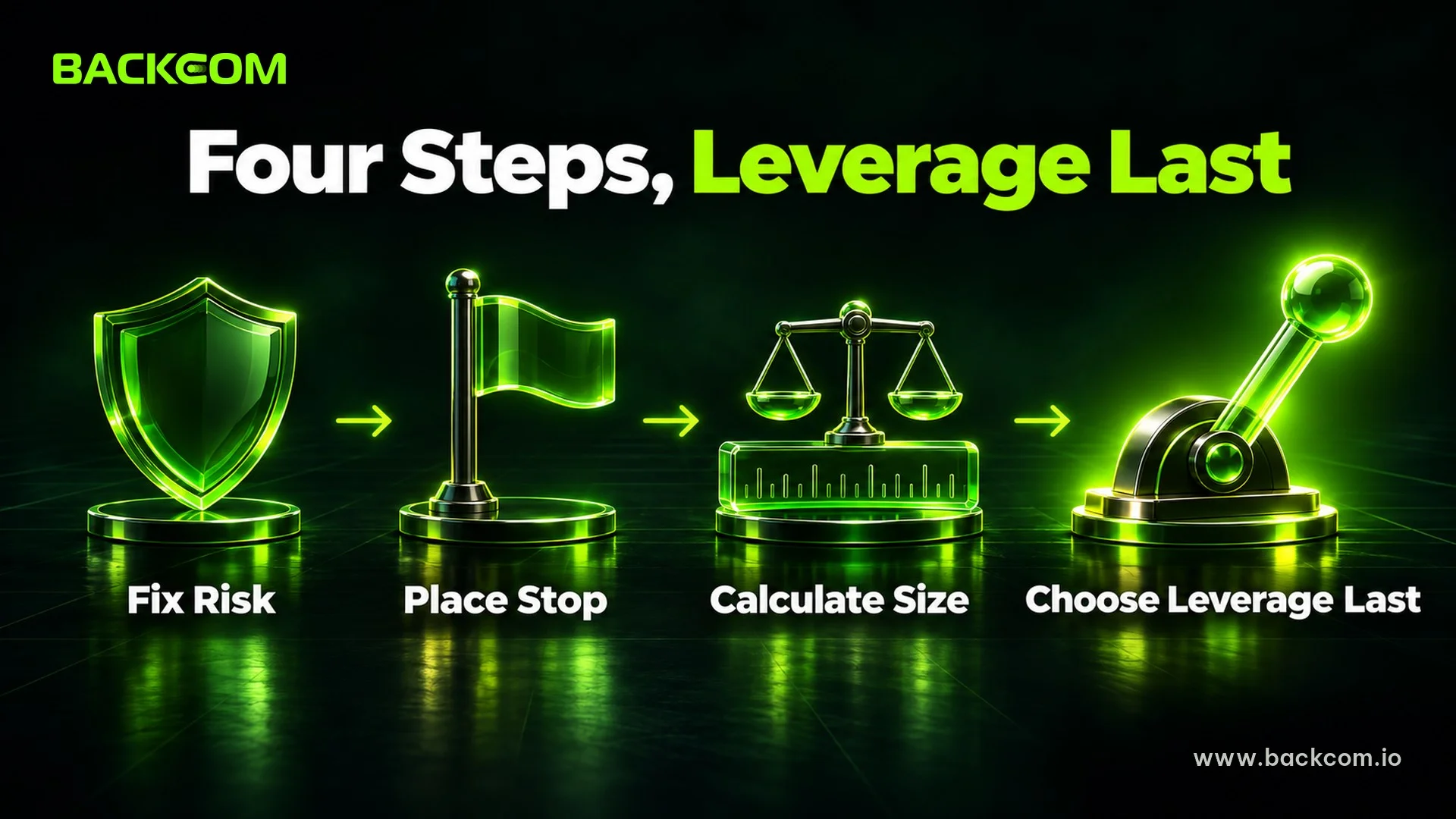
- Fix the risk: decide the share of your account you accept losing if the trade fails, for example 1%.
- Place the stop: put it where your trade idea is proven wrong, based on the chart rather than on a leverage number.
- Calculate the size: position size follows from risk divided by stop distance.
- Choose leverage last: pick the lowest setting that funds the margin and keeps liquidation far behind your stop.
No source can name a universal safe number, because none knows your stop distance, your coin or your account size. If you want the basics first, our explainer on what leverage is in crypto trading covers the mechanics.
2. How Are Leverage And Liquidation Distance Linked?
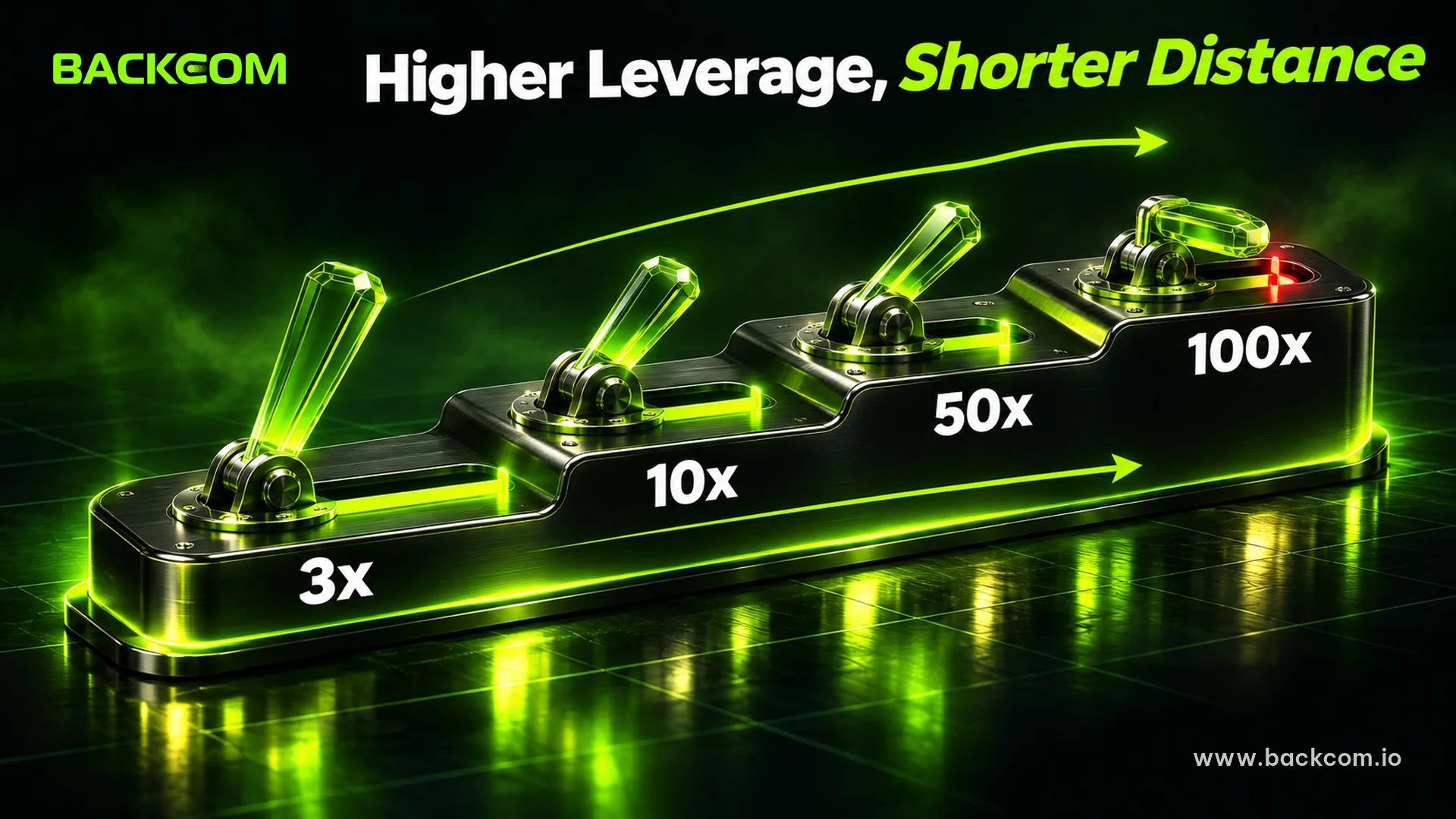
Liquidation distance is the percentage move against your position that wipes out your margin, and it shrinks as leverage rises. The link between leverage and liquidation distance is close to mechanical, which is why a "safe leverage in crypto" cannot be named without knowing where your stop sits. On an isolated position, a rough shortcut is:
Liquidation distance ≈ 1 ÷ Leverage − Maintenance Margin Rate
Exchanges use tiered maintenance rates that depend on position size, and they add fees, so real figures differ. Binance's liquidation formula FAQ explains that maintenance margin equals position notional times the tier's rate, minus a tier-specific amount. For this article we assume a flat 0.4% rate so the numbers are easy to follow. It is an illustration, not a quote from any exchange.
| Leverage | Approx. liquidation distance | Long entered at 60,000 USDT liquidates near |
|---|---|---|
| 3x | 32.9% | 40,240 |
| 5x | 19.6% | 48,240 |
| 10x | 9.6% | 54,240 |
| 20x | 4.6% | 57,240 |
| 50x | 1.6% | 59,040 |
| 100x | 0.6% | 59,640 |
Hypothetical entry price and a flat 0.4% maintenance rate; fees and tiers are ignored, so check the liquidation price your own exchange shows before opening a trade.
Two details change the picture in practice. First, Binance's liquidation protocol page says liquidation happens when the mark price reaches the liquidation price, not the last traded price. Second, the same page warns that in a volatile market a position can be closed at a price different from the calculated one, so the number on your screen is a guide rather than a guarantee. For a step-by-step version of the calculation, see our guide on how to calculate liquidation price.
3. What Did Bitcoin Actually Do To Each Leverage Level Over A Year?
A year of daily candles shows that the highest leverage settings sit inside normal daily movement. We took Binance BTCUSDT daily candles from 25 November 2025 to 24 November 2026 (365 days, UTC) and counted the days on which price moved at least a given distance from the day's open, down for a long or up for a short.
| Leverage (approx. distance) | Days price fell that far from the open (long) | Days price rose that far from the open (short) |
|---|---|---|
| 100x (0.6%) | 263 of 365 (72%) | 264 of 365 (72%) |
| 50x (1.6%) | 149 (41%) | 123 (34%) |
| 20x (4.6%) | 21 (6%) | 23 (6%) |
| 10x (9.6%) | 2 (0.5%) | 1 (0.3%) |
| 5x (19.6%) | 0 | 0 |
Source: Binance BTCUSDT daily candles, retrieved 25 November 2026; distances from the table above. This is past data, not a forecast or a recommendation.
Three readings stand out:
- At 100x, a normal day is enough: the day's price touched 0.6% against the open on roughly 7 days out of 10.
- The average daily range was 3.37% (high minus low, as a share of the open), more than double the 50x distance. On 71 of the 365 days the range exceeded the 20x distance of 4.6%.
- The worst day tested an entire leverage tier: on 5 February 2026 BTC fell 14.79% from the open to the day's low, beyond the 10x distance, while the widest high-to-low range of the year, 18.68%, came the next day.
The pattern is clear: the move needed to liquidate a 20x position happens roughly one day in sixteen, a 10x position about one day in 180. Those frequencies come from a single year that included a sharp February sell-off, so a calmer or wilder year would shift them. Treat the table as a way to compare leverage levels against each other, not as a safe-leverage threshold.
Read the limits honestly. A trader does not enter at the daily open, candles hide the order of moves inside the day, and exchanges trigger liquidation on mark price. The table measures how often the market travels these distances, not how often a specific trader would have been liquidated. When that kind of move cascades through leveraged positions, you get the effect described in our article on liquidation cascades.
4. How Do You Calculate Leverage From Risk Per Trade?
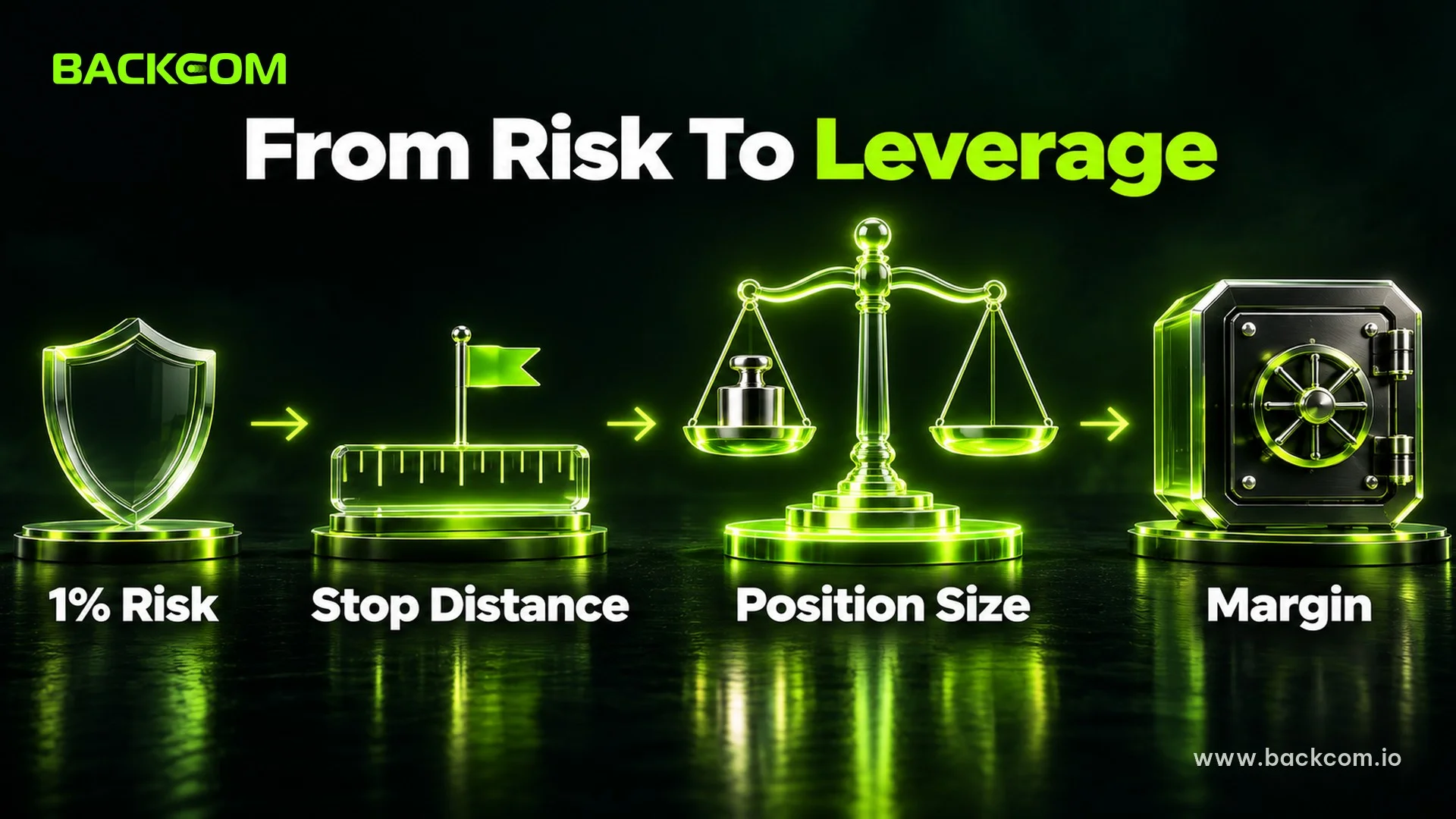
Start from the loss you accept, then derive the position, then check what leverage that implies. Kraken's guide gives the sizing formula as account value times risk percentage, divided by the gap between entry and stop-loss price. Here is a hypothetical long, with every number invented for illustration:
- Account: 2,000 USDT.
- Risk per trade: 1%, so 20 USDT.
- Entry: 60,000 USDT. Stop: 58,200 USDT, a distance of 1,800 USDT or 3%.
Position size = (2,000 × 1%) ÷ (60,000 − 58,200) = 20 ÷ 1,800 = 0.01111 BTC
That is a notional value of about 666.67 USDT. If the stop fills, the loss is 0.01111 × 1,800 ≈ 20 USDT, 1% of the account. Now the leverage setting only decides how much margin you lock:
| Leverage setting | Margin locked | Approx. liquidation | Gap between stop and liquidation |
|---|---|---|---|
| 3x | 222.22 USDT | 40,240 | 17,960 USDT |
| 10x | 66.67 USDT | 54,240 | 3,960 USDT |
| 20x | 33.33 USDT | 57,240 | 960 USDT |
| 30x | 22.22 USDT | 58,240 | liquidation is 40 USDT above the stop, so it triggers first |
Two lessons follow. First, the risk is identical in every row where the stop can fill: about 20 USDT. What changes is the buffer. At 30x the liquidation price sits above the stop, so the position is liquidated first and your stop never fills; the planned exit is replaced by the exchange's closing rules. Second, the effective leverage of this position is only 0.33x (666.67 ÷ 2,000). A disciplined trade sized from a 3% stop uses a fraction of the account, whatever the exchange slider says.
A practical rule of thumb used in this article, not an industry standard, is to choose a leverage whose liquidation distance is at least twice your stop distance. With a 3% stop, that points to a liquidation distance of 6% or more, which is roughly 15x or lower, so 10x is a sensible ceiling here. For the arithmetic of margin and size, our futures leverage calculator guide and the position size calculator do the same sums.
5. Which Rules Keep Leverage From Becoming The Risk?
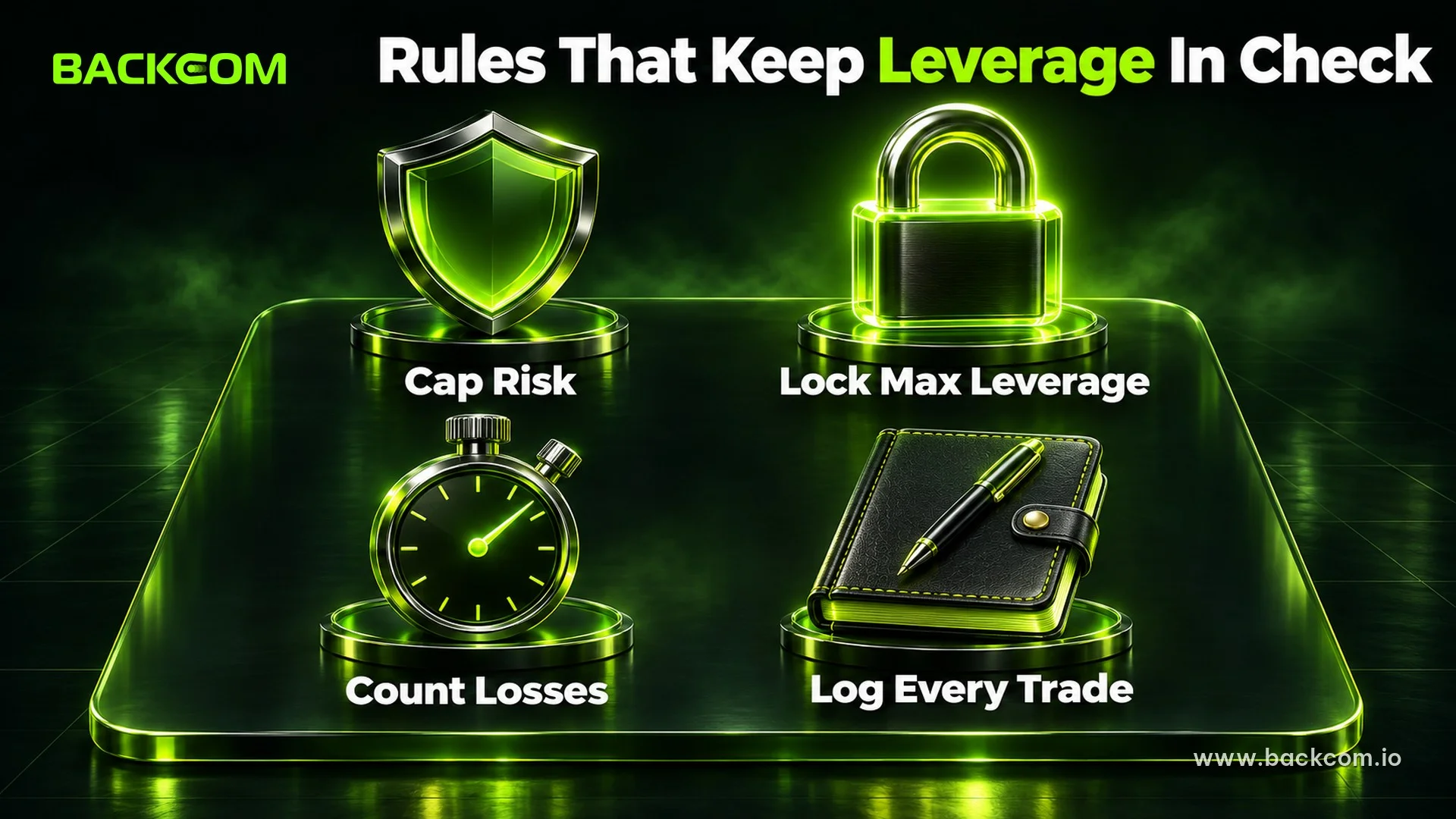
Treat leverage as a setting that must pass a checklist before every trade, not as a tool for making the position bigger. These habits come up repeatedly in exchange education material and in the mechanics described above:
- Keep the stop well before liquidation. If the gap is thin, lower the leverage. A stop placed beyond the liquidation price is useless, because the exchange closes the position first.
- Reduce leverage when the stop widens. A volatile coin needs a wider stop, so the same 1% risk means a smaller position and a bigger buffer. Our guide to crypto stop losses covers placement.
- Prefer isolated margin while learning. It limits the loss to the margin of one position. The differences are in cross margin vs isolated margin.
- Do not add margin to rescue a losing trade. That raises the amount at risk after the idea has already failed. Warning signs are listed in our piece on crypto margin calls.
- Understand the margin terms. Initial and maintenance margin decide where liquidation sits; see initial vs maintenance margin.
- Build in fees and slippage. Trading fees, funding payments and fast markets all move your real liquidation price closer than the screen suggests.
- Keep a fixed maximum. Many traders set a personal ceiling, such as 5x or 10x, and never override it during a winning streak.
6. What Is A Reasonable Leverage For Beginners In Crypto?
Start with the lowest leverage that lets you place the trade, and judge it by results across many trades rather than by one position. The data above explains why a low single-digit setting suits leverage for beginners in crypto: at 5x, none of the 365 daily candles reached the approximate liquidation distance from the open, while at 20x about 6% of days did. That does not make 5x safe. Losses at 5x still follow your position size, and a coin that is more volatile than Bitcoin can move much further.
A reasonable first step is practising on a small position, with a stop and the leverage chosen from your 1% sizing, then reviewing every trade in a journal. Increase leverage only if your stops are respected, not because the account has grown.
Three checks help before you move up a level:
- Review the last 20 trades: count how many were closed by your own stop and how many by liquidation or by panic. Liquidations should be zero.
- Compare actual loss with planned loss: if trades regularly lose more than the 1% you set, the problem is execution, not the leverage slider.
- Test a volatile day: imagine your position on 5 February 2026, when BTC fell 14.79% from the open. If that day ends the trade at your chosen leverage, the setting is too high for the stop you use.
Frequently Asked Questions (FAQ) About Crypto Leverage
What Is The Best Leverage For Crypto Futures?
There is no best number for everyone. The right setting depends on your stop distance, the coin's volatility and how much of the account you risk per trade. A low setting such as 2x to 5x leaves a wide buffer, but that is a choice, not a rule. Size the position from your stop first, then pick the lowest leverage that gives a wide gap between stop and liquidation.
What Is Safe Leverage In Crypto, And Is 10x Safe?
It depends on what you do with it. At 10x the approximate liquidation distance in our example is about 9.6%. In the last 365 daily BTC candles, 2 days moved that far down from the open, so it can happen even on a large coin. A smaller position with a stop at 3% keeps the loss at your chosen risk, while a full-size position with no stop does not.
Does Higher Leverage Mean Higher Profit?
No. Leverage only reduces the margin needed for a given position, so it magnifies gains and losses of that position equally. Higher leverage also brings liquidation closer, which makes it more likely that a normal swing ends the trade before the idea can play out. Profit depends on your size, entry, exit and costs.
How Do I Know My Liquidation Price Before I Trade?
Open the order ticket on your exchange and read the estimated liquidation price after you enter size and leverage. Compare it with your stop. The estimate uses the exchange's own maintenance margin tiers and can shift with fees, funding and other open positions, so check it again after the order is filled.
Conclusion: Let Your Stop Choose The Leverage
The best answer to how much leverage to use in crypto futures is a process: fix the risk at a small share of the account, place the stop where the idea fails, calculate the size and only then choose the leverage that keeps liquidation far behind the stop. The BTC data shows why: very high settings sit inside normal daily movement, while low settings leave room for ordinary volatility. No leverage level removes the risk of losing money.
Disclaimer: This content is compiled by Backcom.io for information only and is not investment advice. Futures trading carries a high risk of loss, including loss of your entire margin. Numbers in the worked example are hypothetical and past BTC data is not a forecast.
Was this article helpful?
Join The Backcom.io Community
Get the latest on trading rebates, trading tips, and broker deals — and connect with thousands of traders worldwide.

Backcom App
Track Your Rebates Every Day
Every rebate is visible by broker and by day. Manage your wallet and withdrawals in one place.
Open Backcom App