How To Calculate ROE Futures Traders See: Formula And Leverage Examples

Summary
ROE in crypto futures is your unrealized or realized PnL divided by the initial margin, times 100. Because margin is only a fraction of the position, a 1% price move shows as roughly 10% ROE at 10x leverage, in both directions.

How to calculate ROE futures traders see on screen comes down to one line: divide your profit or loss by the initial margin you posted, then multiply by 100. ROE answers a different question from PnL. PnL says how many dollars you made or lost, while ROE says how big that result is compared with the capital you actually put up. In this article, Backcom.io shows the formula, worked BTC examples at several leverage levels, and the fee and liquidation effects that change the number on your screen.
1. ROE Vs PnL Futures: What Is The Difference?
ROE in crypto futures stands for return on equity, which in futures means profit measured against posted margin. It is the profit or loss of a position expressed as a percentage of the margin that backs it. Many exchanges show this figure next to an open position, often in brackets beside the PnL amount.
The two numbers describe the same trade from different angles:
- PnL is an amount in USDT or coin, such as +200 USDT.
- ROE is a percentage of margin, such as +20%.
Naming varies. Binance's support pages use the term ROI for the same calculation, and OKX calls it the PnL ratio. Interface labels such as "ROE", "ROI" and "PnL %" usually point to the same idea: PnL divided by initial margin. Always check which label your own platform uses.
If you want the dollar side first, the guide to unrealized PnL in crypto futures explains how the profit figure is built. This article starts where that one ends and focuses on the percentage.
2. How To Calculate ROE Futures Positions Use: The Formula
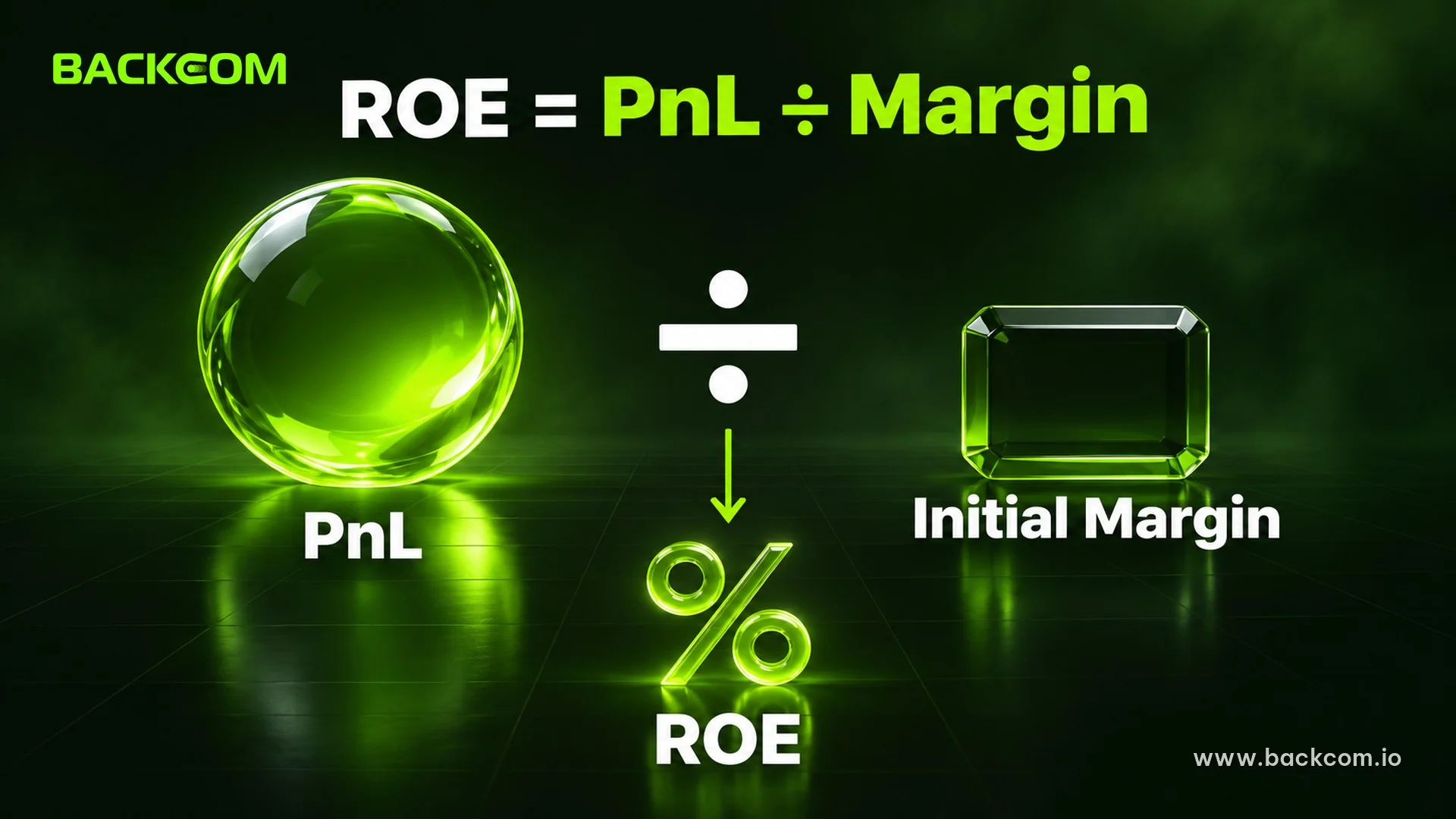
The ROE formula has two parts: the profit or loss of the position, and the initial margin that supports it.
ROE (%) = PnL ÷ Initial Margin × 100
Both parts come from published exchange rules. Binance's futures calculator page (updated 9 January 2026) gives ROI% = PnL ÷ Initial Margin and defines Initial Margin = Contract Size × Entry Price × IMR, with IMR = 1 ÷ Leverage. OKX's PnL calculation rules (updated 11 August 2026) state the ratio as P&L divided by initial margin for isolated and single-currency cross margin.
For a USDT-margined (linear) contract the pieces are:
- Position value = quantity × entry price.
- Initial margin = position value ÷ leverage.
- Long PnL = (current price − entry price) × quantity.
- Short PnL = (entry price − current price) × quantity.
Binance's USDⓈ-M PnL page (updated 2 February 2026) calculates unrealized PnL from the mark price, with an option to switch to last price, and its PnL formula has no fee or funding term. The same page gives a fuller ROI formula that includes realised PnL, commissions and funding in the numerator. So a number shown while the trade is open and a number after you close can differ.
3. Return On Equity Crypto Futures Example: How Is A Long Calculated?
The figures below are hypothetical and use round prices so the arithmetic is easy to follow. They are not a forecast and not a trade idea.
Take a BTCUSDT long at 10x leverage:
- Entry price: 100,000 USDT.
- Quantity: 0.1 BTC.
- Position value: 0.1 × 100,000 = 10,000 USDT.
- Initial margin: 10,000 ÷ 10 = 1,000 USDT.
Now watch what happens at different mark prices:
| Mark price | Price move | PnL (USDT) | ROE |
|---|---|---|---|
| 102,000 | +2% | +200 | +20% |
| 101,000 | +1% | +100 | +10% |
| 100,000 | 0% | 0 | 0% |
| 99,000 | −1% | −100 | −10% |
| 98,000 | −2% | −200 | −20% |
Illustrative figures. Fees and funding are ignored in this table.
At 102,000 the PnL is (102,000 − 100,000) × 0.1 = 200 USDT. Divide by the 1,000 USDT margin and the result is 20%. The price moved only 2%, but ROE shows ten times that, because margin is one tenth of the position value.
The same math runs in reverse. A 2% drop produces −200 USDT, which is −20% ROE. Leverage magnifies gains and losses in the same proportion.
4. How To Calculate ROE For A Short Position
A short profits when the price falls, so the PnL sign flips while the denominator stays the same.
Take a BTCUSDT short at 10x leverage with the same size:
- Entry price: 100,000 USDT, quantity 0.1 BTC, initial margin 1,000 USDT.
- Mark price falls to 96,000.
- Short PnL = (100,000 − 96,000) × 0.1 = +400 USDT.
- ROE = 400 ÷ 1,000 × 100 = +40%.
If the price instead rises to 104,000, the short PnL is (100,000 − 104,000) × 0.1 = −400 USDT and ROE is −40%. Binance writes the direction as +1 for a long and −1 for a short in its formula. The result is the same as flipping the sign by hand.
5. ROE Formula Leverage Effect: How Does Leverage Change ROE?
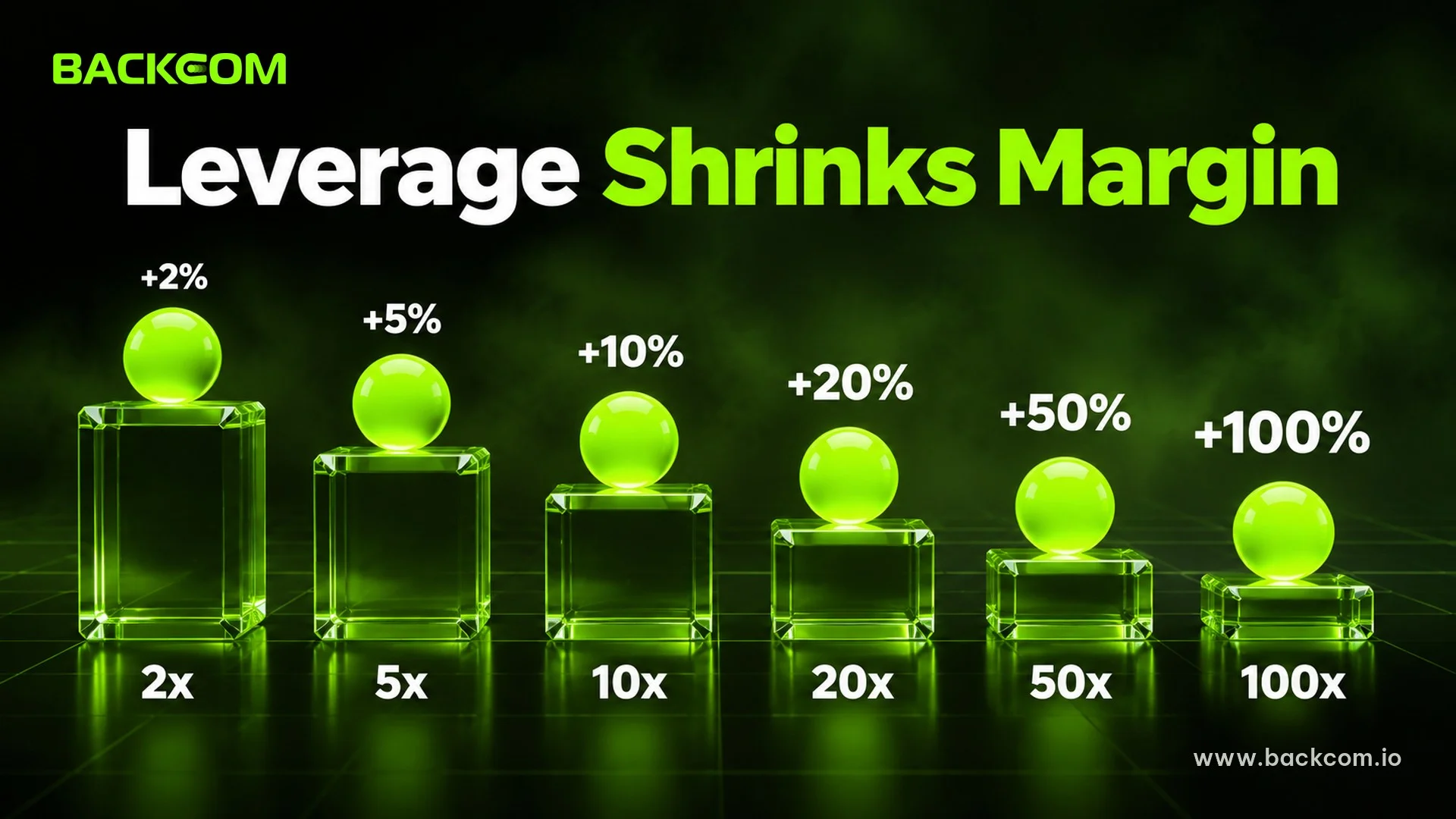
The ROE formula leverage link is simple algebra. Because initial margin equals position value divided by leverage, the formula for a linear contract simplifies to:
ROE (%) ≈ Price move (%) × Leverage
This is Backcom.io's own derivation from the published formulas above, not a quote from an exchange page. It holds before fees and funding, and the sign flips for a short.
The table shows a +1% price move on a 10,000 USDT position at different leverage levels:
| Leverage | Initial margin (USDT) | PnL at +1% (USDT) | ROE at +1% |
|---|---|---|---|
| 2x | 5,000 | +100 | +2% |
| 5x | 2,000 | +100 | +5% |
| 10x | 1,000 | +100 | +10% |
| 20x | 500 | +100 | +20% |
| 50x | 200 | +100 | +50% |
| 100x | 100 | +100 | +100% |
Illustrative figures for a long position. The PnL is identical in every row; only the margin behind it changes.
Read the table carefully. The dollar profit never changes: it is 100 USDT in every row. Leverage only shrinks the margin, so the same dollar result looks like a larger percentage. A high ROE therefore reflects a thin margin cushion as much as a good trade.
The same multiplication applies to losses. At 50x, a 1% move against you shows as −50% ROE. For guidance on choosing a level, see how much leverage to use in crypto futures and the primer on leverage in crypto trading.
6. How Do Fees And Funding Change Your ROE?

Fees and funding reduce ROE, and they hit harder when leverage is high. The PnL formulas published by Binance and OKX have no fee or funding term, so the live percentage can look better than what you finally keep.
Use the 10x long from section 3. Assume a taker fee of 0.05% on each side, purely for illustration, because real rates depend on your tier and order type:
- Opening fee: 10,000 × 0.05% = 5.00 USDT.
- Closing at 102,000: 10,200 × 0.05% = 5.10 USDT.
- Gross PnL: +200 USDT.
- Net PnL after fees: 200 − 5.00 − 5.10 = 189.90 USDT.
- ROE after fees: 189.90 ÷ 1,000 = 18.99%.
Add 2 USDT of funding paid during the hold and the net PnL becomes 187.90 USDT, an 18.79% ROE. Funding can also be received, depending on the side and the rate. The funding rate guide explains when each side pays.
Why Fees Cost More ROE At High Leverage
Round-trip fees of about 0.10% of position value are a fixed cost against the position. In ROE terms they equal 0.10% × leverage:
| Leverage | Fee cost in ROE terms |
|---|---|
| 5x | about 0.5% |
| 10x | about 1% |
| 20x | about 2% |
| 50x | about 5% |
Illustrative: assumes 0.05% taker fee per side and ignores funding and slippage.
At 50x you start the trade roughly 5% of ROE in the hole before the price has moved in either direction. A step-by-step guide to crypto futures trading fees shows how to calculate the fee side from your own tier. The Binance formula for final ROI follows the same logic: it adds commissions and funding to realised PnL before dividing by margin.
7. What Price Move Do You Need For A Target ROE?
You can rearrange the formula to plan a trade before you open it:
Required price move (%) = Target ROE (%) ÷ Leverage
Some examples, before fees:
- A 50% ROE target at 10x needs a 5% move.
- A 50% ROE target at 25x needs a 2% move.
- A 100% ROE target at 20x needs a 5% move.
- A 20% ROE target at 5x needs a 4% move.
This also works for risk. If you set a loss limit of −30% ROE at 10x, the price only has to move 3% against you to reach it. Put differently, a high leverage setting leaves very little room for normal price swings. Pair this calculation with the position size calculator guide so the dollar risk, not just the ROE target, is decided in advance.
8. Why Does Liquidation Happen Before ROE Reaches −100%?
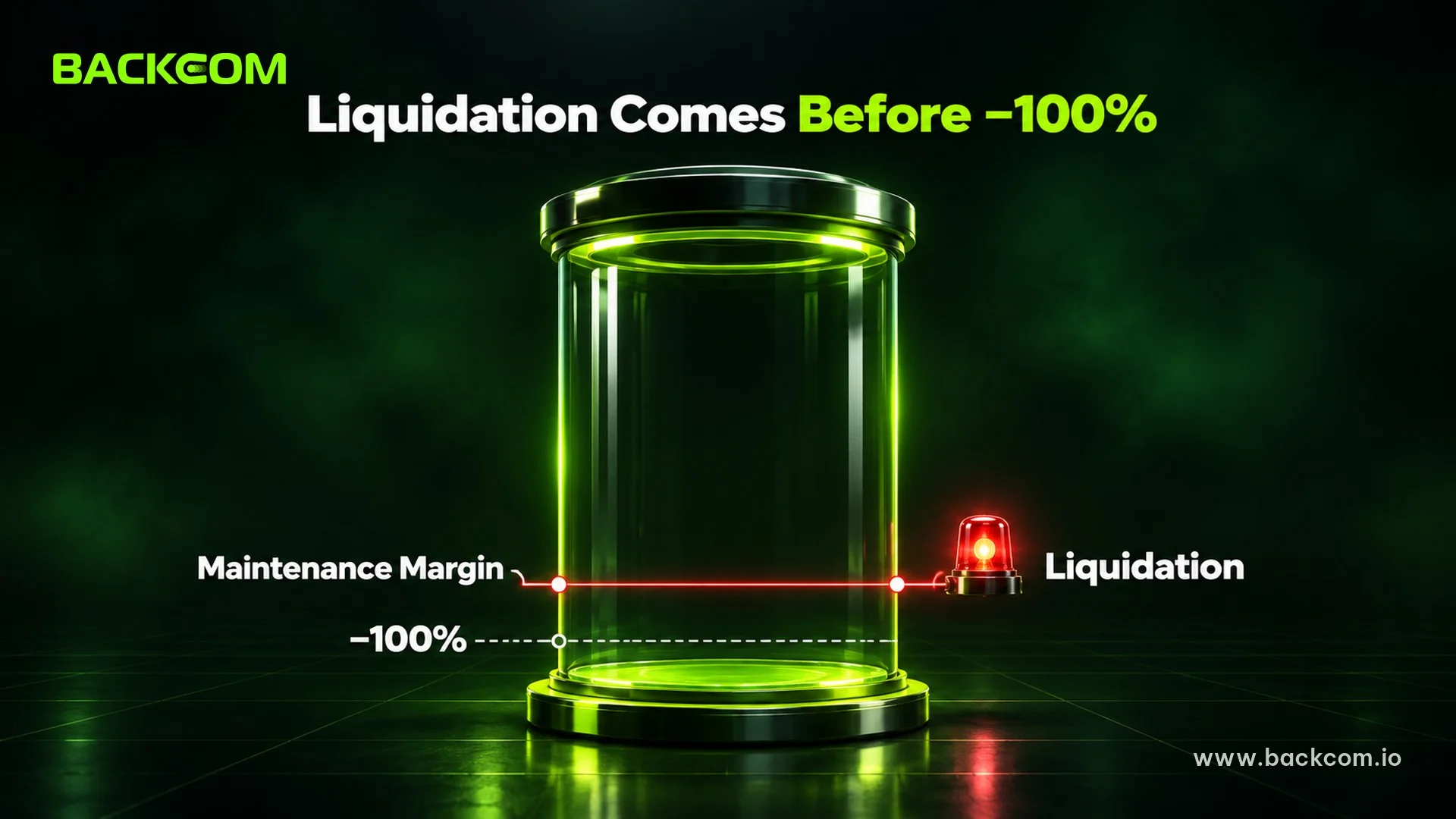
At first glance, a −100% ROE looks like the point where all the margin is gone. On an isolated position, that is the theoretical limit. In practice, the exchange closes the position sooner.
Binance's liquidation protocol page (updated 16 November 2026) states that liquidation is triggered when equity falls below maintenance margin, and that it occurs when the mark price hits the position's liquidation price. Maintenance margin is a small amount the exchange keeps in reserve, so equity never gets to zero before the closing process begins. The exchange page does not describe −100% ROE as the liquidation point.
Here is a simplified illustration, not a live formula. Take a 10x isolated long at 100,000 with an assumed maintenance margin of 0.5% of position value:
Approximate liquidation price = Entry × (1 − 1 ÷ Leverage + Maintenance Margin Rate)
That gives 100,000 × (1 − 0.10 + 0.005) = 90,500 USDT, a fall of 9.5%. The ROE at that price is about −95%, not −100%. Real formulas depend on the exchange, the contract and tiered maintenance rates, so use the liquidation price guide for the full method. The relationship between the starting requirement and the reserve is covered in initial margin vs maintenance margin.
9. How Does ROE Differ From The Return On Your Whole Account?
ROE per position uses the margin of that position, not your total balance. That can make a result look far bigger than it is for your account.
Suppose your futures wallet holds 5,000 USDT and you open the 10x long from section 3 with 1,000 USDT of margin. A +200 USDT PnL shows as +20% ROE. Your account, however, grew by 200 ÷ 5,000 = 4%.
Three other points help you read the screen correctly:
- Cross vs isolated: the margin mode changes how much collateral stands behind the position. The guide to cross margin vs isolated margin explains the difference.
- Platform denominators: OKX uses initial margin for isolated and single-currency cross positions, and position-opening margin for multi-currency cross. Binance's published ROI formula divides by entry price × opened quantity ÷ leverage. OKX computes initial margin from the mark price, so the ratio can differ slightly from an example that uses the entry price. Check the help page of your own platform for the denominator it uses.
- Contract type: for inverse contracts, profit is counted in the coin, so dollar value moves with the coin itself. See inverse vs linear futures before you apply the linear formulas above.
10. How Can You Build A Simple Futures ROE Calculator?
A spreadsheet is enough. Create these cells and the futures ROE calculator is ready:
- Entry price and exit or mark price.
- Quantity in coin.
- Leverage.
- Side: +1 for a long, −1 for a short.
- PnL = side × (exit − entry) × quantity.
- Initial margin = quantity × entry price ÷ leverage.
- Fees = (entry × quantity + exit × quantity) × fee rate, plus any funding paid.
- ROE = (PnL − fees) ÷ initial margin × 100.
Run the calculator for a range of prices before you place the order. The leverage calculator guide shows a similar worksheet that also checks liquidation distance.
Frequently Asked Questions (FAQ) About ROE In Crypto Futures
Is ROE The Same As ROI In Futures?
On most exchange screens, yes. Both divide PnL by the initial margin of the position. Binance's pages use "ROI" and OKX uses "PnL ratio", while many interfaces and traders say "ROE". The label differs, but the calculation is the same unless the page states otherwise.
Does ROE Include Fees And Funding?
Not always. The PnL formulas published by Binance and OKX have no fee or funding term, so a live ROE may overstate the final result. Binance's updated ROI formula adds commissions and funding to realised PnL. Compare the number on your screen with your trade history after you close.
Why Does My ROE Change When I Change Leverage?
Because the denominator, initial margin, depends on leverage. Higher leverage means less margin for the same position, so the same PnL becomes a larger percentage. The dollar profit or loss does not change when only the displayed ratio moves.
Can ROE Be Below −100%?
Not on a typical isolated position, because liquidation starts before the margin is fully used. Very fast markets can still produce fills worse than the liquidation price, so read your platform's liquidation rules and keep a buffer.
Conclusion: Use ROE To Measure Risk, Not Just Reward
ROE in crypto futures equals PnL divided by initial margin. In the worked example, a 2% BTC move produced a 20% ROE at 10x and a 100% ROE would need only a 1% move at 100x. The same multiplication applies to losses, and fees consume more ROE as leverage rises.
Before you open a trade, calculate the ROE you would show at your stop and at your target, include fees and funding, and check how close the stop sits to liquidation. A large ROE number says little about the quality of a trade if the margin behind it is thin.
Disclaimer: This content is compiled by Backcom.io for information only and is not investment advice. Crypto futures and leveraged trading carry a high risk of loss, and liquidation can wipe out your margin. The figures above are hypothetical or taken from exchange documentation and do not predict future results.
Was this article helpful?
Join The Backcom.io Community
Get the latest on trading rebates, trading tips, and broker deals — and connect with thousands of traders worldwide.

Backcom App
Track Your Rebates Every Day
Every rebate is visible by broker and by day. Manage your wallet and withdrawals in one place.
Open Backcom App