Forex Broker For Scalping: 6 Criteria For Choosing Spreads, Execution Speed And Short-Trade Rules

Summary
A forex broker for scalping should be judged on six points: terms that allow short trades, total cost per round turn, account type, execution quality, stop levels on MT5 and the broker's safety basics. A low headline spread is not enough, because commission and slippage can erase a margin of a few pips.
A scalper wins or loses by a few pips per trade, so a forex broker for scalping cannot be picked from one tidy spread figure on a marketing page. Every round turn also carries commission, slippage at execution and the broker's terms on short trades.
If any one of those three slips, a margin of 3–5 pips can vanish. Traders need criteria they can measure, not a "best broker" list with no stated conditions.
In this article, Backcom.io walks through six criteria, how to test each one yourself and where traders most often get it wrong. It does not rank brokers, because every broker has its own terms and account types.
1. Is A Forex Broker For Scalping Really Scalping Friendly?
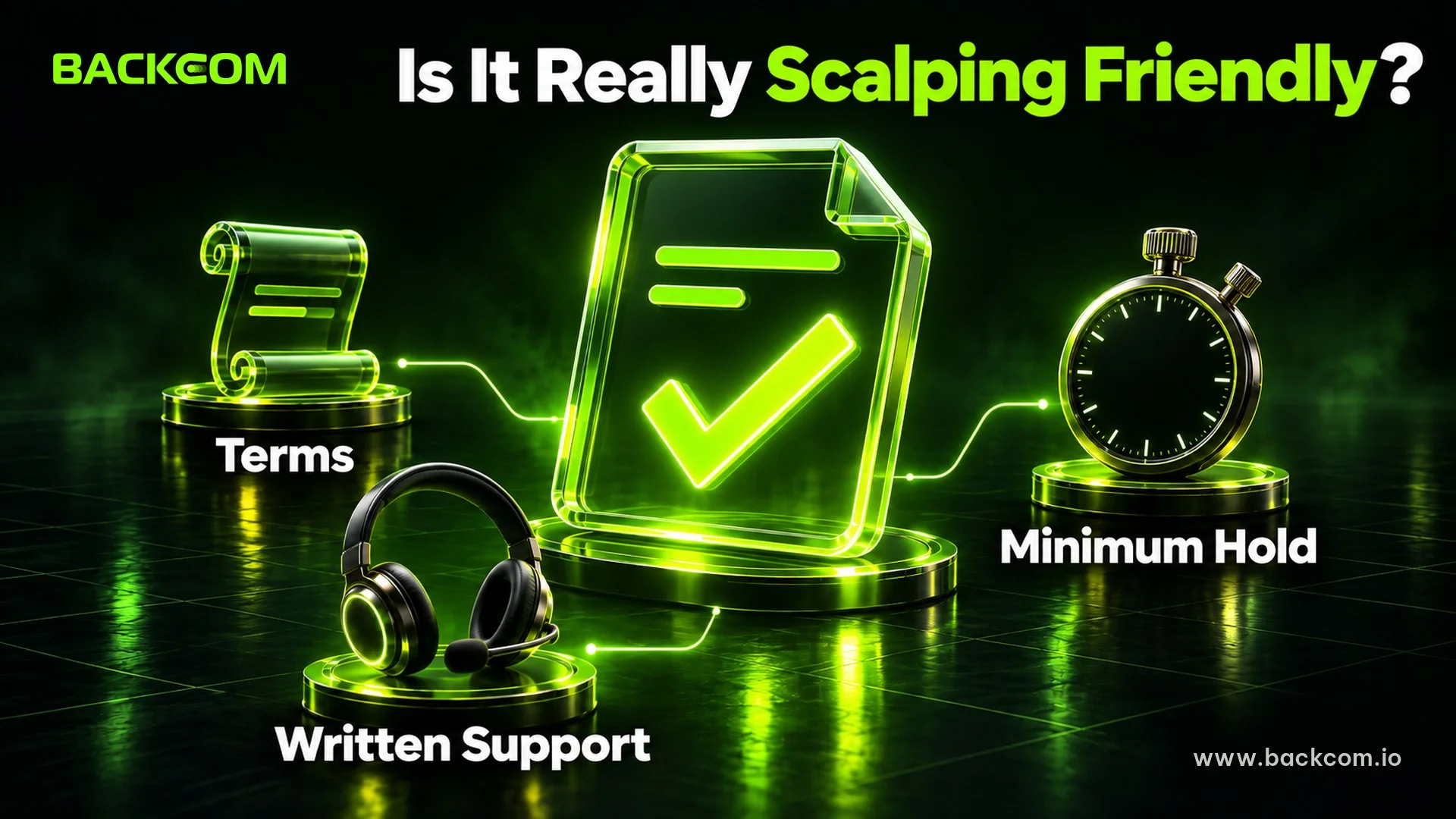
A forex broker for scalping is, first of all, one whose terms do not ban or penalise trades held for seconds to minutes. If the style itself is new to you, start with what scalping is and how scalpers trade. This is the exclusion criterion: if the terms restrict short trades, the other five criteria stop mattering.
The rule does not sit in one fixed place. Depending on the broker, it can appear in the client agreement, the order execution policy, the trading conditions of each account type or the support FAQ.
How To Tell If A Scalping Friendly Forex Broker Allows Short Trades
Whether a broker is scalping friendly can only be answered by the broker's own documents. Search them for these phrases:
- "Scalping", "high-frequency trading" or "abusive trading": shows how the broker names this style of trading.
- "Minimum holding time" or "minimum trade duration": shows whether a minimum time applies.
- "Latency arbitrage" or "price manipulation": shows which behaviour counts as abuse.
- Cancelled trades or adjusted profits: shows what happens if the broker decides a rule was broken.
If the documents are unclear, ask support in writing by live chat or email and keep the reply. A verbal answer from a phone call carries no weight in a dispute.
What A Minimum Holding Time Forex Broker Rule Changes For You
A minimum holding time is the shortest period a trade must stay open before it counts towards a result or an attached benefit. It can apply to the trading account itself, or only to an add-on such as rebates or bonuses.
Those are two different situations:
- Account terms: a breach can lead to adjusted trade results or account restrictions.
- Rebate or bonus conditions: a very short trade may not be counted, but the account carries on as normal.
Our guide to forex rebates for scalping covers the second case. This article deals only with the first: whether the broker accepts your strategy on the trading account itself.
2. What Does A Forex Broker For Scalping Really Cost Per Round Turn?

A low spread forex scalping broker is only cheap once spread and commission are counted for the full round turn, the opening and the closing side. A scalper may open dozens of trades a day, so every pip of cost is multiplied by the number of trades.
The working formula is:
Cost per round turn = Spread (pips) × Pip value + Round-turn commission
For EURUSD, one standard lot is worth about USD 10 per pip. The guide to what a pip is and how to calculate pip value covers other pairs.
Worked Example: Standard Versus Raw For The Same 1 Lot
The table uses assumed numbers to show the method. They are not any broker's published figures. Assume a Standard account with a 1.3 pip spread and no commission, and a Raw account with a 0.2 pip spread plus USD 6 commission for the whole round turn.
| Scenario (1 lot EURUSD, assumed) | Standard | Raw |
|---|---|---|
| Normal spread | 1.3 pips = USD 13 | 0.2 pips = USD 2 |
| Round-turn commission | USD 0 | USD 6 |
| Total cost | USD 13 | USD 8 |
| Break-even (pips) | 1.3 pips | 0.8 pips |
The numbers above are assumptions for illustration. Before comparing, take the real average spread and commission for the exact account type from the broker's own page, at the time you trade.
With a 5 pip target, worth USD 50 on 1 lot, Standard eats 26% of the target and Raw eats 16%. Over 15 round turns of 1 lot a day, the gap is USD 75 a day: USD 195 against USD 120.
Many traders miss what happens around news. If the Raw spread widens to an assumed 2.0 pips, the cost becomes 20 + 6 = USD 26, above normal Standard at USD 13, and Standard spreads usually widen then too. So a scalper should measure the spread at thin liquidity, not just the published average.
How To Measure The Real Cost Before You Choose
Real cost only appears when the trader records it. The simplest method has four steps:
- Open a demo account, or a small live account, of the exact type you plan to use.
- Record the spread of your main pair in three windows: the London session, the London and New York overlap, and just before major news.
- Take the real commission from the trade history, not from the marketing page.
- Work out the cost per round turn with the formula above and compare it with the pip target of your strategy.
Comparing several brokers by cost is covered in how to compare forex broker costs. A list of low spread brokers by published figures is in top low spread forex brokers, so this article does not repeat it.
3. How Does A Raw Account At An ECN Broker For Scalping Differ From Standard?
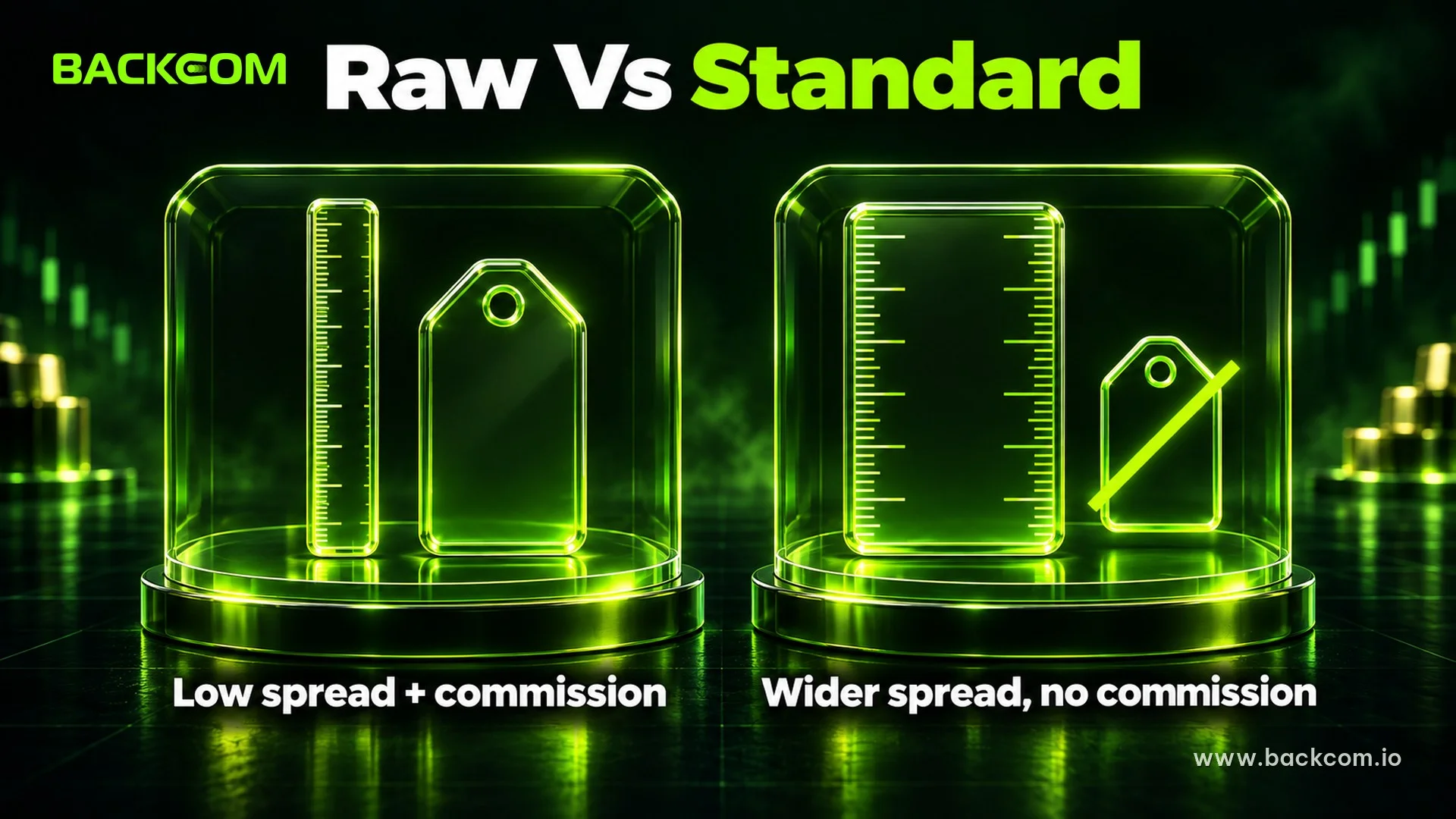
A raw spread account for scalping gives a very low base spread, sometimes close to 0 pips, and charges commission separately per lot. A Standard account folds the cost into the spread, so there is no separate commission, but the spread is usually wider.
Neither is always cheaper. What decides it is the actual spread, the commission and the volume each trader runs.
When A Raw Spread Account For Scalping Makes More Sense
Raw usually suits a scalper when all of these hold:
- Many trades: the profit target per trade is only a few pips.
- Large enough lots: the cost gap is measurable in dollars, not a few cents.
- Avoiding news minutes: that is when Raw spreads widen sharply.
- Accepting visible commission: in exchange for a spread close to interbank prices.
With small lots or few trades, the gap between the two account types may be a few cents per trade. Then execution quality and short-trade rules matter more.
ECN, STP And Each Broker's Naming
Account names differ by broker: Raw, Zero, ECN, Pro, Ultra Low. Do not infer the execution model from a name; read the broker's official description. The guide to what an ECN account is explains ECN, STP and market maker, and raw spread versus standard account real cost works through the numbers broker by broker.
4. How Do You Measure Execution Speed And Slippage?
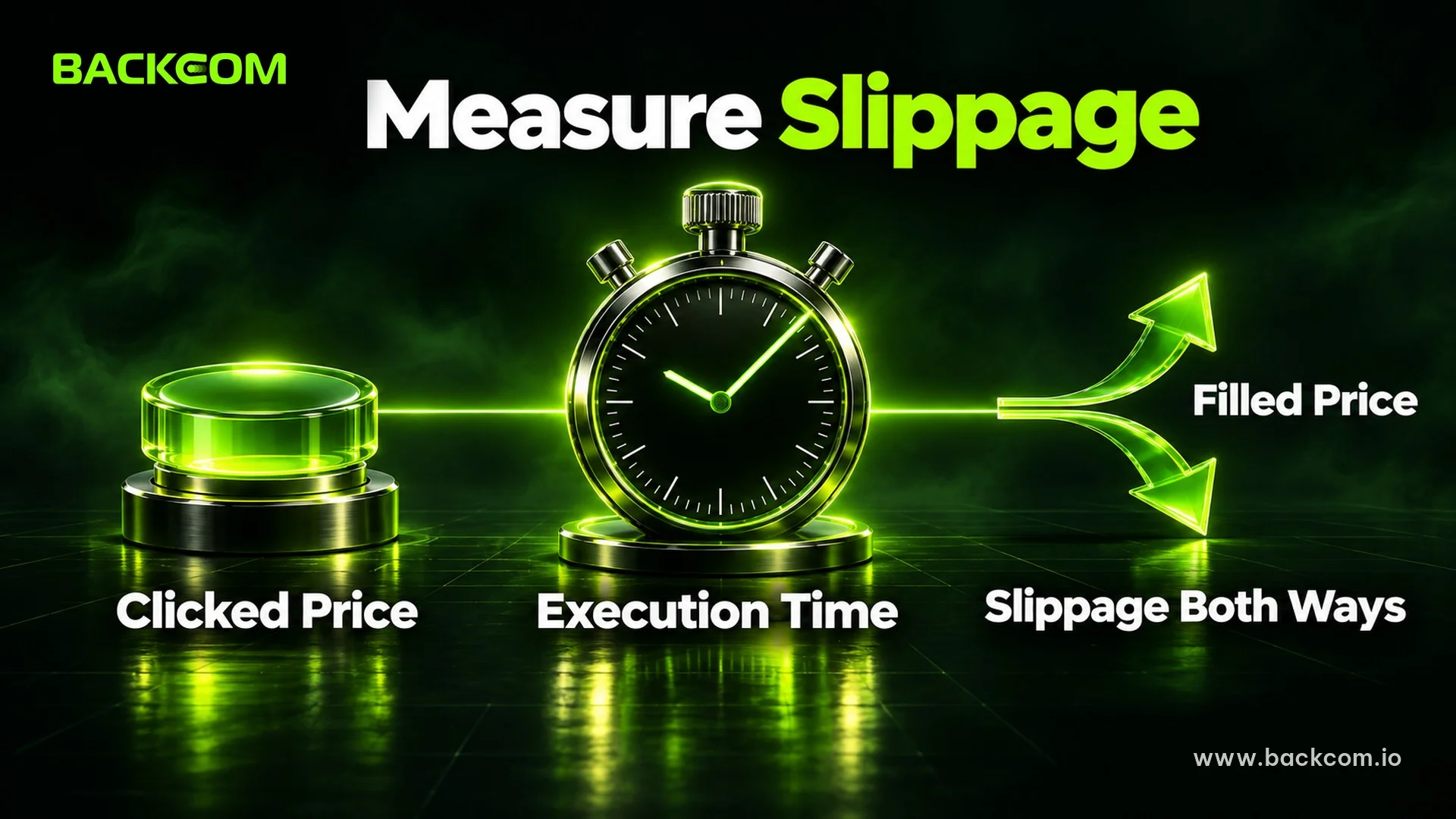
Execution speed is the time from the moment a trader clicks to the moment the broker confirms the fill, and slippage is the gap between the clicked price and the filled price. For a long-term position, a few milliseconds is minor. For a scalper aiming at 3–5 pips, one 0.5 pip slip is already about 10–17% of the target.
How Execution Modes Affect You
According to the Types of Execution section of the MetaTrader 5 help, read on 27 November 2026, the broker picks one of four execution modes for each symbol:
- Request: the trader asks the broker for a price first, then confirms or rejects it, and the market order fills at the price received.
- Instant: the order fills at the price attached by the platform, and if the broker does not accept it, a requote comes back.
- Market: the broker decides the fill price without further discussion with the trader.
- Exchange: the order is routed to an external trading system (a centralised exchange) and fills at the offers available there.
The mode determines how likely requotes and slippage are, and it is part of each symbol's specification on MT5. The guide to slippage in forex and how to reduce it shows how to limit it when entering.
A 30-Trade Test To See Whether Slippage Is Fair
Slippage is not a bad sign on its own, because the market moves between the click and the fill. What matters is that slippage should happen in both directions. If almost every fill is worse for the trader, that is a signal to question the broker.
A compact test looks like this:
- Use a live account with the smallest lot, and open and close at least 30 market orders at different times of day.
- Record the clicked price, the filled price and the difference for each trade.
- Count favourable slips, unfavourable slips and exact fills.
- Note the processing time shown in the MT5 Journal tab as well; it is measured on the trader's own computer, so treat it as a rough guide.
Thirty trades are not enough to judge a broker's quality, but they are enough to expose a clear pattern.
Latency From Your Own Side
Part of the delay sits with the trader, not the broker: network connection, a weak device or too many charts and EAs running at once. Rule these out before deciding that a broker fills slowly.
The article on forex broker platforms that lag or freeze helps separate network, device and broker causes. Traders running scalping EAs can also read forex brokers for EA trading and what a forex VPS is and how to use it.
5. How Do Stop Level And Freeze Level On MT5 Affect Scalping Orders?
The stop level is the minimum distance, in points, from the current price at which a stop order may be placed or Stop Loss and Take Profit changed. The freeze level is the distance within which trade operations are frozen. Both are symbol properties in the MQL5 reference, read on 27 November 2026.
A scalper should care because a scalper's Take Profit often sits very close to price. If the broker sets a large stop level, the order can be rejected with an "invalid stops" message, or cannot be modified while price is near the level.
Check these before funding the account:
- Stop level of your main pair: look it up in the symbol specification on MT5 and compare it with your usual Take Profit.
- Order limits: check the number of open positions or pending orders allowed at once, if the strategy needs many.
- Platform behaviour: try placing, modifying and cancelling orders on a demo account of the same type.
These settings can differ between account types at the same broker, so check the exact type you plan to use.
6. How Should A Forex Broker For Scalping Be Checked For Licence, Leverage And Withdrawals?
A forex broker for scalping needs a clearly licensed legal entity, a stop-out level that suits the lot size you plan to use and a withdrawal process you have tested with a small amount. A tidy spread means little if you cannot get your money back. For gold scalping, see trusted gold trading broker criteria.
Check three points before depositing:
- Licence and legal entity: find out which entity serves your account and which regulator licenses it. The steps are in how to check a forex broker licence.
- Leverage and stop-out level: a scalper using large lots on a small balance can hit a margin call quickly, especially when spreads widen on news.
- Deposit and withdrawal process: read processing times, fees and withdrawal conditions. Withdraw a small amount before sending a large one.
The general safety checklist is in the pillar article, reputable forex broker: 7 criteria. The six criteria here only add what is specific to short trades.
Frequently Asked Questions (FAQ) About Forex Broker For Scalping
Which Forex Broker Allows Scalping?
There is no universal list, because it depends on each broker's terms and on the account type. Read the client agreement, the order execution policy and the trading conditions, then ask support in writing if anything is vague. Keep the reply before you deposit.
Is A Low Spread Enough To Choose A Scalping Broker?
No. Spread is only part of the cost, and low spreads usually come with commission. A scalper should work out the total cost per round turn, measure spread at thin liquidity and test slippage. A low spread broker with poor fills can still cost more than a wider spread broker that fills steadily.
Should I Use A Raw Account For Scalping?
Many scalpers pick a Raw account because the spread is close to the base price, but Raw is not always cheaper. With small lots or few trades, Standard can be simpler because it has no separate commission. The surest way is to calculate the round-turn cost of both types using the broker's real figures.
How Can I Tell Whether A Broker Fills Fast Or Slow?
Measure it. Open and close about 30 small-lot trades at different times, and record the clicked price, filled price and processing time. Rule out your own network and device first. Slippage in both directions is normal; unfavourable almost every time is a sign to ask the broker.
Conclusion: Choose A Forex Broker For Scalping By Measurement, Not Advertising
Traders choosing a forex broker for scalping should weigh all six criteria: short-trade terms, total cost per round turn, account type (Raw or Standard), execution quality, stop levels on MT5 and the broker's safety basics.
Before depositing, do four things: read the terms and ask support in writing, work out the cost per round turn with real numbers, test about 30 small-lot trades, then withdraw a small amount.
Once you have a broker that fits, you can see rebate levels for each broker on the brokers page. Backcom.io is an independent introducing broker (IB/affiliate) of the brokers it lists; rebates are paid from the commission the broker pays Backcom.io, as set out in the risk disclaimer.
Disclaimer: This content is compiled by Backcom.io for information only and is not investment advice, a trading recommendation, or tax or legal advice. Leveraged forex trading carries a risk of losing your capital, and broker terms can change. Traders should check each broker's official documents before trading.
Was this article helpful?
Join The Backcom.io Community
Get the latest on trading rebates, trading tips, and broker deals — and connect with thousands of traders worldwide.

Backcom App
Track Your Rebates Every Day
Every rebate is visible by broker and by day. Manage your wallet and withdrawals in one place.
Open Backcom App