What Is Swing Trading? How To Swing Trade Forex And What Holding Trades Costs


A gold Buy held from Monday to Friday can cost several times more in swap than in spread. Held over the weekend, its Stop Loss can also fill far from the level you set if the market reopens with a gap. Understanding what swing trading is therefore also means understanding the cost and the risk of the days your trade stays open.
In this article, Backcom.io explains how to swing trade forex on H4–D1, compares swing trading vs day trading, works out the costs a swing trader pays and covers risk management when swing trading gold.
What Is Swing Trading? Holding Trades For Days To Weeks On H4–D1
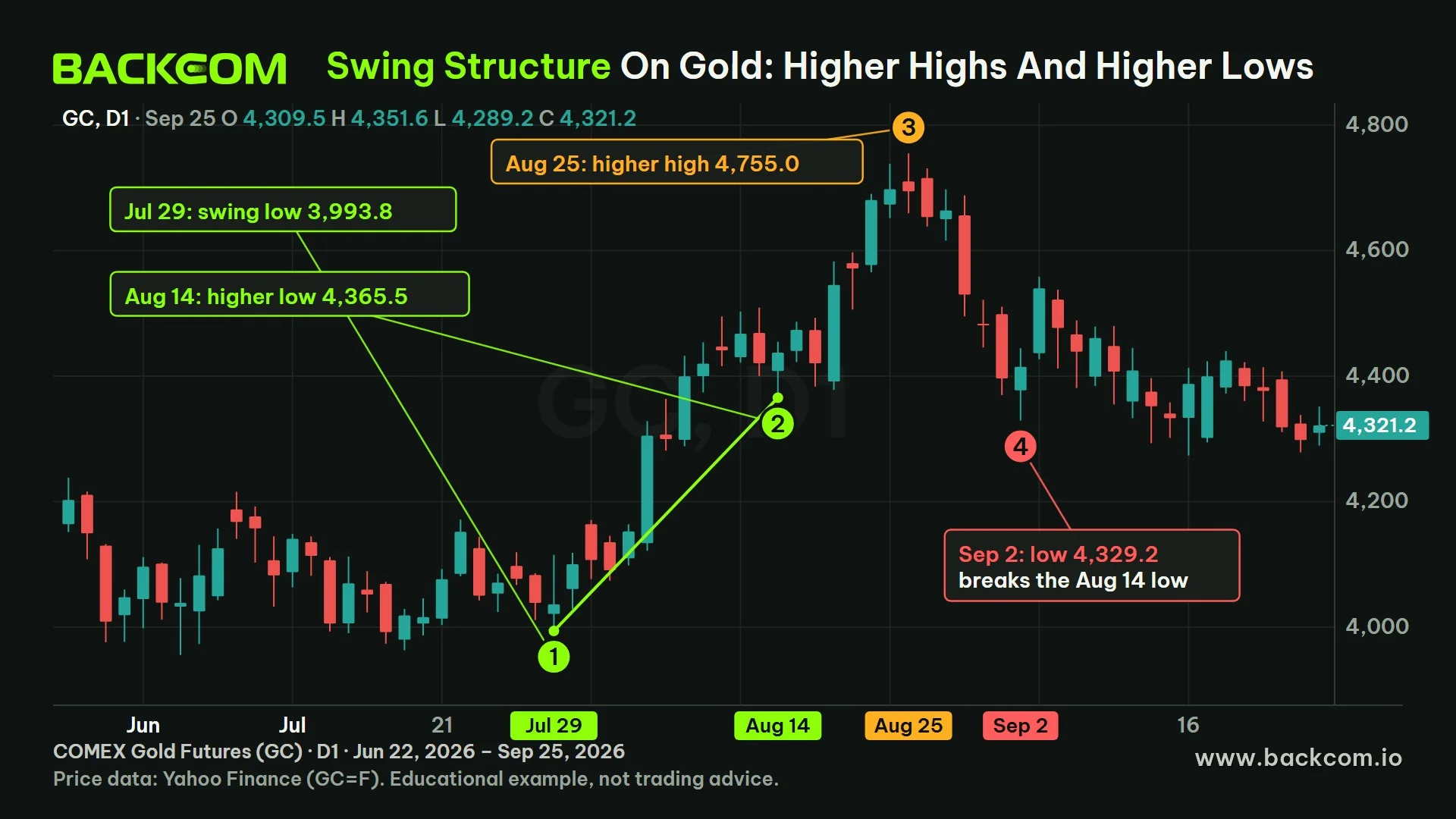
Swing trading is a style of holding trades for a few days to a few weeks to capture one price swing within a larger trend. Swing traders usually read the trend on D1, look for entries on H4 and accept that positions stay open overnight. The plan therefore has to include swap and weekend gap risk.
StockCharts ChartSchool uses 1–5 days as an example holding period for a swing trade, while Charles Schwab describes trades lasting several days or even a few weeks.
A real example on the gold futures (GC) daily chart: from a swing low of 3,993.8 on Jul 29, 2026, price made a higher low at 4,365.5 on Aug 14 and a higher high at 4,755.0 on Aug 25. The structure broke on Sep 2, when a low of 4,329.2 fell below the Aug 14 swing low.
Data: GC=F daily candles, Yahoo Finance, retrieved Nov 20, 2026; past prices, not a recommendation.
MetaTrader 5 offers 21 timeframes, from M1 to MN1. The style has four features:
- Overnight holding: a position can stay open through the swap cut-off and the Friday close.
- Analysis on H4–D1: charts are less noisy than minute charts, but price-based stops can be wider.
- Few trades: a swing trader may look for only a handful of setups each week.
- Scheduled monitoring: traders usually check the chart a few times a day instead of watching all session.
Swing Trading Vs Day Trading And Scalping: Holding Time, Trade Count And Costs
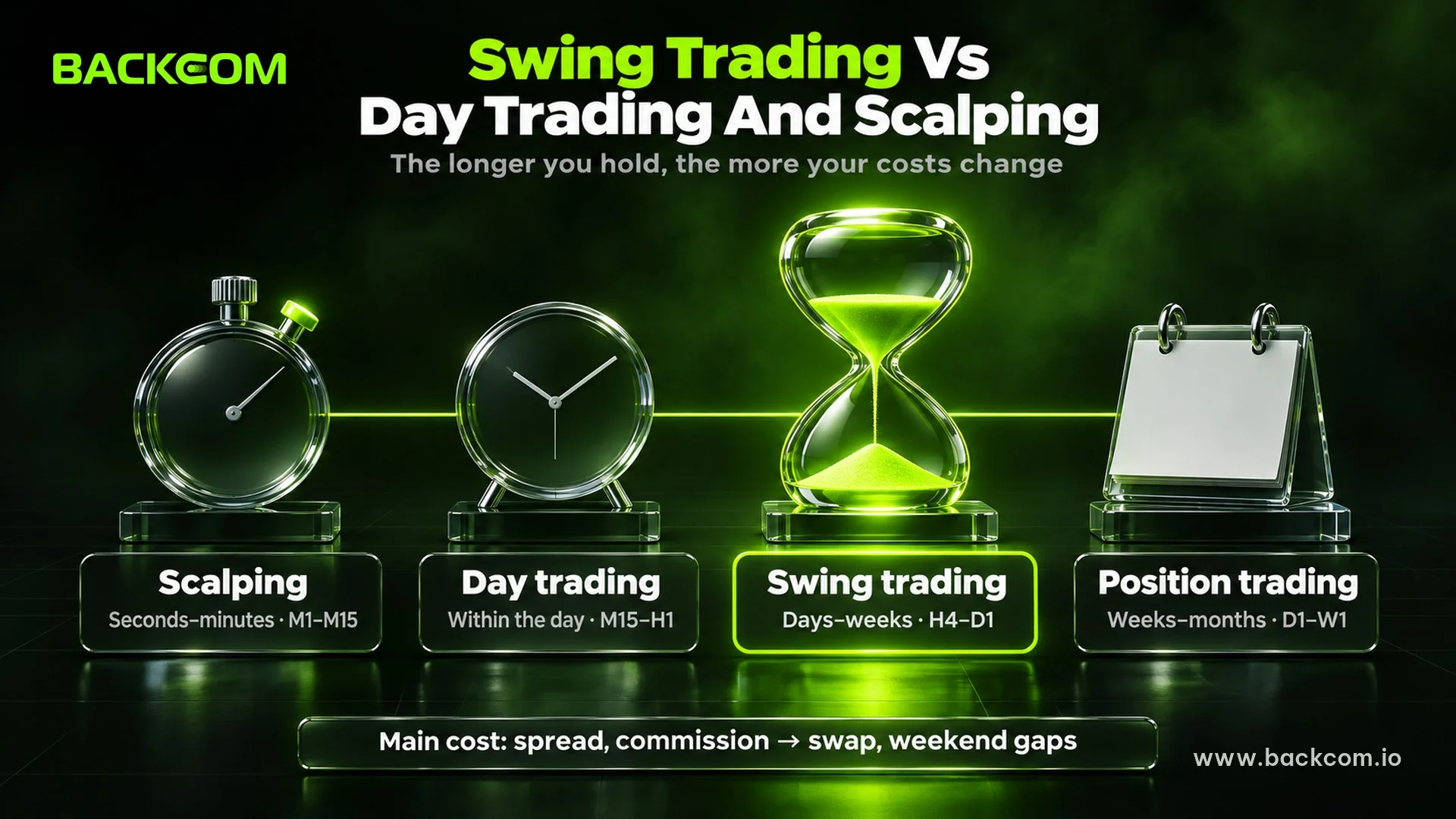
Swing trading vs day trading differs first in when the position is closed: day traders usually exit before rollover, while swing traders hold overnight. The table compares four styles:
| Criterion | Scalping | Day Trading | Swing Trading | Position Trading |
|---|---|---|---|---|
| Holding time | Seconds to minutes | Within the day | Days to weeks | Weeks to months |
| Common timeframes | M1–M15 | M15–H1, H4 for direction | H4–D1 | D1–W1 |
| Number of trades | Many per day | A few per day | A few per week | Very few* |
| Stop Loss | Very tight | Tight | Wider, with a smaller lot | Widest* |
| Main cost | Spread, commission | Spread, commission | Swap, weekend gaps | Accumulated swap |
| Weight of per-lot rebates | Large* | Significant* | Small next to swap* | Very small* |
| Monitoring time | Constant | Throughout the trading day | A few times a day | Low |
Compiled from StockCharts ChartSchool, Charles Schwab and cost mechanics; style boundaries are not fixed. Cells marked * are inferred from how costs work, not published figures.
StockCharts uses 1–5 days as an example for swing traders and 1–8 weeks for position traders, and describes day traders as using intraday charts with very tight stops. See Arthur Hill on Goals, Style and Strategy on StockCharts ChartSchool.
Three practical differences stand out:
- Scalping vs swing: a scalper pays the spread many times, while a swing trader pays swap every night.
- Day trading vs swing: day traders usually avoid swap and weekend gaps but have to watch the market more closely.
- Position trading: swap can build up over many weeks, so check the symbol's swap rate.
How To Swing Trade Forex: Trend, Pullback And Entry
To swing trade forex, start from the larger trend and only then choose an entry, in five steps:
- Identify the trend on D1: higher highs and higher lows point to an uptrend, lower highs and lower lows to a downtrend.
- Wait for a pullback on H4: in an uptrend, watch for price returning to support; in a downtrend, watch for a rally into resistance.
- Choose the entry type: a bounce is when price touches a zone and turns, a breakout is when price moves through it. A Limit order may not fill, while a Stop order can slip.
- Set the Stop Loss and target: for a bounce, the target can be the opposite zone. For a breakout, the distance between the two zones helps estimate the target.
- Size the lot from the stop distance: a stop beyond an H4–D1 zone can sit far from the entry, so reduce the volume to keep the same risk.
See The Ins and Outs of a Swing Trade by Charles Schwab.
Note: this is a framework, not a trading signal. A pullback can turn into a reversal, and no win rate is guaranteed.
Holding Costs For A Swing Trader: Swap, Weekend Gaps And Opening Spreads
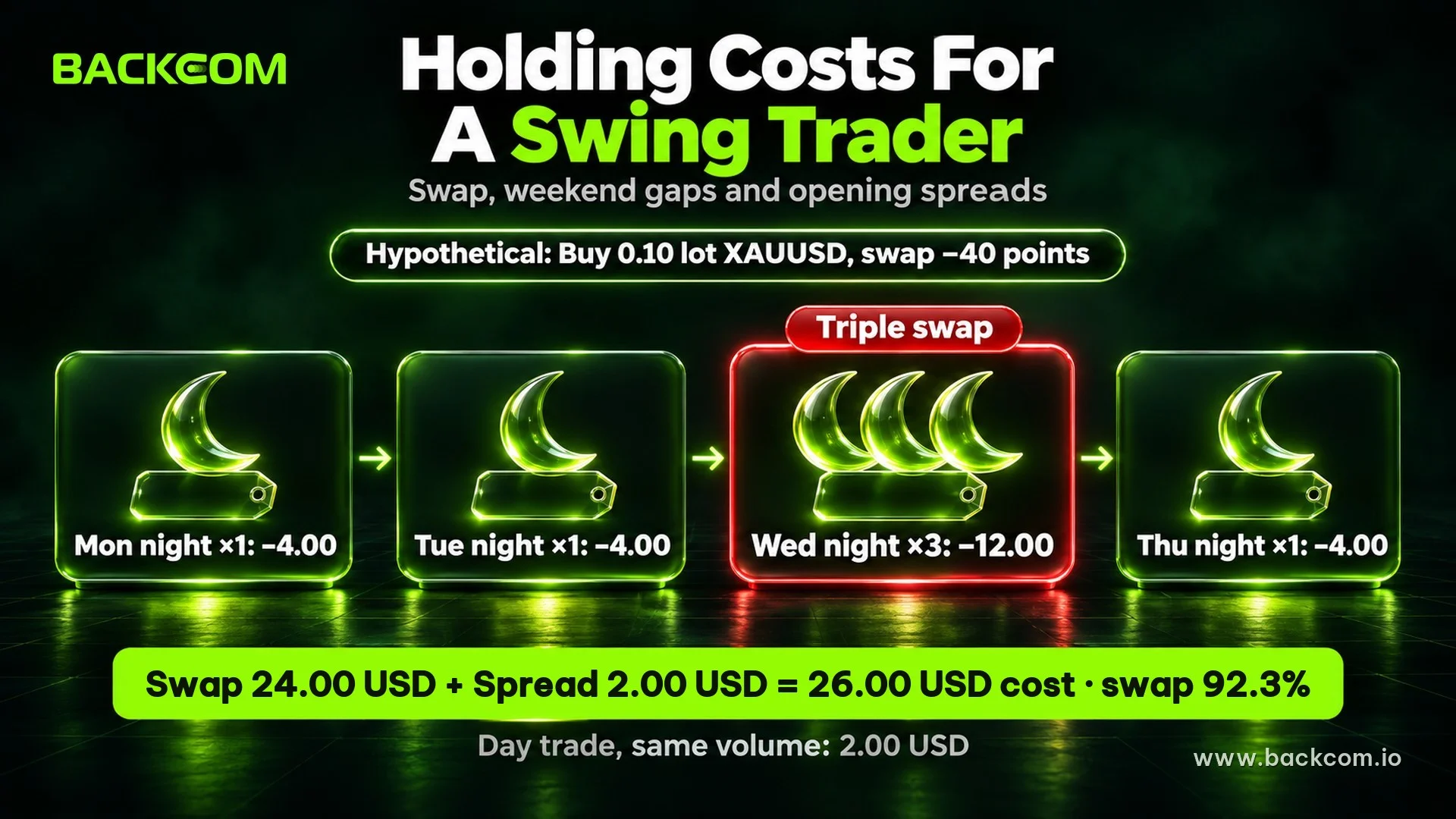
For a swing trader, swap can outweigh the spread when a trade is held for several days. Three items need to be counted:
- Swap: rollover usually happens at 00:00 server time, around 21:00 or 22:00 UTC depending on the season. For servers set to the New York close, rollover was at 21:00 UTC in the week of Oct 26–30, 2026 and at 22:00 UTC from Nov 2, 2026. Forex and gold usually charge triple swap on Wednesday night because of T+2 settlement. See our swap in forex guide.
- Weekend gaps: the opening price after the weekend can jump past your Stop Loss and fill it far from your level.
- Wider spreads: thin liquidity can widen the spread, and a Sell order's Stop Loss is triggered by the Ask even though the chart usually shows the Bid.
If the Swap type is in points, you can estimate:
Swap = Swap (points) × Contract size × Point size × Lots × Swap days
A normal night counts as 1 and Wednesday night counts as 3. A trade opened on Monday and closed on Friday therefore carries 1 + 1 + 3 + 1 = 6 swap days.
Cost Example For Swing Trading Gold Over 5 Days: Swap Makes Up 92.3%
Assume XAUUSD has a contract size of 100 oz per lot, two-decimal quotes and 1 point equal to 0.01 USD. A 0.10 lot Buy at 4,150.00 has a Swap Long of −40 points per lot per day, a spread of 0.20 USD/oz and no commission. Each swap day costs −40 × 0.10 = −4.00 USD, and the spread costs 0.20 × 100 × 0.10 = 2.00 USD.
| Point In The Week | Swap Multiplier | Swap On 0.10 Lot | Cumulative Swap | Note |
|---|---|---|---|---|
| Monday: open the trade | — | — | — | Pay 2.00 USD spread |
| Monday night rollover | 1 | −4.00 USD | −4.00 USD | 21:00–22:00 UTC |
| Tuesday night rollover | 1 | −4.00 USD | −8.00 USD | |
| Wednesday night rollover | 3 | −12.00 USD | −20.00 USD | Triple swap for T+2 |
| Thursday night rollover | 1 | −4.00 USD | −24.00 USD | |
| Friday: close the trade | — | — | −24.00 USD | Total cost 26.00 USD |
Swap, spread and prices are hypothetical, not any broker's rates or a broker comparison.
Swap of 24.00 USD makes up 92.3% of the 26.00 USD total cost, 12 times the spread. Other scenarios:
- Hold until Monday: the Friday night rollover takes swap to −28.00 USD and the total cost to 30.00 USD.
- Close the same day: with no rollover, the hypothetical cost is just the 2.00 USD spread.
- Sell instead: a hypothetical Swap Short of +12 points adds +7.20 USD over six swap days. That credit can change and is not a reason to enter.
- Reduce to 0.03 lot: holding until Friday costs 7.80 USD, made up of 0.60 USD spread and −7.20 USD swap.
What Do Per-Lot Rebates Mean For A Swing Trader?
Rebates are calculated on eligible volume, win or lose, as a forex rebate per lot shows:
Rebate = Total eligible lots × Rebate rate in USD per lot
A swing trader's single 0.10 lot trade counts as 0.10 lot whether it is held one night or five. A day trader who places 25 trades of 0.10 lot has traded 25 × 0.10 = 2.5 lots, so under the same conditions the rebate is 25 times larger.
From the per-lot mechanism, you can infer that rebates do not grow with the number of nights held, while swap keeps accruing. Count spread, commission, swap and rebates together.
Risk Management When Swing Trading Gold: Wide Stops, Small Lots, Trailing Stops
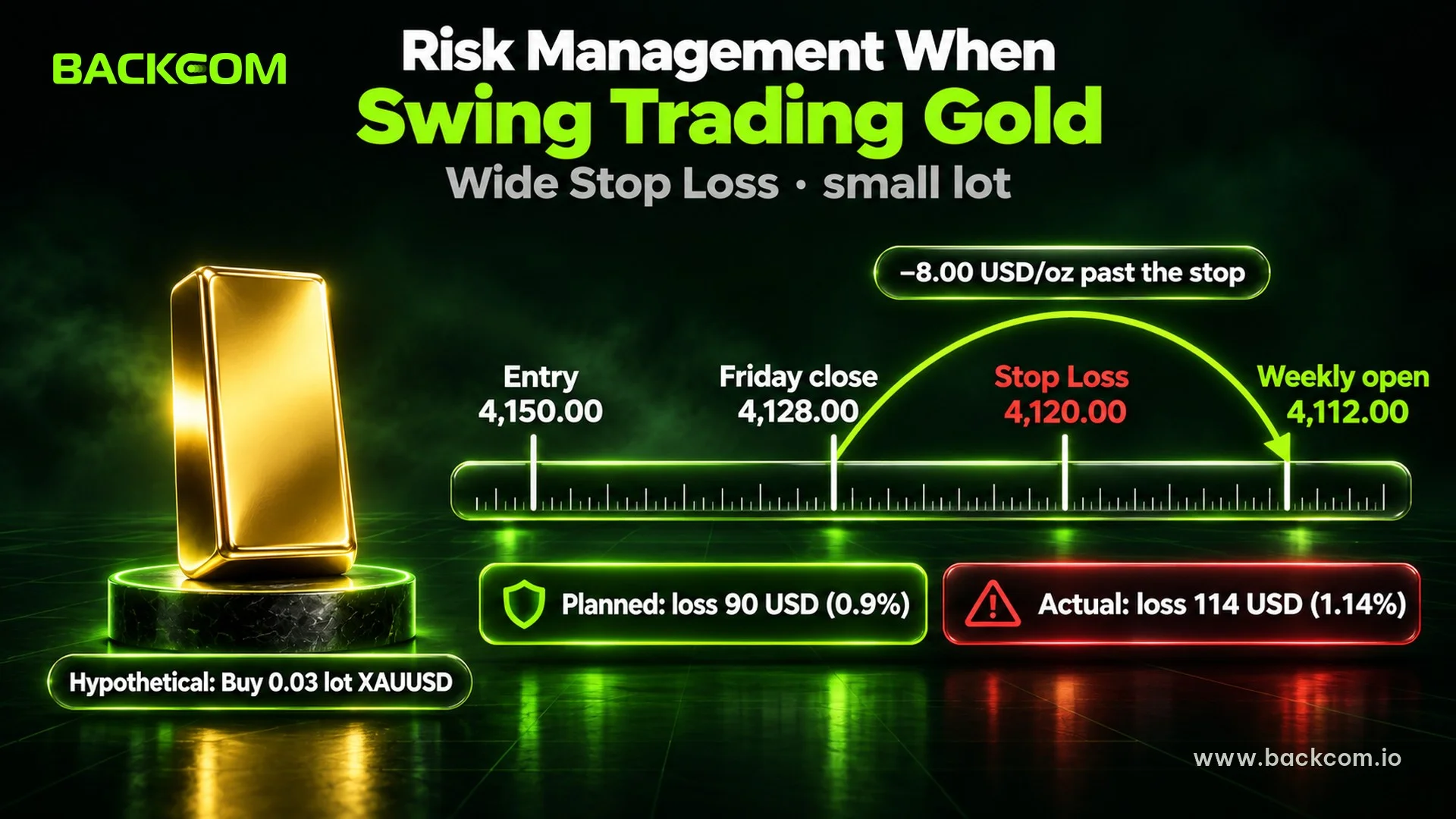
When swing trading gold, a Stop Loss placed beyond an H4–D1 zone can sit far from the entry, so the lot must shrink to keep the same risk.
A Wide Stop Loss Means A Small Lot: The 1% Rule In Practice
The 1% rule caps the planned loss on a trade at 1% of the balance, not 1% of the volume (see the 1% rule and lot sizing).
With 100 oz per lot, calculate from the distance in USD/oz:
Lot = Amount at risk ÷ (Stop Loss distance in USD/oz × 100)
A hypothetical 10,000 USD account has a 1% risk budget of 100 USD:
| Trade Type | SL Distance (USD/oz) | Calculated Lot | Lot Used (Rounded Down) | Loss If SL Is Hit | Share Of Account |
|---|---|---|---|---|---|
| Gold day trade | 8 | 0.125 | 0.12 | 96 USD | 0.96% |
| Swing trade on H4–D1 | 30 | 0.0333 | 0.03 | 90 USD | 0.90% |
When the stop widens from 8 to 30 USD/oz, the lot falls from 0.12 to 0.03. Both stop distances are hypothetical, not trade recommendations.
Weekend Gaps Can Push A Loss Past 1%
Assume a Buy of 0.03 lot at 4,150.00 with a Stop Loss at 4,120.00 and a planned loss of 90 USD, or 0.9% of the account. Gold closes on Friday at 4,128.00, but the first Bid after the weekend is 4,112.00. A Buy closes on the Bid, so the loss is (4,150 − 4,112) × 100 × 0.03 = 114 USD, or 1.14%.
The loss overshoots the plan by 24 USD, nearly three times the −8.40 USD swap for holding the full week. Charles Schwab notes that a stop order becomes a market order once triggered, so it can fill far from the expected price.
You can reduce the risk by:
- Reviewing the trade: decide whether to hold, reduce or close before the market break and before major news.
- Leaving room for a gap: the lot should still be acceptable if the fill comes in worse than the Stop Loss.
- Remembering the reopening time: forex usually reopens around 21:00–22:00 UTC on Sunday.
A Trailing Stop On A Swing Trade Only Works While MT5 Is Running
A Trailing Stop moves the Stop Loss as price moves in your favour, but MetaTrader 5 handles this function in the terminal. For each position, the trailing level moves no more than once every 10 seconds. Source: Trailing Stop section of the MetaTrader 5 documentation.
Note: when MT5 is closed, the trailing stops moving, but the last Stop Loss level stays in force. To keep the trailing running, the desktop MT5 has to stay connected, usually on a VPS.
The trailing distance for a swing trade should be wider than the normal range of an H4 candle, as our guide to setting a trailing stop on MT5 explains.
Frequently Asked Questions (FAQ) About Swing Trading
Does Swing Trading Suit People With A Full-Time Job?
It often can, because you check H4–D1 charts a few times a day instead of watching the screen all session. In exchange, overnight positions pay swap and can be hit by gaps. Test the plan on a demo for a few weeks and log the actual fills.
Should A Swing Trader Use H4 Or D1?
A swing trader usually uses both: D1 to identify the trend and H4 to choose entries and exits. Switching timeframes constantly makes a plan inconsistent. H4 candles close according to server time, so fix your checking schedule before you open a trade.
Should You Hold A Swing Trade Over The Weekend?
You can hold over the weekend if the expected risk is acceptable. In forex, Stop Loss and Take Profit orders carry over into the new day but are only processed when the market reopens. In the example above, holding longer took swap on 0.10 lot from −24.00 to −28.00 USD.
Can You Hold Swing Trades Overnight Or Over The Weekend With A Prop Firm?
According to the FAQ of FTMO's US version (FTMO x OANDA), the restriction on holding positions over market breaks longer than two hours does not apply during the Challenge or Verification stages or on a Swing account. The Swing account type also cuts leverage from 1:100 to 1:30. Read the rules before buying a challenge, and still account for swap and gaps.
Can Rebates Offset Swap When Swing Trading?
Partly, but per-lot rebates do not increase with the number of nights a trade is held. A 0.10 lot trade held for one night or five has the same volume, while the gold example generated 24.00 USD in swap. Check Swap Long and Swap Short before holding a position overnight.
Conclusion
In short, swing trading means holding trades for a few days to a few weeks to capture one swing within a larger trend. When you swing trade, weigh the D1 trend, the Stop Loss, the lot size and the holding costs. That is the practical difference when you compare swing trading vs day trading.
You can compare your costs with the forex rebate table per lot for each broker. Backcom.io is an independent introducing broker (IB/affiliate) of these brokers; rebates are paid from the commission the broker pays Backcom.io — see the risk disclaimer.
Disclaimer: This content is compiled for information only and is not investment advice or a trading signal. The prices, spreads, swaps and gaps in the examples are hypothetical. Leveraged forex and gold trading can cost you all of your capital.
Was this article helpful?
Join The Backcom.io Community
Get the latest on trading rebates, trading tips, and broker deals — and connect with thousands of traders worldwide.

Backcom App
Track Your Rebates Every Day
Every rebate is visible by broker and by day. Manage your wallet and withdrawals in one place.
Open Backcom App