Quarterly Futures Vs Perpetual Futures: Expiry, Funding And Cost Differences

Summary
Quarterly futures expire on a fixed date and settle in cash, while perpetual futures never expire and use funding payments to stay near spot. The cheaper contract depends on how long you hold, the funding rate and the basis at entry.
Quarterly futures vs perpetual futures is one of the first choices a crypto derivatives trader faces, and it is easy to get wrong. Both contracts let you trade price with leverage, but they handle time in opposite ways. A quarterly futures contract expires on a fixed date and settles in cash, while a perpetual futures contract never expires and relies on funding payments to stay close to spot. In this article, Backcom.io compares expiry, settlement, funding, basis and rollover, then works through a hypothetical cost example so you can see which contract fits a given holding period.
1. What Is The Difference Between Quarterly And Perpetual Futures?
The core difference is the expiry date. A quarterly contract, also called a delivery or fixed-term contract, ends on a set day. A perpetual contract has no end date, so you can hold it for as long as your margin allows. Our guide to perpetual futures covers that second type in detail.
According to Kraken's fixed-term futures guide, the most common expiry cycle is March, June, September and December, which is why these contracts are called quarterly. Everything else on the comparison table follows from that one feature:
| Feature | Quarterly futures | Perpetual futures |
|---|---|---|
| Expiry | Fixed date each quarter | None |
| Price anchor to spot | Converges as expiry nears | Funding payments |
| Periodic funding | No | Yes, at fixed intervals (often 8 hours, varies by contract) |
| Holding cost | Basis paid at entry and at each roll | Funding paid or received |
| Rollover needed | Yes, to keep exposure | No |
| Settlement | Cash at the settlement price | Not applicable while open |
Reference only, based on exchange documentation read on 27 November 2026. Details differ by exchange and contract, so check the current contract page before trading.
Are Delivery Futures Crypto Contracts The Same Thing?
Yes. Delivery futures crypto contracts are simply another name for quarterly or fixed-term contracts, because they close out on a delivery date.
If you are still choosing between derivatives and the underlying coin, read spot versus futures trading in crypto first.
2. How Does Futures Expiry Settlement Work On Quarterly Contracts?
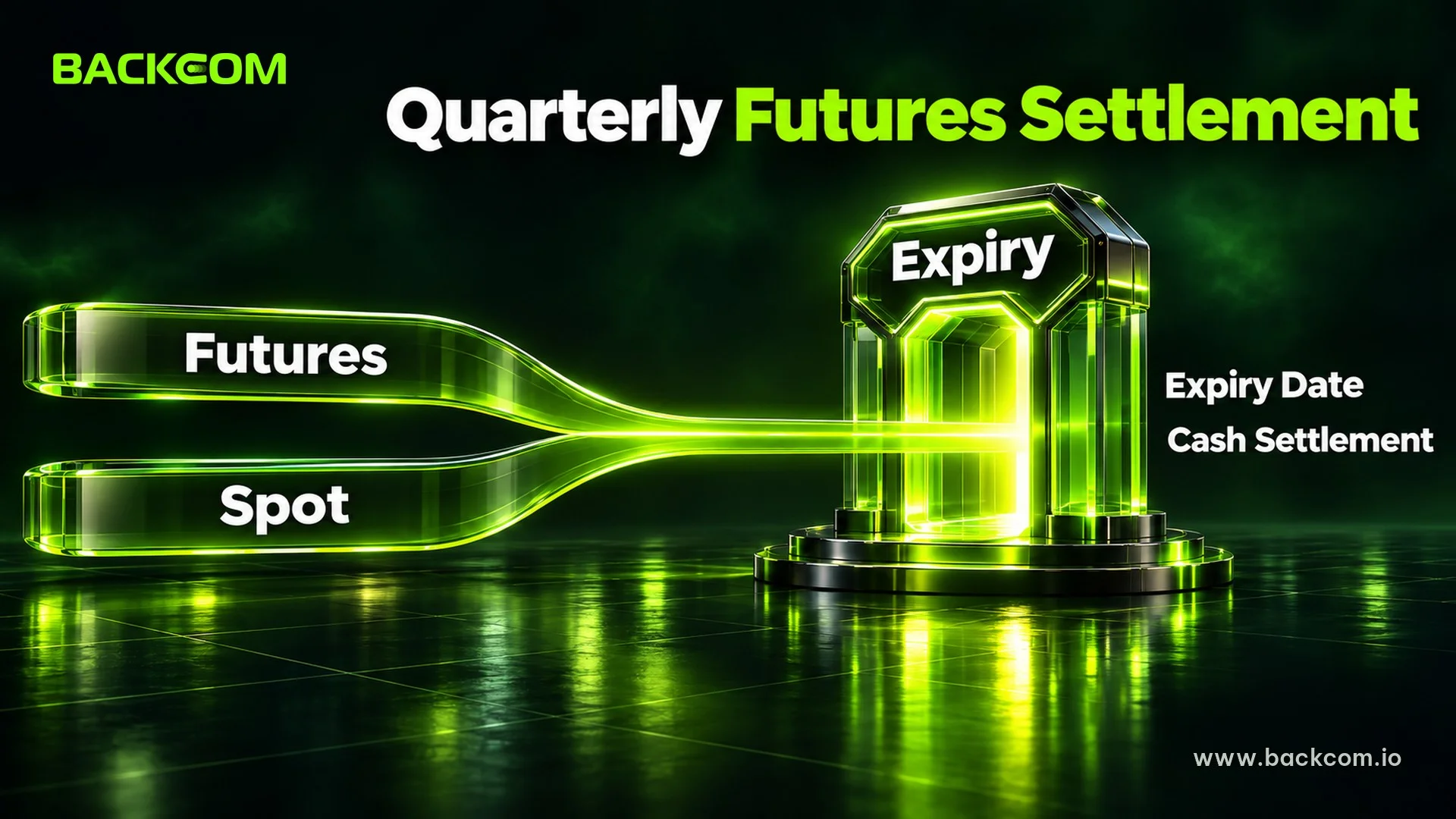
Settlement is the process that closes every open quarterly position at a reference price on expiry day. Kraken states that its fixed-term contracts settle in cash: the difference between your entry price and the settlement price is credited to or debited from your account, and no coin is delivered. The settlement price usually comes from an index or reference rate at a point on expiry day, not from the last traded price.
Binance documents the rules for its quarterly contracts in a delivery and settlement FAQ. As of the page update on 2 January 2026, the main points are:
- Expiry time: the last Friday of each calendar quarter at 08:00 UTC.
- Settlement price: the average of the per-second price index over the final 30 minutes, from 07:30 to 08:00 UTC.
- Settlement fee: charged at the same rate as the taker fee.
- Last minutes: from 10 minutes before delivery, you can only reduce or close positions, not open new ones.
- Naming: contracts carry a month and year code, such as BTCUSD 0925.
Binance also says it may delay settlement in extreme cases of market manipulation. The page itself carries a warning that its content can be out of date, so treat these details as an example of how settlement works rather than a permanent rule.
An averaged settlement price matters because it smooths out a single sharp print. It also means the final price you receive is not necessarily the price you could have sold at on the last tick.
3. Why Do Perpetual Futures Need Funding And Quarterly Futures Do Not?
Funding is the mechanism that replaces expiry for perpetual contracts. Without an end date, nothing forces a perpetual price toward spot. So exchanges move a periodic payment between longs and shorts. When the perpetual trades above spot, longs usually pay shorts, and the reverse when it trades below. Our funding rate guide explains how the rate is built.
A quarterly contract does not need that payment. Kraken notes that fixed-term futures converge to spot as expiry approaches through arbitrage, rather than through funding. At expiry the contract is settled against the index, so the gap must close. Binance's educational blog adds that quarterly contracts do not carry a funding fee, which can suit longer-term traders because funding can change from one period to the next.
The cost does not disappear, though. It moves from a stream of small payments into the basis, which is the next section.
4. What Is Quarterly Futures Basis And How Does It Change Your Cost?
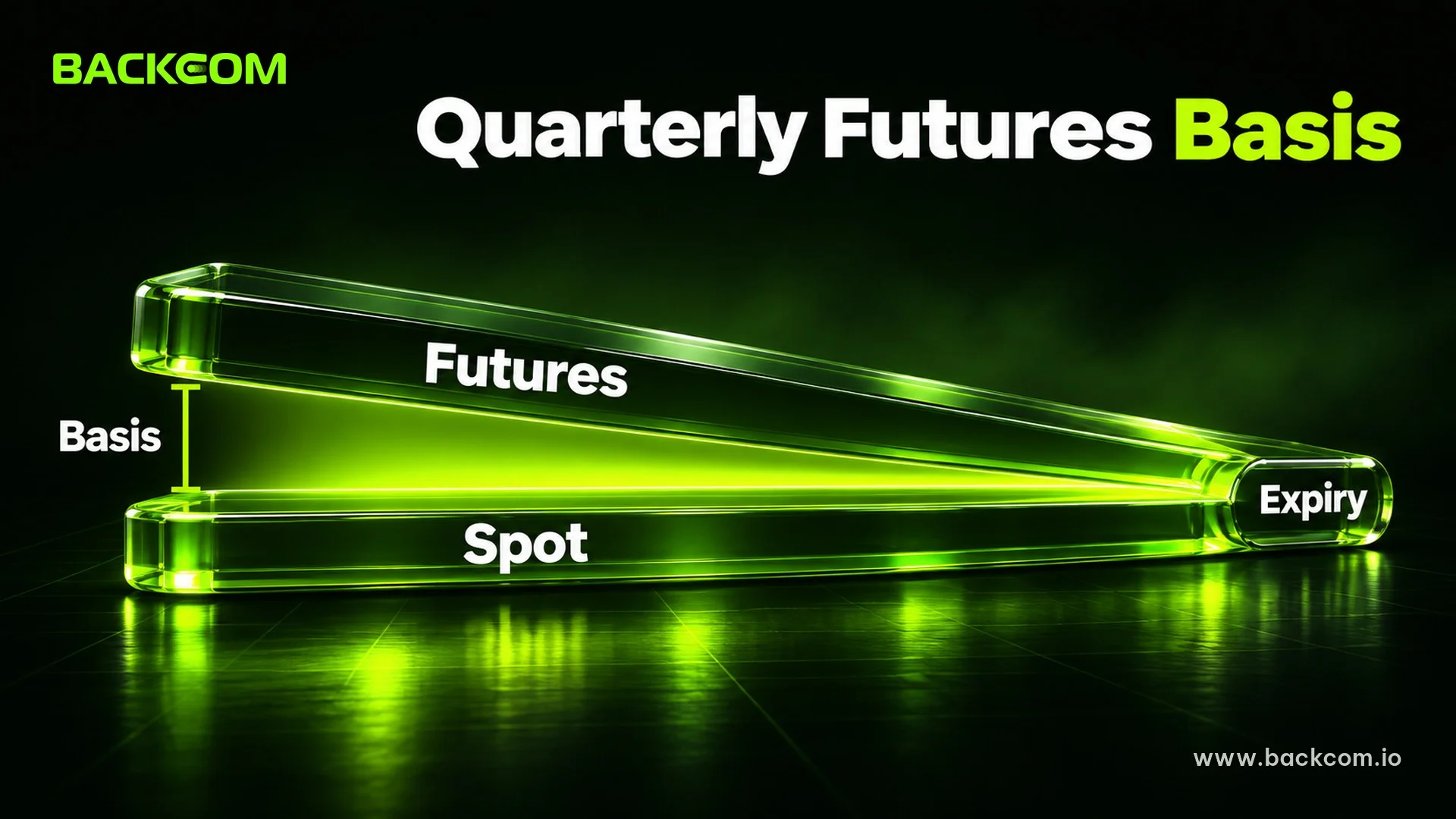
Basis is the price gap between a futures contract and the spot market. Binance's blog describes it as the difference between the futures price and the underlying spot price, and says it is typically positive and larger the further away the expiry date is. A positive basis, where futures trade above spot, is often called contango. A negative basis is called backwardation.
For a quarterly long position, basis works like a built-in cost. If you buy at a premium and spot does not move, the premium shrinks to zero by expiry, so you lose the amount you paid above spot. For a short position the same shrinking gap works in your favour. For the strategy that exploits this gap, see our article on what basis trading is in crypto.
Basis is usually quoted in annualised terms so you can compare it with a funding rate:
Annualised basis = (Futures price − Spot price) ÷ Spot price × 365 ÷ Days to expiry
The number is a snapshot. It changes with demand for leverage, interest rates and market mood, and it can turn negative during sharp sell-offs.
5. How Do The Holding Costs Compare In A Worked Example?
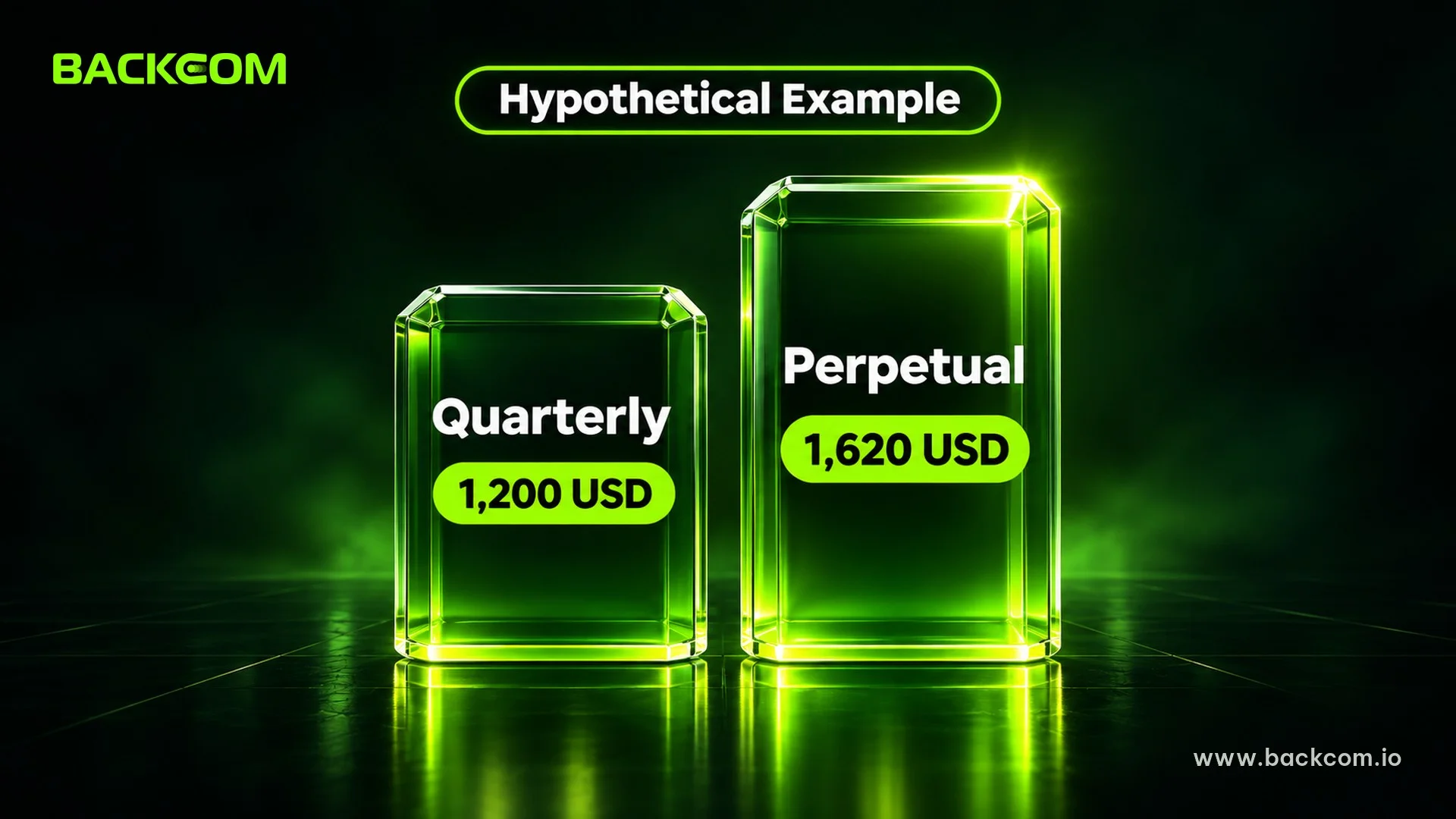
The example below uses hypothetical numbers to show the structure of the calculation. It is not a forecast and not a recommendation. Assume Bitcoin spot is USD 60,000, the quarterly contract trades at USD 61,200 with 90 days to expiry, and the perpetual funding rate is a steady 0.01% every 8 hours.
| Item | Quarterly long | Perpetual long |
|---|---|---|
| Entry price | USD 61,200 | USD 60,000 |
| Position size | 1 BTC | 1 BTC |
| Premium over spot at entry | USD 1,200 (2.0%) | None |
| Funding over 90 days (0.03% a day) | None | About USD 1,620 |
| Cost if spot stays flat for 90 days | About USD 1,200 | About USD 1,620 |
Hypothetical example for illustration. Assumes spot is unchanged, funding stays constant and ignores trading fees. Real funding and basis change constantly.
The annualised basis here is 2.0% × 365 ÷ 90, which is about 8.1%. The funding rate of 0.03% a day equals about 11% a year. On these numbers, holding the quarterly contract for the full 90 days costs less than holding the perpetual. That result flips easily:
- If funding falls toward zero or turns negative, the perpetual becomes the cheaper long, and longs may even get paid.
- If the basis at entry is much wider, the quarterly premium can exceed the funding you would have paid.
- If you hold for only 10 days, you keep just the part of the quarterly premium that has narrowed by then, roughly USD 133 if it shrinks evenly, against about USD 180 of funding on the perpetual. Both contracts also pay trading fees to open and close, so on short holds the fee and spread often matter more than the carry gap.
Price direction is a separate matter. In this example the cost is measured against spot, so a rise or fall in the coin's price changes profit and loss for both contracts alike. Use our guide to calculating crypto futures trading fees to add the fees for your own exchange.
6. What Does Rollover Cost When You Hold A Quarterly Contract?
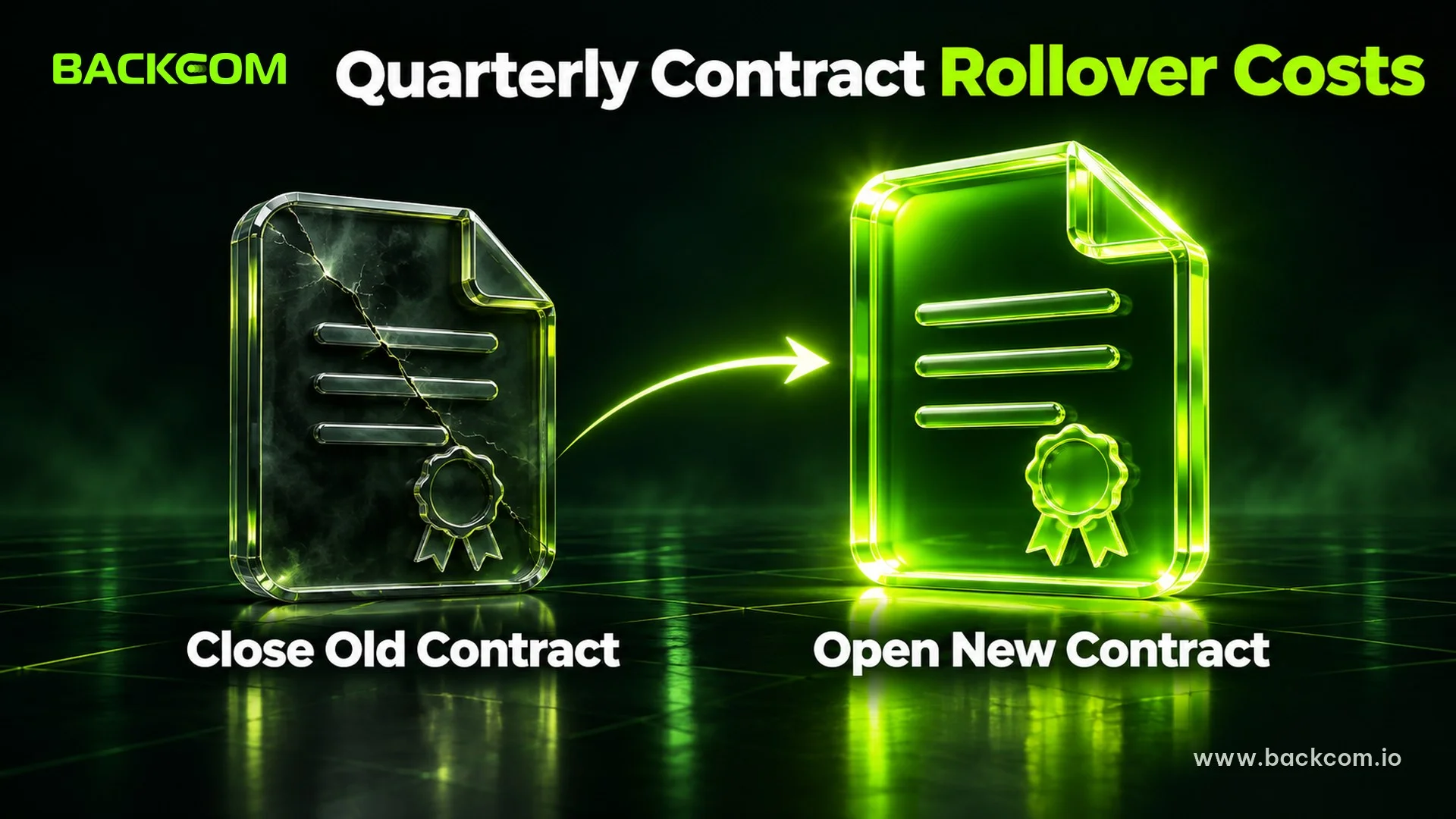
Rollover means closing a contract near expiry and opening the next one to keep the same exposure. Binance's blog gives the example of selling 10 September contracts and buying 10 December contracts at the same time. Kraken adds that rollover is usually done days to weeks before expiry, and that rolling too late can mean poor fills when liquidity thins out.
Each roll has three costs:
- Trading fees on two orders. At an assumed taker fee of 0.04% per order, a roll of USD 60,000 notional costs about USD 48 in fees. Our explanation of maker versus taker fees shows how order type changes that figure.
- Spread and slippage. Two orders must fill, and spreads widen in the last days of a contract.
- The new basis. Kraken notes that in contango the roll costs money, and in backwardation it can return a small credit.
A perpetual avoids rollover but never stops charging or paying funding. For a trade held for a year, a quarterly position needs about four rolls, while a perpetual needs none.
7. What Are The Risks Specific To Each Contract Type?
Each contract type hides a different kind of risk, and neither is safer by default. The main ones are:
- Funding shock (perpetual): a crowded market can push funding up sharply, and you pay it every interval you hold.
- Expiry and settlement (quarterly): an open position is closed automatically at the settlement price. You can miss a move you meant to hold through.
- Basis risk (quarterly): the premium you pay at entry may be wasted if basis narrows faster than expected.
- Liquidity (quarterly): volume often concentrates in the nearest contract, so farther dates can have wider spreads.
- Margin type: some quarterly contracts are coin-margined. Binance's blog notes that COIN-M contracts are margined and settled in the coin itself, so your collateral moves with the price.
Both types can be liquidated. Leverage, margin mode and maintenance margin work the same way on either, so see how to calculate liquidation price and what leverage is in crypto trading before sizing a position. You can also judge how crowded the market is by reading open interest.
8. Perpetual Vs Delivery Futures: Which Contract Fits Which Holding Period?
The right choice depends on how long you plan to hold and what you want the contract to do. Use these questions as a checklist:
- How long will you hold? For days, funding is small, and the perpetual avoids rollover and keeps the choice of exit open. For months, compare the annualised basis with the funding rate.
- Do you want to avoid funding payments? A quarterly contract has none, which makes costs easier to fix in advance.
- Are you hedging a known date? A contract expiring after that date can match it more cleanly.
- Are you willing to roll? Rolling adds fees and slippage several times a year.
- What does the current basis say? A wide premium means a quarterly long starts at a cost; a negative basis reverses that.
- Does your platform offer both? Product lists, margin type and fee tiers vary. Read the contract specification and fee page first.
None of these answers tells you which direction price will move. They only tell you which contract costs less for the trade you have already decided to make.
Frequently Asked Questions (FAQ) About Quarterly Futures Vs Perpetual
Do Quarterly Futures Have Funding Fees?
No. Quarterly futures converge to spot at expiry instead of using funding payments. Kraken and Binance both describe fixed-term contracts as having no funding rate. You still pay trading fees, a settlement fee on some platforms, and the basis you accept at entry.
What Happens To My Position On Expiry Day?
If you do nothing, the exchange settles it. On Binance, open positions are closed at the settlement price on the last Friday of the quarter at 08:00 UTC, and the profit or loss is credited or debited in the margin asset. You can close early or roll to the next contract before then.
Are Quarterly Futures Cheaper Than Perpetuals?
It depends. The quarterly contract is cheaper when the basis is small compared with the funding you would pay over the same period. If funding is low or negative, the perpetual can cost less. Compare the annualised basis with the funding rate at the time you trade.
Can A Quarterly Contract Trade Below Spot?
Yes. When the market is stressed, futures can trade below spot, which is called backwardation. The gap still closes by expiry, so a long may gain from that convergence and a short may lose from it.
Which Contract Is Better For Beginners?
Neither is easier by nature. Perpetuals are simpler to hold because there is no expiry, but funding can add up. Quarterly contracts have a fixed end date and no funding, but they need rollover. Start with a small size and learn the rules of one contract before moving to the other.
Conclusion: Pick The Contract By Holding Period And Cost
Quarterly futures vs perpetual futures comes down to how each contract handles time. Quarterly contracts expire, settle in cash and charge their cost through basis and rollover. Perpetuals never expire and charge theirs through funding. The worked example shows the comparison can flip with a small change in funding, basis or holding time, so always calculate both before you trade. To go further, read our guides on funding rates and basis trading.
Disclaimer: This content is compiled by Backcom.io for information only and is not investment advice. Crypto derivatives carry a high risk of loss, including the loss of your entire investment. The numbers in the worked example are hypothetical, and exchange rules and fees change over time. Rules on crypto derivatives differ by country of residence.
Was this article helpful?
Join The Backcom.io Community
Get the latest on trading rebates, trading tips, and broker deals — and connect with thousands of traders worldwide.

Backcom App
Track Your Rebates Every Day
Every rebate is visible by broker and by day. Manage your wallet and withdrawals in one place.
Open Backcom App