Is Bitunix Legit? What To Check Before You Trade

Is Bitunix legit? Based on what Bitunix publishes itself, it is an operating crypto derivatives exchange with public fee tables, a Merkle-tree proof-of-reserves page and an open-source verifier, but its own legal pages do not name a licensed entity, and several strong claims about it come only from third-party sites. In this Bitunix review, Backcom.io separates what can be checked on official pages from what cannot, so you can decide with facts instead of marketing.
Is Bitunix Legit? The Short Answer
Bitunix is a real, working exchange with no public finding that it is a scam, but "legit" does not mean "licensed where you live" or "risk free". Three questions decide whether it fits you:
- Is the platform real? Bitunix runs public fee tables, a help center and a proof-of-reserves page.
- Can you verify who regulates it? This is the weak point, because the official legal pages name no company or licence.
- Can you get money out? Withdrawal rules and limits are published, and a small test withdrawal is the practical check.
No exchange can be called safe in absolute terms. A fair verdict is a list of facts, a list of open questions and a plan to keep your own exposure small.
Bitunix Regulation: What Is Verified And What Is Not
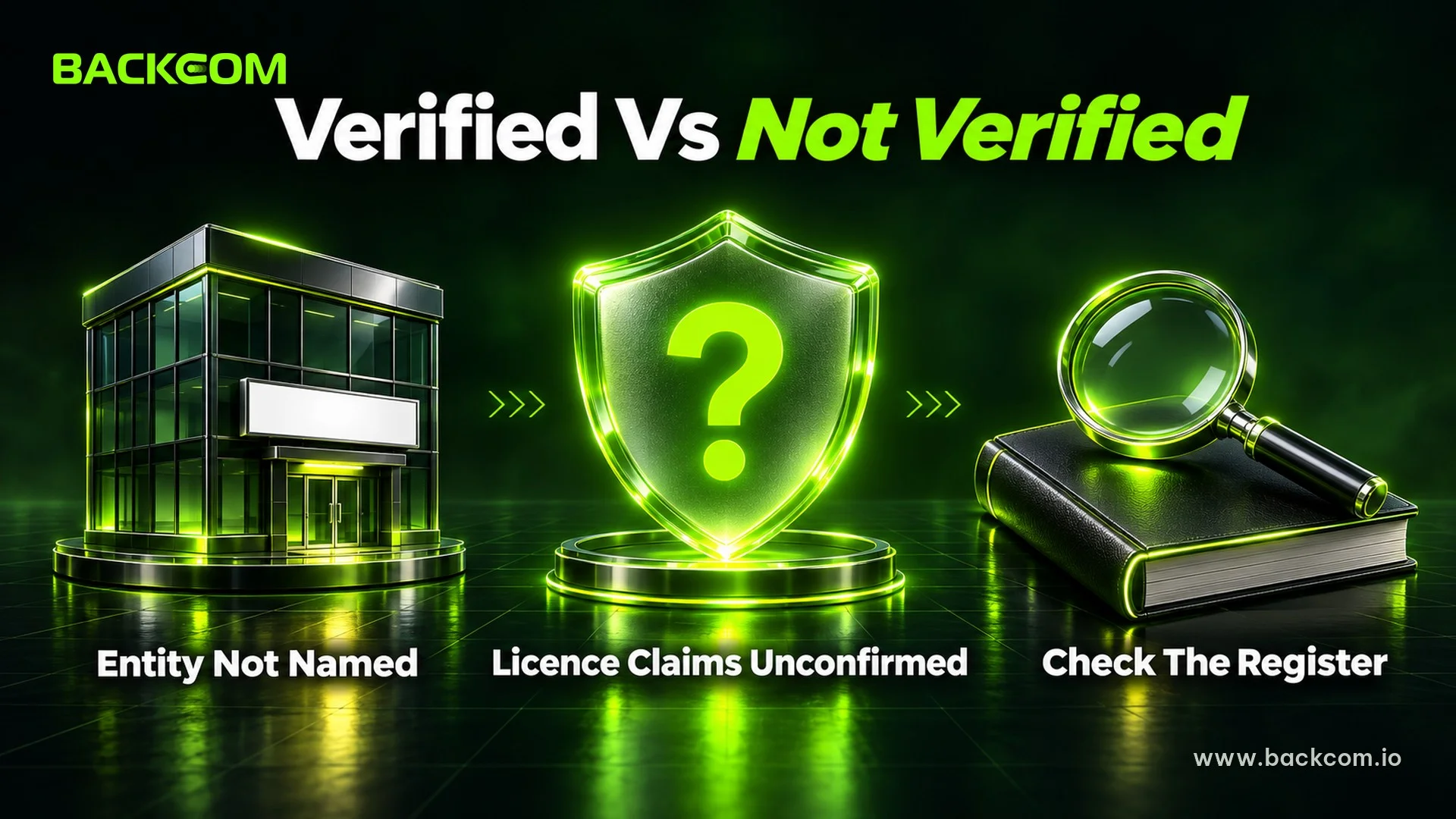
Bitunix regulation is the hardest part of this review, because the exchange's own pages say very little about licences. Bitunix's Legal Statement, its User Agreement and its regulatory and law enforcement request guide do not name the operating company, its registered address or any licence number (checked 21 November 2026). The User Agreement only says that Bitunix operates "together with its affiliates". The only company name we found is in the README of Bitunix's official proof-of-reserves repository on GitHub, which reads "Licensed to Bitunix Limited", with no registration number or jurisdiction.
Some review websites list a US FinCEN registration, a Canadian FINTRAC registration and a Philippine VASP licence. Those lists disagree on dates, and none of them is a regulator record, so treat them as unconfirmed claims until you find the entry yourself.
| Item | What the public record shows | How to verify |
|---|---|---|
| Operating entity | Not named on Bitunix's legal pages | Ask support in writing which entity serves your account |
| US registration | Claimed by third-party sites, no registration number found | FinCEN MSB registrant search |
| Canada | Claimed by third-party sites, not on official pages | FINTRAC |
| EU or UK authorisation | No authorisation found | Your national regulator's register |
Reference summary of public information, as at 21 November 2026. Licences and registrations change, so check the registers before you act.
Two cautions apply. First, a money services registration is an anti-money-laundering registration, not approval of an exchange's financial safety. Second, even a real registration covers one entity in one region, and it does not extend to customers elsewhere.
Bitunix also restricts access by country. Its restricted regions and user eligibility notice, last updated on 5 August 2026, lists restricted jurisdictions that include the United States and Canada, and says the list can change at any time. Check the accepted and restricted countries list for your KYC country before you register, and remember that rules and taxes on crypto differ by country of residence.
Is Bitunix Safe? Proof Of Reserves And Account Security
Safety has two parts: what the exchange discloses about its assets, and the protections you control yourself. A fair Bitunix review covers both.
Bitunix Proof Of Reserves
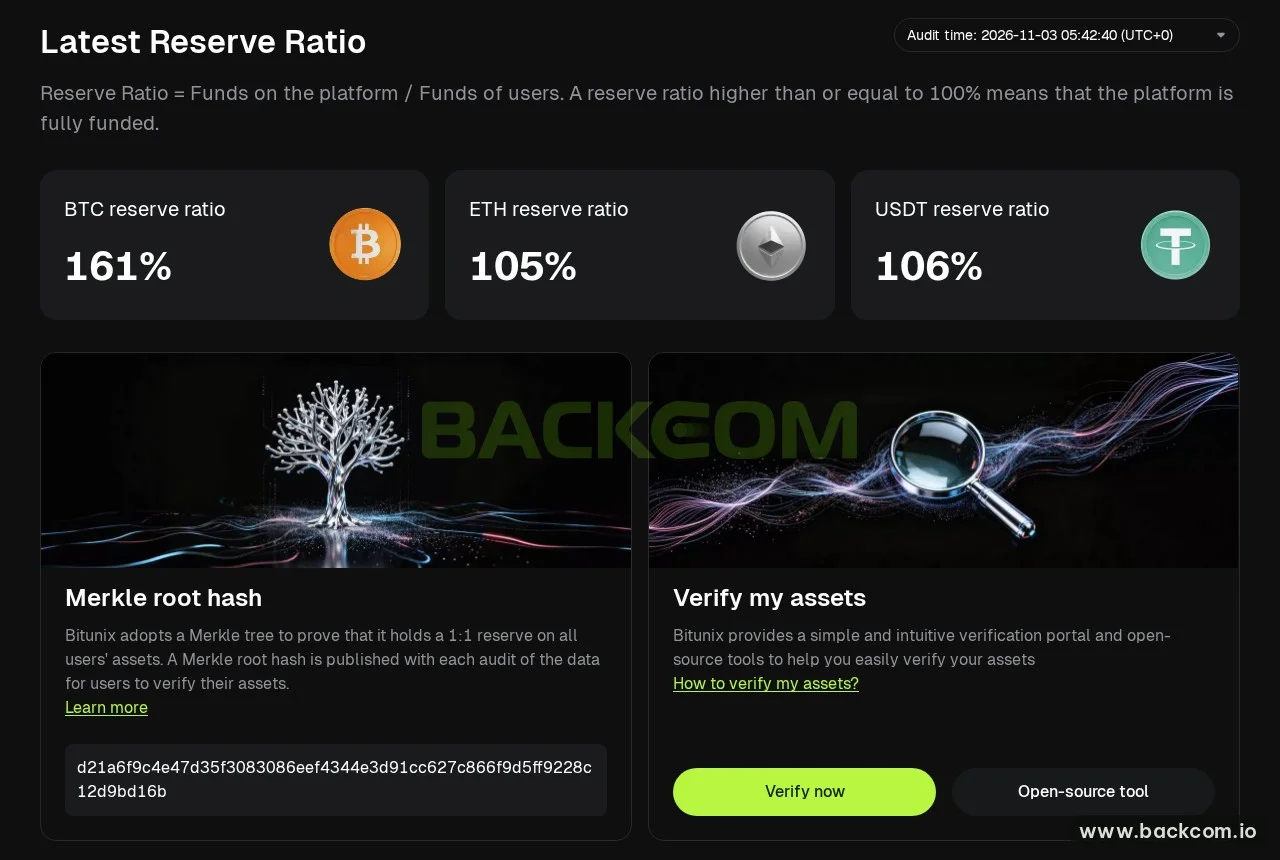
Bitunix publishes a proof-of-reserve page that explains a Merkle tree method. Each account is hashed from its balance and account name, and the page defines the reserve ratio as funds on the platform divided by funds of users. An open-source verifier on GitHub lets you check that your own balance sits inside the tree.
The latest snapshot on that page, with an audit time of 3 November 2026 (UTC), shows reserve ratios of 161% for BTC, 105% for ETH and 106% for USDT. A ratio at or above 100% means the platform holds at least what it owes users in that asset.
Read the numbers with care. The ratio is Bitunix's own figure, the page names no independent auditor, and the ratios change between snapshots. Our guide to proof of reserves on a crypto exchange explains why a snapshot is not an audit: it compares listed assets and liabilities at one moment and does not show loans or off-platform obligations.
The "Care Fund" Claim
Some review sites mention a user-protection "Care Fund" with a stated size. We found no Care Fund page on bitunix.com, and the address that sites usually cite returns a "not found" error. Until Bitunix publishes the size, the rules and the payout terms itself, do not count on it as protection for your balance.
Protections You Control
Bitunix offers two-factor verification by email, phone or authenticator app, and an anti-phishing code that appears in every genuine email it sends (see its anti-phishing setup guide). Turn both on. The settings in our account security checklist apply to any exchange, including a withdrawal whitelist where one is offered.
Bitunix Trading Fees: What You Actually Pay
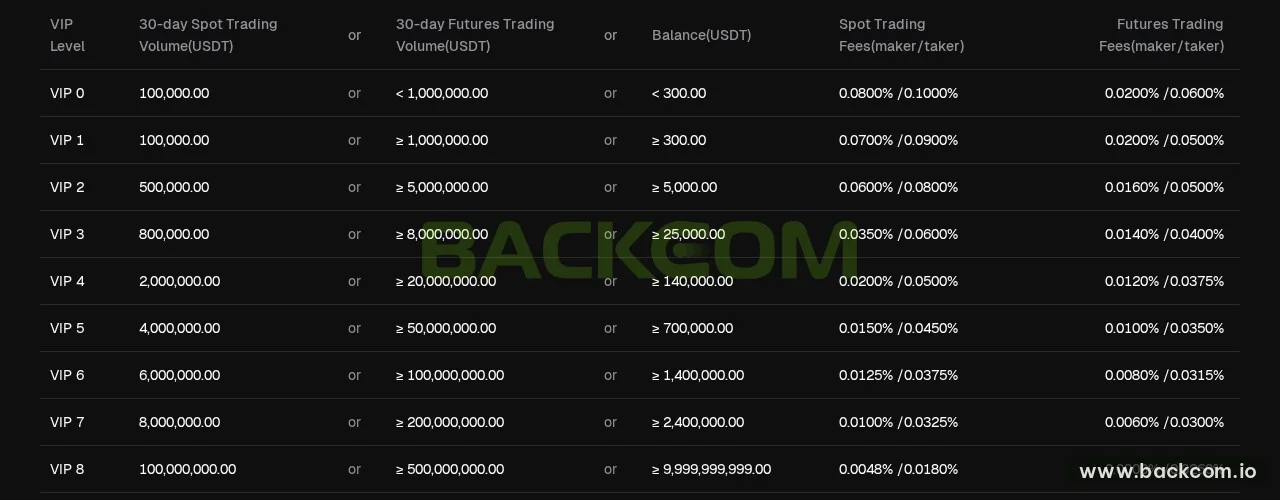
Bitunix fees follow a maker-taker model, and your rate depends on the product and your VIP level. At VIP 0 the official fee page lists these base rates:
| Product | Maker | Taker |
|---|---|---|
| Futures (USDT perpetual) | 0.02% | 0.06% |
| Spot | 0.08% | 0.10% |
Reference summary of the official fee page, checked 21 November 2026. Rates can change, so confirm them on the live page before you trade.
The practical point is that order type changes your cost. Limit orders that rest on the book pay the lower maker rate, while market orders pay the taker rate and can also suffer slippage. Our guide to maker and taker fees explains the difference, and the Bitunix trading fees guide covers funding and VIP levels in detail.
An illustration only, with an assumed $100,000 of monthly futures volume: all-maker orders cost $20 in fees, and all-taker orders cost $60. The same $100,000 on spot at the taker rate costs $100. Funding payments on perpetual contracts come on top and are charged separately.
Bitunix Withdrawals And Account Reviews: What To Check First
Withdrawal problems usually trace back to a few causes you can test for before depositing real size. Bitunix's withdrawal FAQ states that a basic account has a daily withdrawal limit equal to 10,000 USD and that completing identity verification unlocks higher limits, without naming a threshold. It also says confirmation times depend on the network and recommends a small test transfer to a new address.
The causes to expect are:
- Pending identity verification: the KYC guide says an unverified account is usually restricted from full features.
- Compliance reviews: users on public review platforms report accounts placed under review when they tried to withdraw. These are individual claims we did not verify, so treat them as signals, not proof.
- Network fees and minimums: a network fee is deducted in the coin you withdraw, and each network has a minimum amount. The fee and limit table lists them.
- Wrong network: sending a token on the wrong chain can lose it permanently.
Our guide to crypto withdrawal fees shows how to compare networks. A sensible routine is to verify your identity first, make a small test withdrawal and only then move larger amounts, and to keep long-term holdings in your own wallet instead of on any exchange.
Bitunix Futures Risk: Leverage Is The Bigger Danger
For most traders, the larger risk on a derivatives exchange is leverage, not the exchange itself. Bitunix futures let you open positions larger than your margin, and a small move against you can trigger forced closure. Before you size a trade, learn how to calculate your liquidation price and decide your maximum loss in advance. Losing a leveraged position is a trading outcome, not evidence that an exchange is a scam.
Bitunix Rebates And Your Net Fees
Bitunix Rebates are a share of your trading fees returned to you when your account is registered through a partner link. Our page for Bitunix lists a 60% rebate on fees paid, on spot and futures, credited by Bitunix with no minimum volume (page updated 21 November 2026).
Using the example above: $100,000 of taker-only futures volume at 0.06% produces $60 in fees, and a 60% rebate returns $36, leaving a net fee of $24. A rebate is a share of a fee, not of your trade or your profit, and it applies to winning and losing trades alike.
Three conditions matter. The account must be registered through the partner link before you trade, each UID, including sub-accounts, has to be linked in the Backcom.io App, and an existing account is usually tied to another referrer, so a new account with a new email is the usual route. To judge any program on equal terms, read our crypto exchange rebate comparison. You can read the current terms and linking steps on the Bitunix rebate page.
Backcom.io is an independent introducing broker (IB/affiliate) of the exchanges it lists, including Bitunix; rebates are paid from the commission the exchange pays Backcom.io. See the risk disclaimer for details. A rebate is not a reason to open an account, deposit funds or trade more than you planned.
Bitunix Review: How It Compares With Other Exchanges
A fair comparison looks at licences, security record, fees and the products you need, and it does not produce one winner for every trader. We do not rank exchanges here, because there is no common scoring method that fits every user. If you are building a shortlist, our independent reviews of OKX, Bybit and MEXC ask the same questions, so you can read them side by side. It also helps to understand centralized and decentralized exchanges, because Bitunix is a centralized exchange that holds custody of what you leave on it.
6 Checks Before You Trade On Bitunix
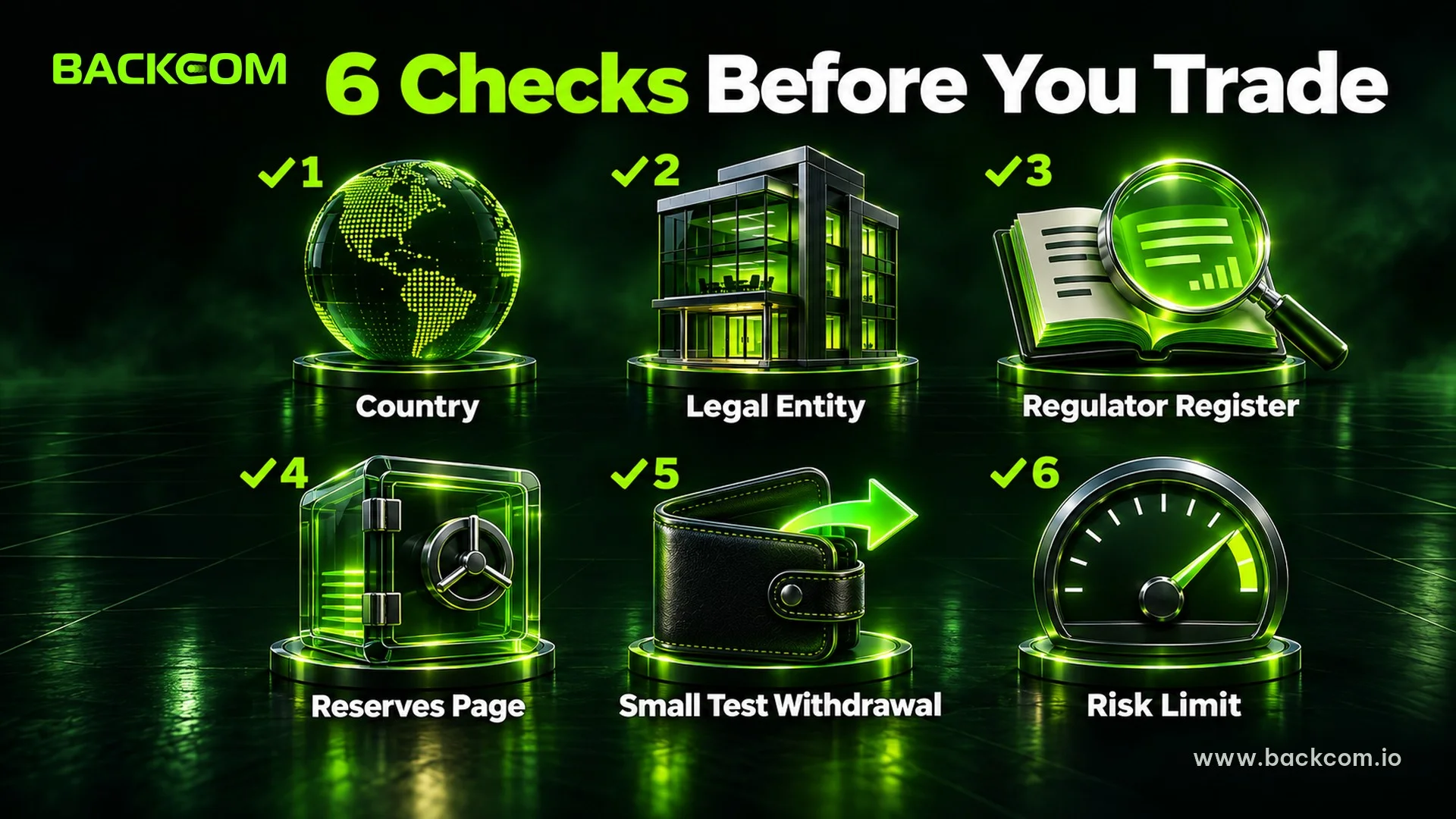
Run the same checklist on any exchange before you deposit.
- Confirm your country is accepted in the restricted regions notice for your KYC country.
- Ask which legal entity serves your account and request the answer in writing.
- Search the regulator's register for that entity instead of trusting a review site.
- Read the proof-of-reserves page and note the date, the assets and whether an auditor is named.
- Test with a small deposit and withdrawal before moving size.
- Set a risk limit for each leveraged position, and never deposit money you cannot afford to lose.
Frequently Asked Questions (FAQ) About Bitunix
Is Bitunix A Scam?
There is no public finding that Bitunix is a scam. It publishes fee tables, a proof-of-reserves method and a verifier tool. That does not remove risk, and its official pages do not name a licensed entity, so verify what applies to you.
Is Bitunix Regulated?
Bitunix's own pages do not confirm it. Third-party sites mention registrations in a few countries, but dates conflict and none comes from a regulator record we could open. Search the relevant register yourself before relying on any claim.
Is Bitunix Safe For Beginners?
Beginners can lower risk by turning on two-factor verification and the anti-phishing code, starting with small spot trades and avoiding high leverage. Many avoidable beginner losses come from high leverage and wrong-network transfers, so start small and double-check the network.
Can I Withdraw My Money From Bitunix?
Withdrawals are available once your account meets the verification rules, subject to daily limits, network fees and any compliance review. Delays happen on every exchange. Test with a small amount first and use the correct network.
How Much Do Bitunix Fees Cost?
At VIP 0 the published base rates are 0.02% maker and 0.06% taker on futures, and 0.08% maker and 0.10% taker on spot. Your real cost also includes slippage and funding, so compare the net cost for your own trading style.
Conclusion: Is Bitunix Legit?
Bitunix looks like a real, working exchange, but the right question is whether its disclosures, licences and fees fit your situation. Its fee tables, proof-of-reserves method and withdrawal rules are public, yet its legal pages do not name a licensed entity, no auditor is named for its reserves, and we found no official page for the protection fund some sites describe. Verify the entity and registration for your country, test a small withdrawal, keep leverage modest and treat any rebate as a small cost reduction, not a source of profit.
Disclaimer: This content is for information only and is not investment advice. Crypto assets are volatile and you can lose your capital. Licences, fees and rebate terms can change, and rules differ by country of residence. Check the current terms and your local regulations before you register or trade.
Was this article helpful?
Join The Backcom.io Community
Get the latest on trading rebates, trading tips, and broker deals — and connect with thousands of traders worldwide.

Backcom App
Track Your Rebates Every Day
Every rebate is visible by broker and by day. Manage your wallet and withdrawals in one place.
Open Backcom App