DCA Crypto Strategy: How Dollar-Cost Averaging Works And Its Limits


A DCA crypto strategy means buying a fixed amount of a coin at regular intervals, whatever the price is on the day. Instead of trying to pick the perfect entry, you spread your purchases over weeks or months and let the average price smooth out the swings. It is simple, it is popular with beginners, and it is often misunderstood. In this article, Backcom.io explains how dollar-cost averaging works, walks through the arithmetic with two worked examples, compares it with lump-sum buying, and shows where the method stops helping.
Dollar Cost Averaging Crypto: What Is DCA?
Dollar cost averaging crypto investing is the habit of buying coins in equal amounts on a schedule. More broadly, dollar-cost averaging is a method of investing equal amounts at regular intervals regardless of the ups and downs in the market, a description the US investor education site Investor.gov gives in similar terms (Investor.gov glossary: dollar-cost averaging). In crypto, the same idea applies to coins such as Bitcoin or Ethereum. You might buy 50 USD of Bitcoin every Friday, or 200 USD on the first day of each month.
The method rests on three rules:
- A fixed amount: the budget per purchase never changes, so you buy more units when the price is low and fewer when it is high.
- A fixed schedule: weekly, biweekly or monthly, set in advance and followed without checking the chart.
- A fixed asset list: you decide what to buy before you start, rather than switching to whatever is trending.
Notice what DCA does not promise. It does not predict the market, it does not guarantee a profit, and it does not remove the risk that the asset itself falls and never recovers. It only changes when your money goes in. If you are new to the asset class, our beginner guide to how cryptocurrency works covers the basics before you decide on any strategy.
How Does A DCA Crypto Strategy Work?

A DCA strategy works by turning one big timing decision into many small ones, so no single purchase can be a disastrous entry. Your average cost per coin ends up as a blend of every price you paid.
The key formula is the average cost:
Average cost per coin = Total money spent ÷ Total coins bought
Because the budget is fixed, the same 100 USD buys more coins when the price drops. That is why the average cost per coin tends to land below the simple average of the prices when the market swings up and down.
Worked Example: A Volatile Six-Month Market
Suppose you invest 100 USD on the first day of each month for six months. The coin price on those days is hypothetical: 100, 80, 60, 80, 100 and 120 USD.
| Month | Price (USD) | Amount invested (USD) | Coins bought |
|---|---|---|---|
| 1 | 100 | 100 | 1.000 |
| 2 | 80 | 100 | 1.250 |
| 3 | 60 | 100 | 1.667 |
| 4 | 80 | 100 | 1.250 |
| 5 | 100 | 100 | 1.000 |
| 6 | 120 | 100 | 0.833 |
| Total | – | 600 | 7.000 |
Illustrative figures only, not real market data. Your result depends on the actual prices and fees you pay.
Your average cost is 600 ÷ 7.000 = 85.71 USD per coin, while the simple average of the six prices is 90 USD. At the final price of 120 USD, your 7 coins are worth 840 USD, a gain of 240 USD or 40%. Someone who put the whole 600 USD in at month 1 would hold 6 coins worth 720 USD, a gain of 20%.
The lesson is narrow but useful: in a market that dips and then recovers, DCA lets you buy more of the dip. It does not mean DCA always wins, as the next example shows.
DCA Vs Lump Sum Crypto: Which One Wins?
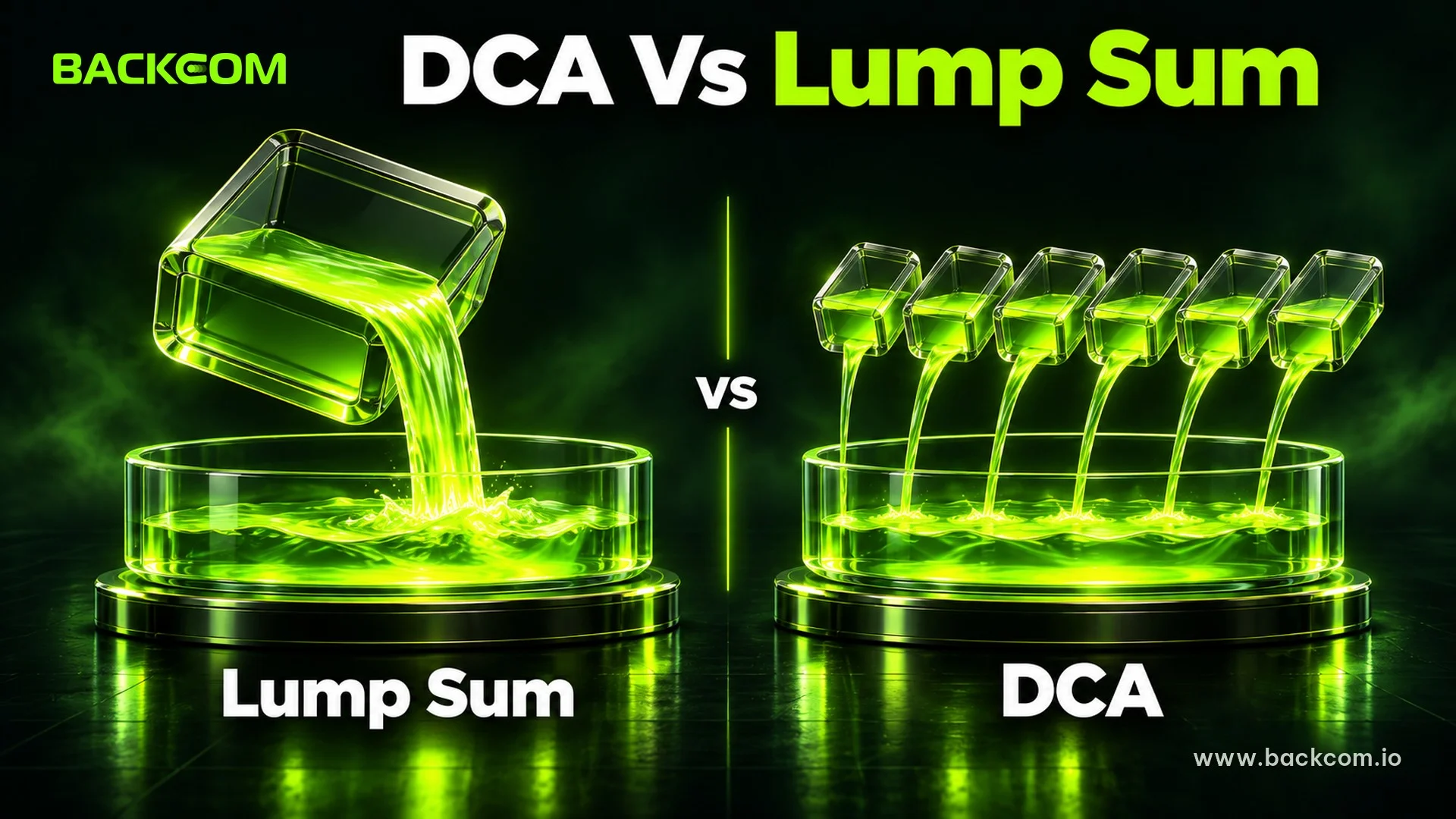
Lump-sum investing means putting the whole amount in at once. Research on traditional markets shows that it usually beats DCA, and the reason is simple: if prices tend to rise over time, money that is invested earlier has more time to grow. A Morningstar comparison published on 26 August 2024 reports that lump sum investing came out ahead in the majority of scenarios, and that Vanguard's comparable study found fairly similar results (Morningstar: dollar-cost averaging vs lump sum investing).
Those studies cover stocks and traditional portfolios, not crypto. We could not verify a win rate for Bitcoin specifically, so treat any precise percentage quoted for crypto with caution.
Worked Example: A Steadily Rising Market
Take the same 600 USD, but now the price rises every month: 80, 90, 100, 110, 120 and 130 USD.
| Strategy | Coins held | Value at 130 USD | Result |
|---|---|---|---|
| Lump sum (600 USD at 80) | 7.500 | 975 USD | +62.5% |
| DCA (100 USD per month) | 5.873 | 763 USD | +27.2% |
Illustrative figures only, not real market data.
The lump-sum buyer wins by a wide margin because every dollar was working from the start. The DCA buyer kept buying at higher and higher prices.
Putting the two examples side by side gives a practical summary:
- Falling then recovering market: DCA tends to look better, because you buy during the dip.
- Steadily rising market: lump sum tends to look better, because money is invested earlier.
- Steadily falling market: both lose, but DCA loses less at first because part of the money is still in cash.
Nobody knows in advance which market is coming. DCA is therefore best understood as a risk-management and discipline tool, not a return-maximizing one.
Why Traders Use DCA In Crypto
The main reasons people choose DCA are practical rather than mathematical. Crypto prices can move several percent in a day, and DCA reduces the damage of a bad guess.
- It removes the timing decision. You do not need to decide whether today is the top or the bottom.
- It reduces regret. If the price falls right after a purchase, you have only invested part of your budget.
- It builds a habit. A schedule is easier to keep than a feeling, especially when the news is loud.
- It suits regular income. If you save from a monthly salary, DCA matches how the money actually arrives.
- It limits position size. Because the plan is set in advance, it is harder to put in more than you can afford during a hype cycle.
None of these benefits changes the fact that the asset can still lose value. DCA manages the entry, not the asset.
How To DCA Bitcoin: A Practical Plan In 5 Steps
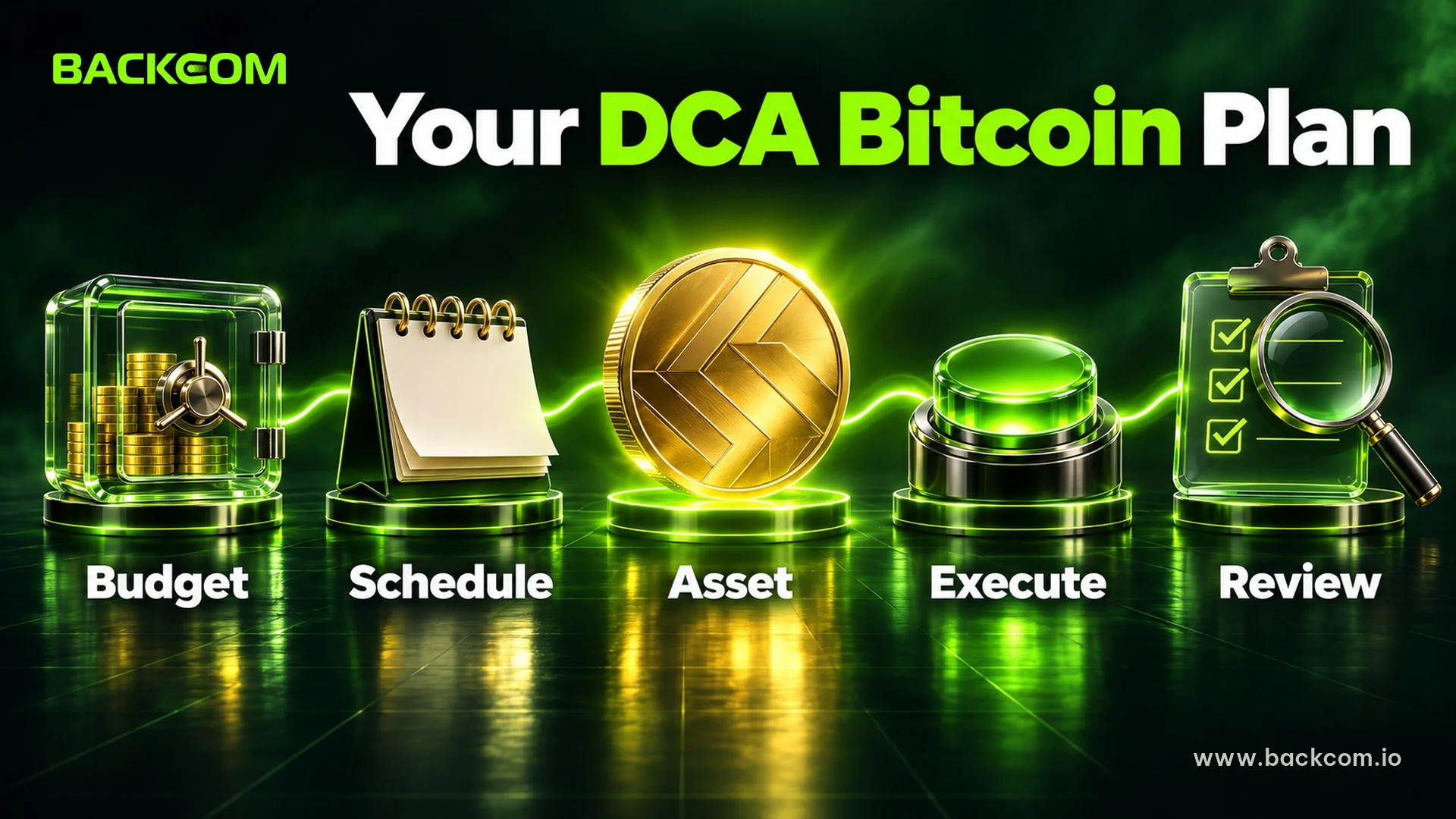
Learning how to DCA Bitcoin (or any coin) comes down to writing a short plan before you buy anything. A plan you wrote while calm is easier to follow when the price is moving fast.
- Set a total budget you can afford to lose. Use money that is not needed for rent, emergencies or debt. Crypto can fall sharply, so size the plan for the worst case.
- Choose the schedule. Weekly or monthly are the most common. A shorter interval smooths the average more, but it can mean more fees.
- Choose the asset and the amount per buy. Decide the coin and the fixed amount, for example 50 USD of Bitcoin per week.
- Pick a way to execute. Many exchanges offer a recurring-buy feature, and you can also buy manually on your own calendar. Automation helps you stay consistent; manual buying gives you more control over where the coins are bought. Read the fee page of your chosen platform first, and see our guide to maker and taker fees in crypto to understand what each order costs.
- Write the exit and review rules. Decide when you will review the plan, for example every quarter, and under what conditions you would stop, such as a change in your income or in your view of the asset. Do not change the plan because of a single day's price move.
Before you start, check where your coins will be held. A platform that keeps your funds takes on custody for you, and the trade-offs are covered in our comparison of centralized and decentralized exchanges.
Costs matter more in DCA than in a single purchase, because you pay them many times. A fee that looks small on one trade can add up over a year of weekly buys.
Take a flat 1 USD fee on a 50 USD purchase. That is 2% on every buy, and over 52 weekly buys it is 52 USD, a sizeable drag on a 2,600 USD plan. A percentage-based fee of 0.1% would cost far less, so the fee structure of the platform you use can change which interval is sensible. These numbers are illustrative; check the current fee schedule of any platform before relying on them.
Other costs to keep in mind:
- Spread and slippage: small orders usually fill close to the quoted price, but thin markets can fill worse. Our guide to slippage in crypto trading explains how to measure it.
- Network fees on withdrawals: moving coins to your own wallet each time would be expensive, so many people withdraw in larger batches.
- Taxes: in many countries each purchase creates a separate tax lot, which makes record keeping more important. Rules differ by country of residence, so check local guidance or ask a qualified adviser.
- Currency conversion: if you fund purchases in a currency that differs from the trading pair, exchange-rate costs add up as well.
Keep a simple spreadsheet with the date, amount, price and fee of every buy. It will make both reviews and tax reporting much easier.
DCA Crypto Risks: What Dollar-Cost Averaging Cannot Fix
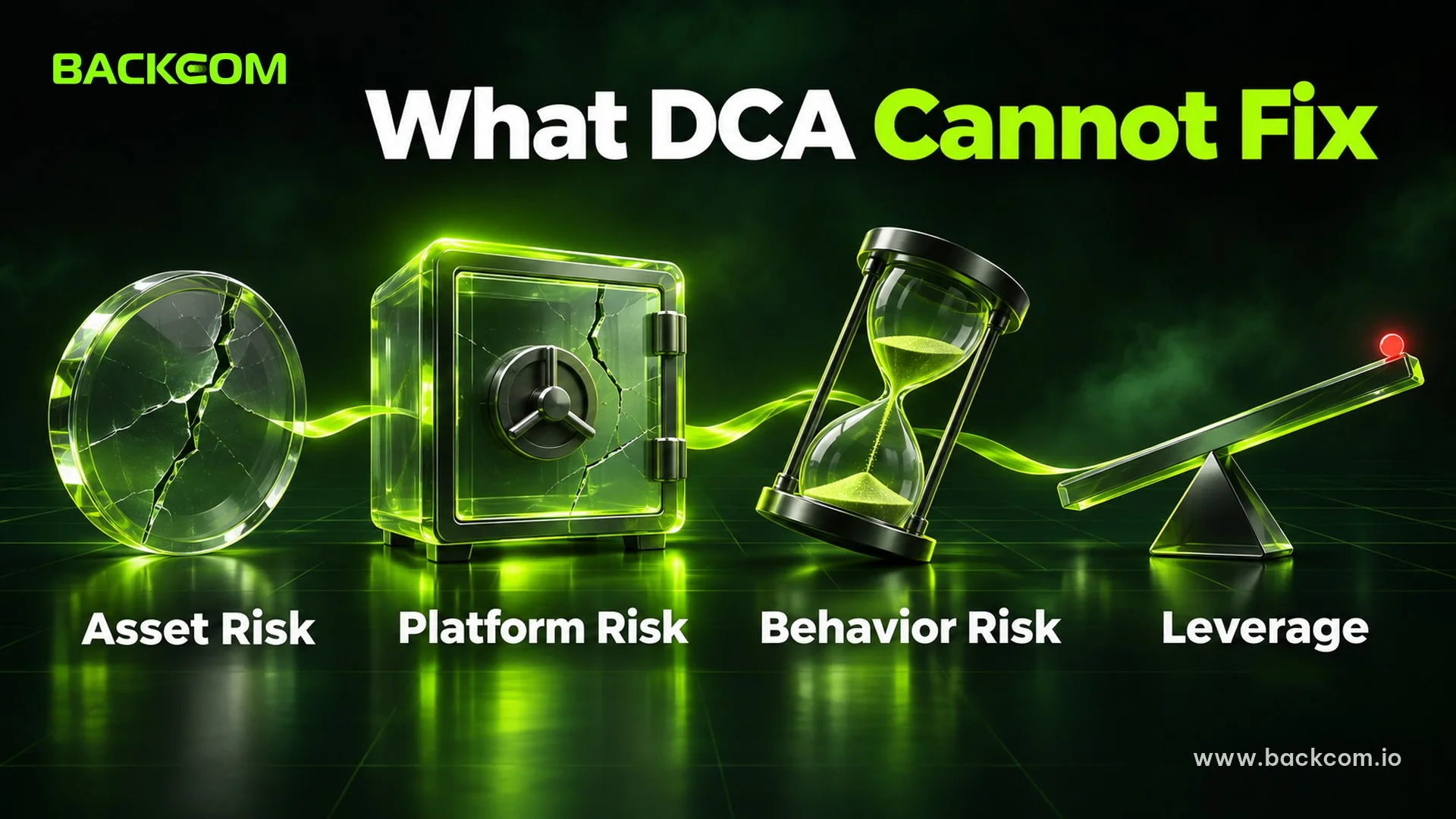
The biggest of the DCA crypto risks is the one the method cannot touch: the asset can fall and stay down. Buying more of something that keeps dropping only grows the loss. Averaging down on a project that fails is not a strategy, it is a larger mistake.
Other limits to understand:
- Asset risk: many small coins have disappeared entirely. DCA works best with an asset you have researched and expect to survive, and even then there is no guarantee.
- Platform risk: coins held on an exchange depend on that company staying solvent and secure. The US SEC warned in an investor alert dated 23 March 2023 that the risk of loss in crypto asset transactions remains significant and that platforms may lack key investor protections (SEC: exercise caution with crypto asset securities).
- Stablecoin risk: if you park cash in a stablecoin while waiting to deploy it, remember that stablecoins carry their own risks. We cover them in what a stablecoin is and how USDT and USDC work.
- Behavior risk: the plan only works if you follow it. Skipping buys when the price is low and doubling up when it is high defeats the purpose.
- Leverage: DCA is a spot-buying approach. Adding leverage to it changes the risk completely, because you can be liquidated before the average cost helps you. See what leverage means in crypto trading.
A final point on size. A DCA plan does not reduce the amount you can lose, only how fast you commit it. If a total loss of the budget would hurt your finances, the budget is too big.
Is DCA Right For You? A Quick Checklist
DCA suits some people and not others. Answer these questions honestly before you start:
- Do you receive regular income that you can set aside each period?
- Can you leave the money invested through large drops without selling in panic?
- Have you researched the asset beyond its price chart?
- Is the total budget an amount you can afford to lose?
- Have you checked the platform's fees, custody model and withdrawal rules?
If most answers are yes, a small, scheduled plan may fit your situation. If you already hold a large lump sum, remember that DCA is a way to manage regret and timing risk, not a way to earn more. For active traders, DCA is a different tool from trading on margin, and the two should not be mixed without understanding both.
Frequently Asked Questions (FAQ) About DCA Crypto Strategy
Is DCA A Good Strategy For Crypto?
DCA is a reasonable way to enter the crypto market gradually if you cannot or do not want to time the market. It reduces the impact of a single bad entry and builds discipline. It does not remove the risk of loss, and in rising markets lump sum buying has often performed better in traditional-asset studies. Whether it is "good" depends on your goals, budget and ability to hold through drops.
How Often Should I DCA Into Bitcoin?
There is no single best interval. Weekly and monthly are the most common. A shorter interval smooths the average price more but may increase fees, while a longer interval means fewer transactions and less record keeping. Choose the interval that fits when you are paid and that keeps fees a small share of each purchase, then stay consistent.
Is DCA Better Than Lump Sum In Crypto?
Neither wins every time. Studies of traditional markets show lump sum investing ahead in most scenarios, because prices tend to rise over time. DCA tends to look better when the market falls first and recovers later. Because crypto is more volatile than most assets, both outcomes can be larger. Pick DCA if reducing regret and timing risk matters more to you than maximizing the expected return.
Can I Lose Money With A DCA Strategy?
Yes. If the asset you buy keeps falling or fails, a DCA plan will lose money, and buying more as it drops increases the amount you have at risk. Platform failure, hacks and scams are additional risks. Only invest an amount you can afford to lose, and research both the asset and the platform you use.
Conclusion: DCA Is A Discipline Tool, Not A Guarantee
A DCA crypto strategy spreads your purchases over time, lowers the pressure of choosing one entry and keeps your behavior consistent. The two worked examples show both sides: it helps in a dip-and-recover market and trails lump sum in a steady rise. It cannot fix a bad asset, hidden fees or a risky platform, and it works only if you follow the plan.
Before you start, write down your budget, schedule, asset and review rules, check the full cost of each purchase, and keep the amount small enough that a loss would not change your life.
Disclaimer: This content is compiled by Backcom.io for information only and is not investment advice. Crypto assets are highly volatile and you can lose all the money you invest. All figures in the examples are hypothetical. Rules and taxes differ by country of residence, so check local regulations before you trade.
Was this article helpful?
Join The Backcom.io Community
Get the latest on trading rebates, trading tips, and broker deals — and connect with thousands of traders worldwide.

Backcom App
Track Your Rebates Every Day
Every rebate is visible by broker and by day. Manage your wallet and withdrawals in one place.
Open Backcom App