Fake Forex Broker Support On Telegram: 6 Warning Signs And How To Check Official Channels

Summary
Fake forex broker support on Telegram is a stranger posing as broker staff, usually messaging you first after you ask for help in a public group, to get a verification code, password or unlock fee. Stop the chat at any such request, find support through the broker's own site, and change passwords at once if a code was sent.

You cannot log in to your trading account, the verification code never arrives, and right then a stranger messages you privately: "I'm from broker support, send me the code and I'll unlock it for you." This is the classic fake forex broker support scam on Telegram and other messaging apps, and it often starts minutes after a trader asks for help in a public group.
What makes it dangerous is that the scammer does not need to hack anything. They only need you to read out a verification code, share a password or pay an "unlock fee". Most fake support agent in forex scams work because the victim is stuck and in a hurry, not because the technique is clever.
In this article, Backcom.io walks you through 6 warning signs, how to find official broker support channels, and what to do right away if you have already sent a code or transferred money.
1. How Does A Broker Impersonation Scam Work On Telegram?
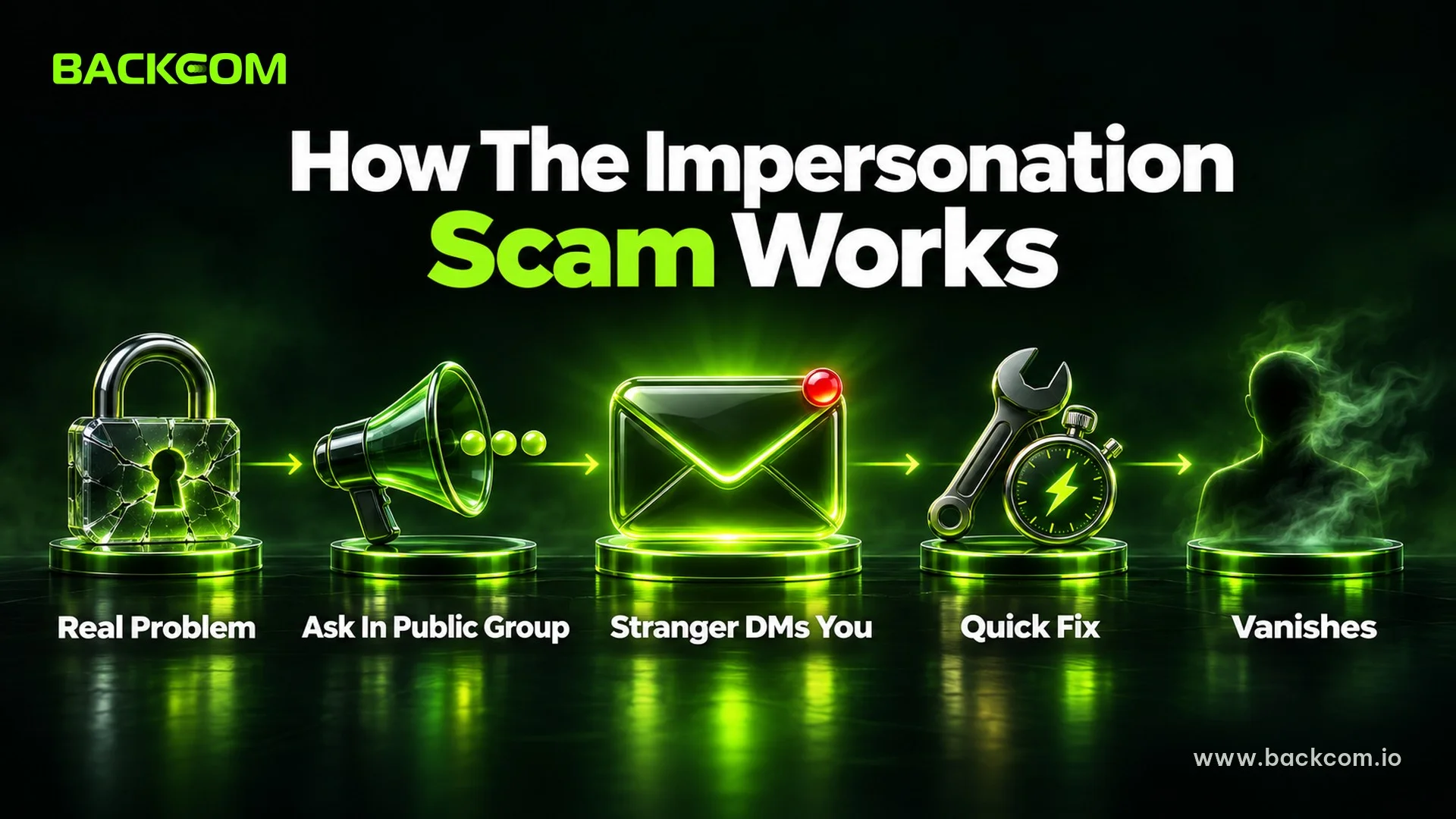
A broker impersonation scam is a fraud in which a person or group poses as a broker's customer-support staff, using a similar name, logo and tone to obtain your verification codes, passwords or money. The real broker keeps operating as normal. You are simply talking to the wrong person.
This is different from a scam broker, a company that poses as a broker and keeps client money, which is covered in our guide to signs of a forex broker scam. This article is about the person behind the message.
A typical scenario unfolds in five steps:
- You hit a real problem: a missing code, a locked account, a login error or a slow withdrawal.
- You ask in a public place: a Telegram group, a forum thread or a comment under a post.
- A stranger messages you privately: claims to be support, often with the broker's logo as an avatar and a similar display name.
- They offer a "quick fix": send a code, pay a fee or click a link.
- Once they have what they need, they vanish or ask for more.
The US Commodity Futures Trading Commission (CFTC) notes that most forex and crypto fraud begins on social media or in messaging apps. The pattern is the same everywhere. Only the brand being borrowed changes.
2. Six Warning Signs Of A Fake Support Agent In Forex
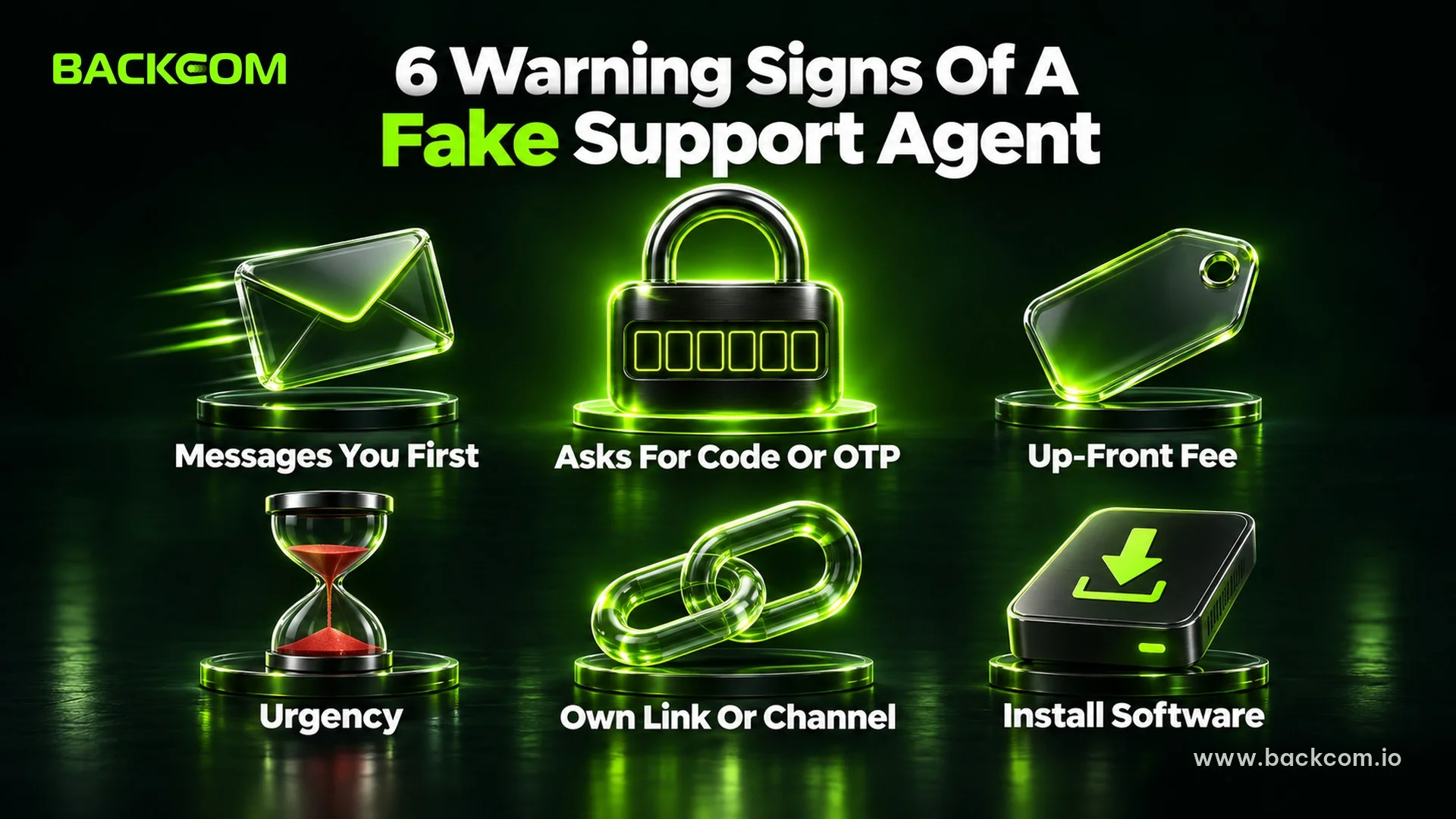
Any one of the six signs below is enough to stop the conversation and move to the checks in section 3. You do not need to see all six.
They Message You First, Before You Contact Support
According to the Telegram FAQ, people can contact you only if they know your phone number or if you message them first. Telegram also shows an info page for a first message from someone outside your contacts, with their country, when they joined Telegram and any groups you share, and lets you block and report from the same screen. See the source directly: Telegram FAQ.
If "support" appears right after you posted a question in a public group, that person may simply have read your post. An account that claims to be broker staff but joined Telegram a few days ago, or sits in an unrelated country, is a reason to stop.
They Ask For A Verification Code, OTP Or Password
This is the clearest sign and the real goal of most scripts. Telegram states that login codes should never be shared with anyone. The CFTC gives the same rule for scams in general: never give personal, payment or account information over the phone or by email. The FTC adds that you should not hand over personal or financial information in response to a request you did not expect.
For a forex trader, the "never send to anyone" list includes:
- Your password and your trading password.
- Verification codes sent to your email or phone.
- Codes from an authenticator app used for two-factor login.
- Screenshots that show any of the above.
Genuine support can investigate from the broker's side and does not need you to read out a code. Any request to send a verification code to support so they can "fix it for you" should be refused.
They Demand A Fee Up Front To "Unlock" Or "Verify"
An unlock fee, an identity-verification fee, a "release" fee or a "withdrawal tax" are different names for the same trick. The CFTC describes recovery scams as advance-fee fraud: you are asked to pay before receiving any service. The FTC warns against paying anyone who insists on cryptocurrency or other hard-to-reverse payment methods.
One rule is enough: a request that starts with "transfer money first" is already a serious red flag.
They Claim To Be An Organization You Know And Rush You
The FTC sums up the technique in one line: scammers pretend to be from an organization you know. A time limit usually comes with it: "your account will be locked in 30 minutes", "your order is stuck, we must act now".
Urgency is a tool, not information. You can stop replying at no cost, while a code you have sent or money you have transferred cannot be taken back.
They Hand You A Phone Number, Link Or Channel Of Their Own
The CFTC advises not to use phone numbers or web addresses supplied in the correspondence until you have verified them. Any link, hotline, Telegram username or group handed to you by a stranger is untrusted, however professional it looks.
If they want to move the chat to another channel, find the real channel yourself using the steps in section 3 instead of following theirs.
They Tell You To Install Software Or Log In Again Somewhere Unfamiliar
The FTC notes that legitimate companies will not email or text a link to update your payment information. For trading accounts, the usual variants are a remote-control app for "live support" or a page that asks you to "verify your login again". See the source directly: FTC guide to phishing.
Remote-control software lets another person see and operate your device, including while you are logged in to your bank or broker. Do not install anything at a stranger's request, even if the app has a familiar name.
3. What Are The Official Broker Support Channels?
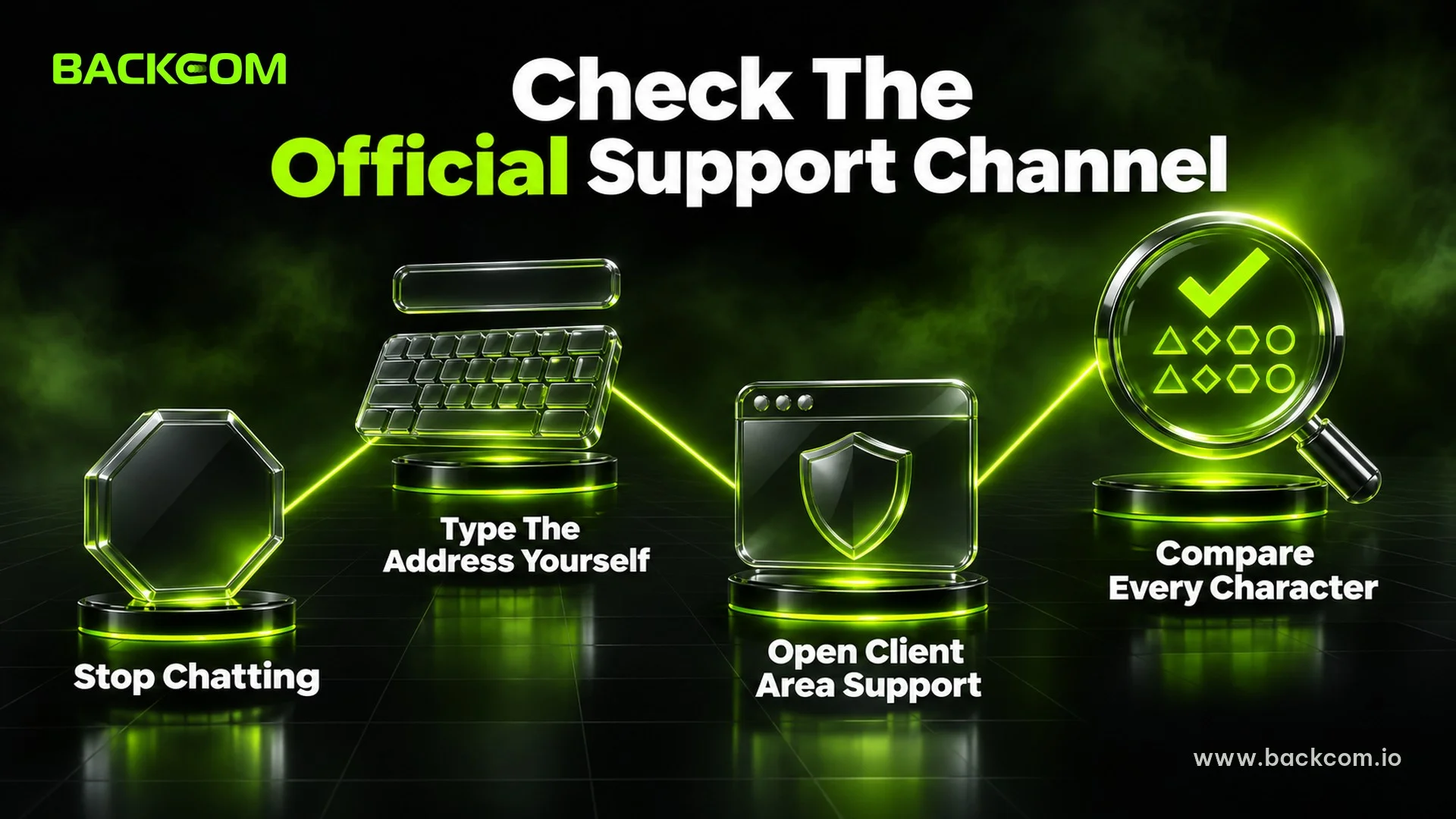
Official broker support channels are the channels you find yourself, starting from a point you already know is genuine, instead of channels a stranger sends you. That starting point is the website address you type yourself or saved the first time you visited the right broker, plus the client area after you log in.
Verify in four steps, in order:
- Stop the current conversation. Do not reply, click any link or send any code.
- Open the broker's website from an address you type or a saved bookmark. Never from a message, an ad or a sponsored search result.
- Find the contact or support section inside that site, preferably in the logged-in client area, and use only the channels listed there.
- Compare the sender's username, phone number or email with the channel you just found. If it does not match character for character, treat it as a stranger.
To check a web address before typing a password, see our guide to a fake forex broker website. This matches the advice of Australia's regulator ASIC: independently verify who you are dealing with instead of trusting details supplied by the party contacting you. If the broker's site is blocked where you are, our guides on broker websites blocked on a phone and accessing broker sites with 1.1.1.1 can help, but the four steps stay the same. If you can no longer open the email you registered with, see how to recover a broker account after losing email access through the broker's own support.
How To Check A Fake Broker Support Account On Telegram
Before comparing, run a quick scan inside the app:
- Join date and country on the Telegram info page: do they make sense for broker staff?
- Username: mixed upper and lower case, digits replacing letters, or suffixes such as "support", "vip" or "official".
- Broker name in the display name that cannot be found on the broker's own contact page.
An account that passes all three is still not proven genuine. Display names and logos are easy to copy, so steps 3 and 4 above remain the final test.
4. What To Do Right Away If You Sent A Code Or Money
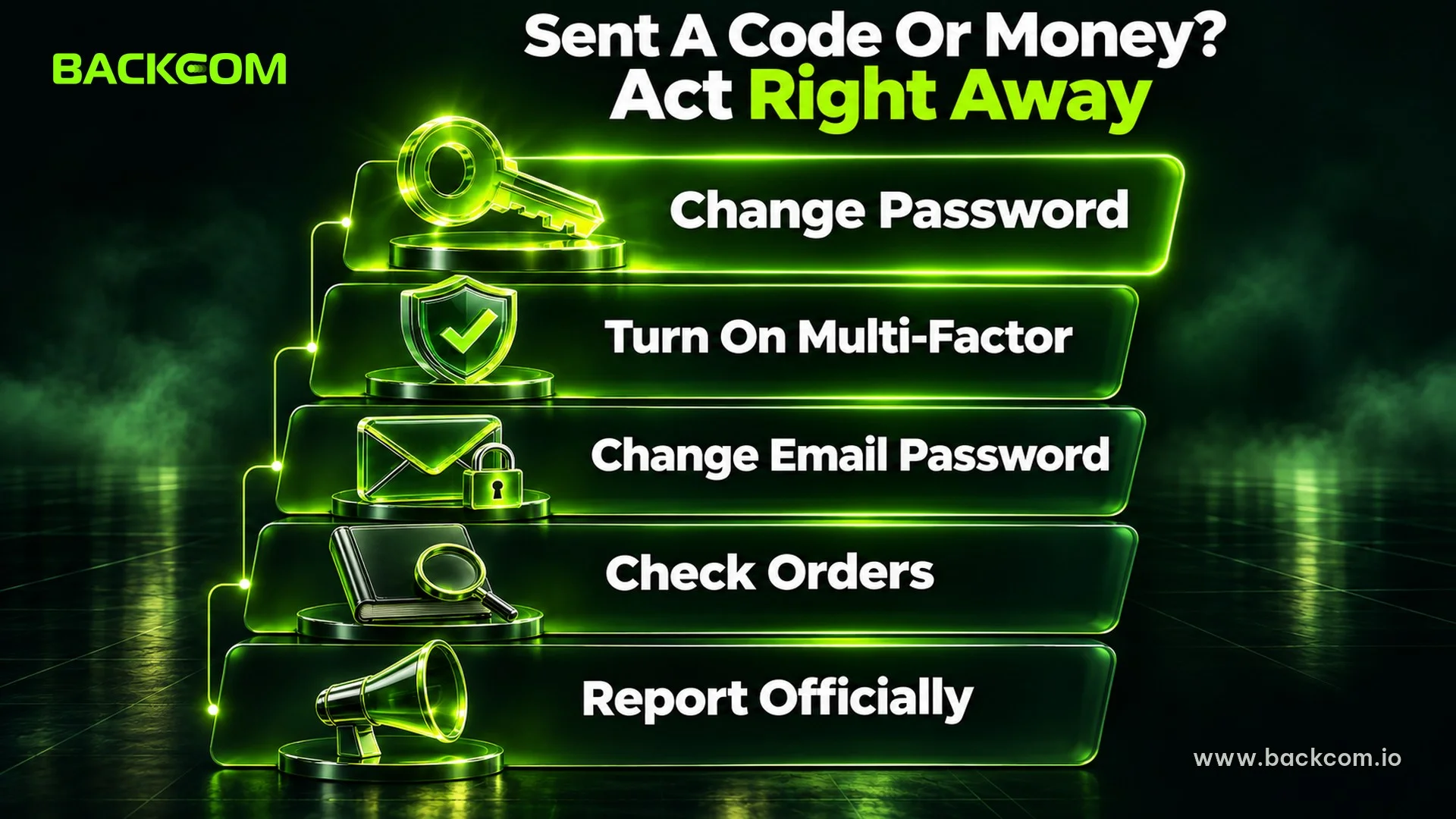
Sending a code is not the end, but the order of your actions decides the damage. First, stop all contact with that person and send nothing more, even if they threaten to lock the account. Then work through five actions in order:
- Change your password through the official channel: open the broker's site from an address you type, then change both the login and trading passwords.
- Turn on multi-factor authentication if it is off. The FTC notes that it makes life harder for anyone using a stolen password.
- Change your email password, because the email address linked to the account is often the recovery key.
- Check open orders and withdrawal history, and capture anything unusual.
- Report the incident through the official channel you found in section 3.
If you installed remote-control software, remove it at once and change passwords from a different device first. If you transferred money, tell your bank as soon as possible and keep every message, receiving account number and transaction ID. That is your evidence when you report to the authorities where you live.
5. Why Is A "Fund Recovery" Offer Often A Forex Recovery Scam?
After a loss, traders often meet someone who claims they can get the money back. This forex recovery scam is a second round of fraud aimed at exactly the person who has lost money and is willing to pay to fix it.
The CFTC says these scammers pose as government officials, attorneys or recovery-service representatives and demand payment before any service is delivered. The FBI reports "recovery" companies that take an up-front fee and stop communicating after the first deposit, and states that law enforcement does not charge victims a fee for investigating crimes. See the sources directly: CFTC warning on recovery fraud and FBI IC3 alert of 11 August 2023.
Three quick questions help you check:
- Who made contact first, you or them?
- Do they ask for a fee, deposit or package before doing anything?
- Do they claim to be a public authority but contact you from a personal chat account?
One "yes" is enough to stop. The safest route is to deal directly with your bank, your broker through its official channel, and the authorities where you live.
Frequently Asked Questions (FAQ) About Fake Forex Broker Support On Telegram
Does Broker Support Message Clients First On Telegram?
You should not assume so. According to the Telegram FAQ, a stranger can message you only if they know your phone number or you contacted them first, so an unexpected "support" message needs checking. The safe way is to open the broker's website yourself, go to the client area and use the channel listed there.
Can I Send A Verification Code To Support So They Unlock My Account?
No. Telegram states that login codes must not be shared with anyone. Genuine support can resolve account issues from the system side, so a request to send a verification code to support is a sign of impersonation, not a procedure.
Is An Account Unlock Fee Real?
Treat a fee as real only if you can read it on the broker's own website, opened from an address you typed yourself. A demand to send money to an individual in a chat before an account is "unlocked" matches the CFTC's description of advance-fee fraud. Stop and ask again through an official channel before paying anything.
Should I Pay A Service To Recover Money After Being Scammed?
You should not pay up front for any service that claims to recover funds. The CFTC classes these offers as advance-fee fraud, and the FBI reports many that take a fee and then go silent. Contacting your bank, your broker and the authorities is the route that does not require paying first.
Conclusion: Trust The Channel You Find, Not The Message That Finds You
Fake forex broker support works because it shows up exactly when you need help most. All six signs share one feature: a stranger wants something nobody is allowed to hand over, whether a verification code, a password or money paid in advance.
You need to look at three things together: who made contact first, what they are asking for, and whether the channel appears on the list the broker itself publishes. If any one is off, stop and go to the official website yourself.
To see a broker's details, you can open the Exness page; Backcom.io is an independent introducing broker (IB/affiliate) of Exness, and rebates are paid from the commission Exness pays Backcom.io, as explained in the risk disclaimer. For any issue involving money or account access, you still need to contact the broker through its official channel. If the problem is a genuine missing code, start with what to check when a forex broker verification code does not arrive.
Disclaimer: This content is compiled by Backcom.io for information and reference only and is not investment advice, a trading recommendation or legal advice. Trading forex and CFDs carries a high level of risk and you may lose all of your capital. Guidance from Telegram, CFTC, FBI IC3, FTC and ASIC is cited as at 23 November 2026 and may change, so check the original sources before relying on it.
Was this article helpful?
Join The Backcom.io Community
Get the latest on trading rebates, trading tips, and broker deals — and connect with thousands of traders worldwide.

Backcom App
Track Your Rebates Every Day
Every rebate is visible by broker and by day. Manage your wallet and withdrawals in one place.
Open Backcom App