KuCoin Fee Rebate Explained: Referral Rebates, KCS Discount And Real Savings

A KuCoin fee rebate returns part of the trading fees you pay on the exchange, so your net cost per trade is lower than the rate printed on the fee schedule. The headline percentage is easy to read and easy to misread: a rebate is a share of fees already paid, not a share of your volume or your profit. In this article, Backcom.io walks through what KuCoin charges, how a 60% rebate changes the maths on spot and futures, how it differs from the KCS discount, and where to confirm that every payout is correct.
What Is A KuCoin Fee Rebate And Who Pays It?
A KuCoin fee rebate is a payment funded by the commission KuCoin pays a partner for the trades of users linked to that partner. The partner passes a share of that commission back to the trader. You still pay the full fee when each order fills, and the rebate arrives afterwards as a separate daily credit.
That is the key difference from a fee discount. With a discount, the fee itself is smaller at the moment of the trade. With a rebate, the fee is charged in full and a portion returns later. Both lower your net cost, but they show up in different places, so a trade history that lists the normal fee does not mean the rebate is missing.
The partner terms published for KuCoin state 60% of fees paid, covering spot and futures, paid daily by the exchange, with no minimum volume and no time limit for as long as you trade on the linked account. The page was last updated on 23 October 2026 and checked again on 16 November 2026. Rates are set by KuCoin and the partner agreement, so they can change. The live page is the reference, not this article.
What Does KuCoin Charge Before Any Rebate?
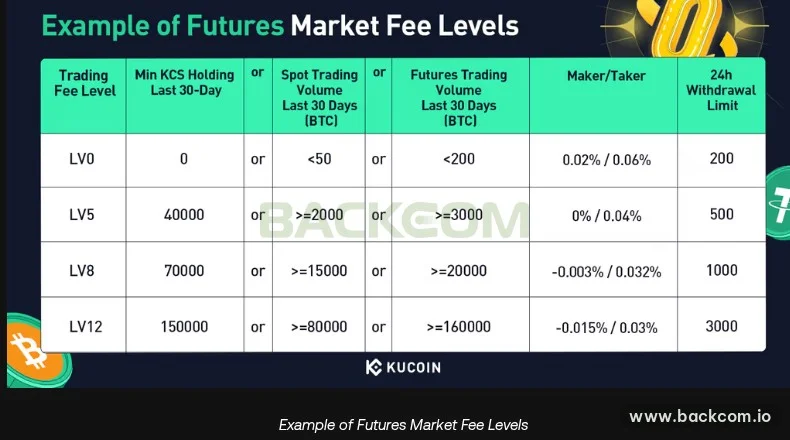
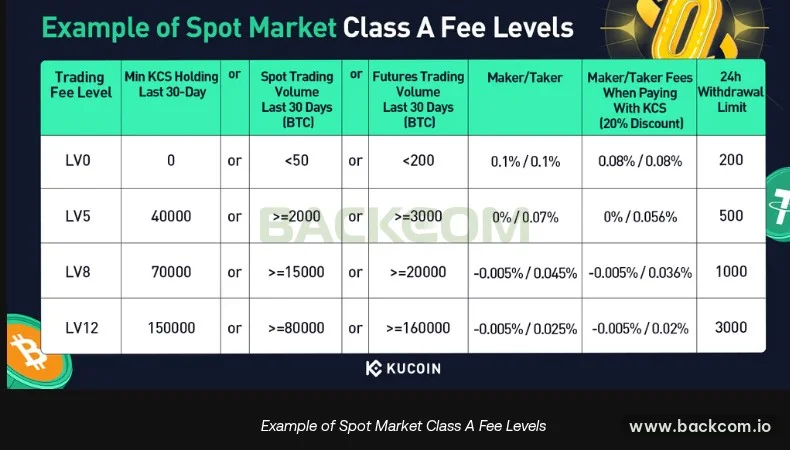
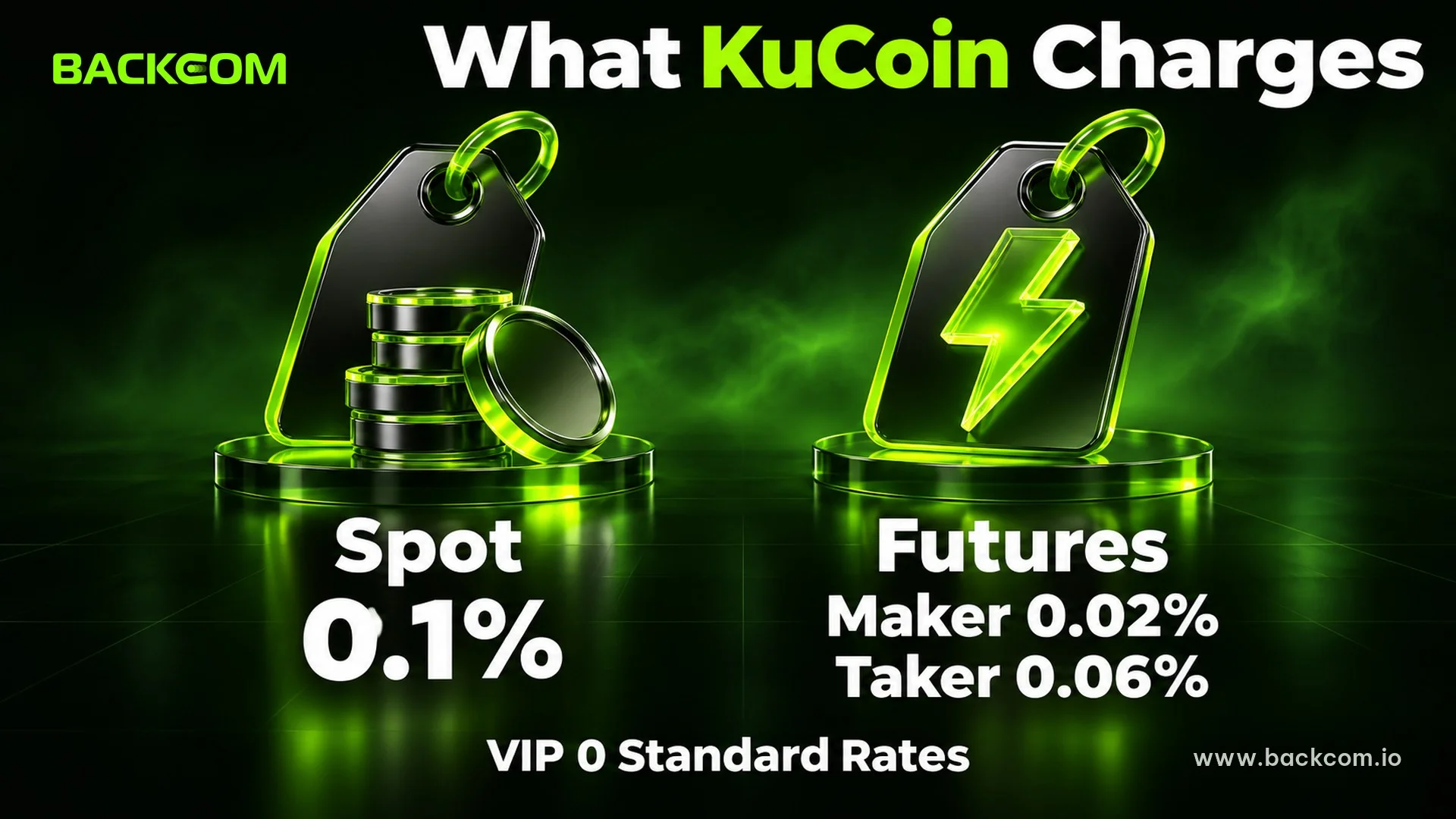
The rebate is a share of a fee, so the starting point is the fee schedule. These are the entry-level rates for a standard account at VIP 0:
| Product | Maker | Taker | Source |
|---|---|---|---|
| Spot (Class A pairs) | 0.100% | 0.100% | KuCoin fee guide |
| Futures | 0.020% | 0.060% | KuCoin futures fee analysis |
Reference rates as at 16 November 2026. They can change, so check the live schedule before trading. Spot pairs are grouped into classes, and KuCoin's own guide lists higher base rates of 0.16% and 0.24% for Class B and Class C pairs, so the pair you trade matters as much as the product.
KuCoin explains the spot rate in its guide to KuCoin fees, and the futures figures in its futures fee analysis. If the maker and taker distinction is new to you, our explainer on maker versus taker fees in crypto covers why a resting order and a market order are charged differently. Higher VIP levels pay lower rates, so confirm the tier shown on your own account before relying on any number here.
Funding is separate. On perpetual contracts, funding is a payment between long and short holders that KuCoin describes as a non-fee cost settled every 8 hours. Because funding is a transfer between traders, it is not part of the trading fees a rebate is calculated on. Our guide to what the funding rate is shows how that cost is calculated.
How Much Does A 60% Rebate Return On A Trade?
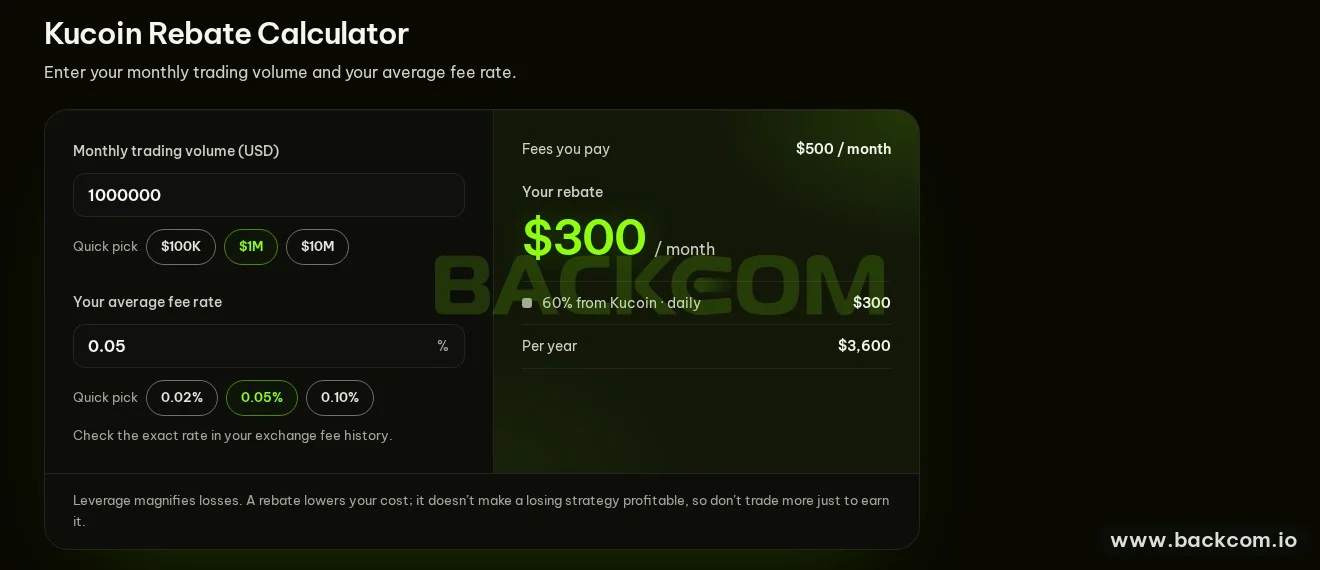
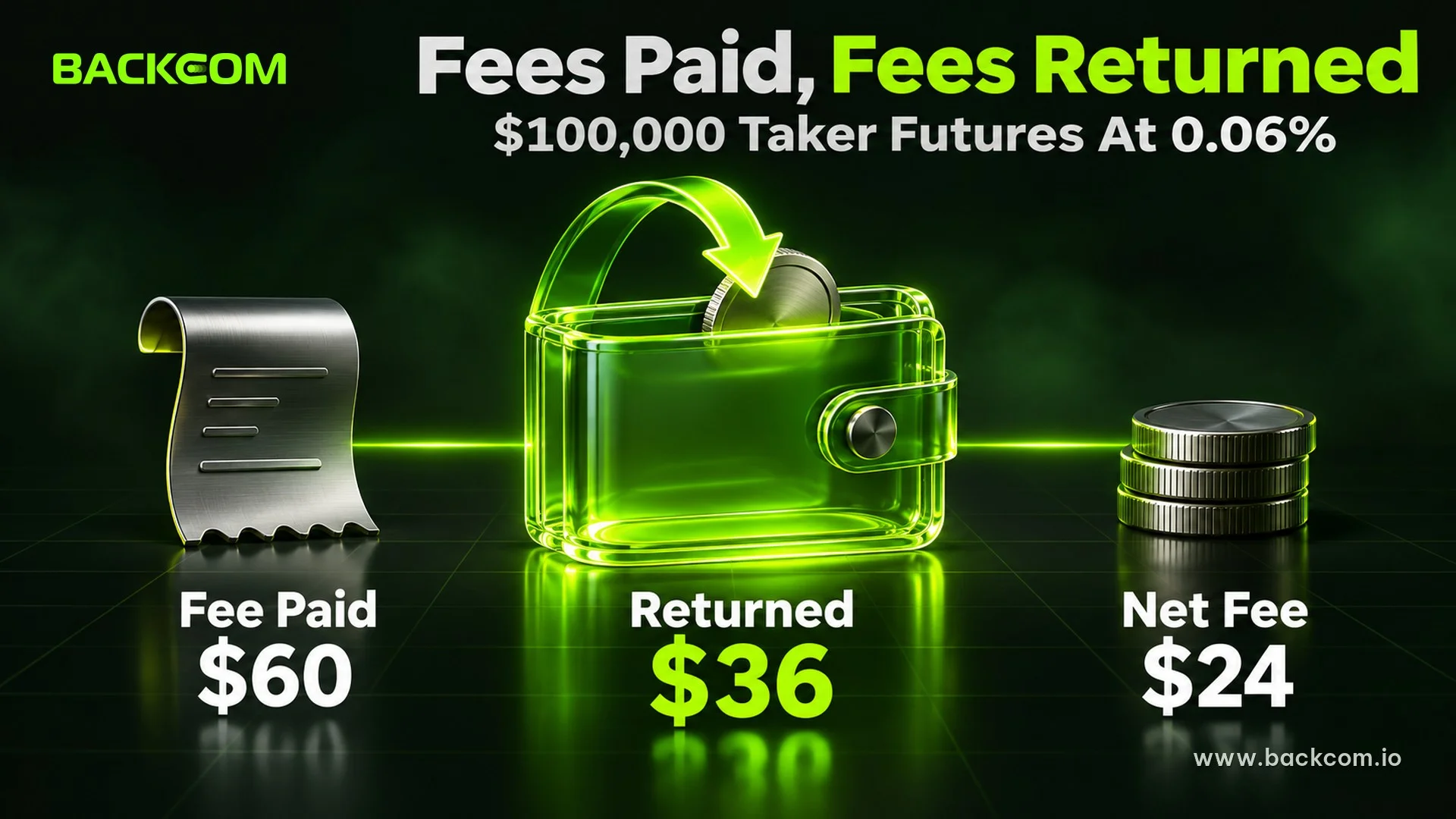
The rebate equals your fees paid multiplied by the rebate rate, so the amount depends on how many fees you generate and whether your orders are maker or taker.
Rebate = Fees Paid × 60%
Take a purely arithmetic example with $100,000 of notional volume in one month and a single order type each time:
| Scenario | Fee rate | Fees paid | 60% rebate | Net fee |
|---|---|---|---|---|
| Futures, all maker | 0.020% | $20 | $12 | $8 |
| Futures, all taker | 0.060% | $60 | $36 | $24 |
| Spot Class A, maker or taker | 0.100% | $100 | $60 | $40 |
These are assumptions for illustration, not forecasts. The effective fee falls from 0.06% to 0.024% on taker futures, and from 0.1% to 0.04% on spot Class A pairs. A trader who generates $100,000 of volume a month gets between $12 and $60 back, depending on the product and order type. That is a useful saving for an active trader and a rounding error for someone who trades twice a month.
A mixed month is closer to real life. Suppose you trade $60,000 of taker futures and $40,000 of maker futures:
- taker fees: $60,000 × 0.060% = $36;
- maker fees: $40,000 × 0.020% = $8;
- total fees: $44, so the rebate is $26.40 and the net fee is $17.60.
If you want to rebuild these numbers with your own position sizes, the guide to calculating crypto futures trading fees walks through the formula step by step.
KuCoin Fee Discount Or Rebate: How Does The KCS Fee Discount Work?
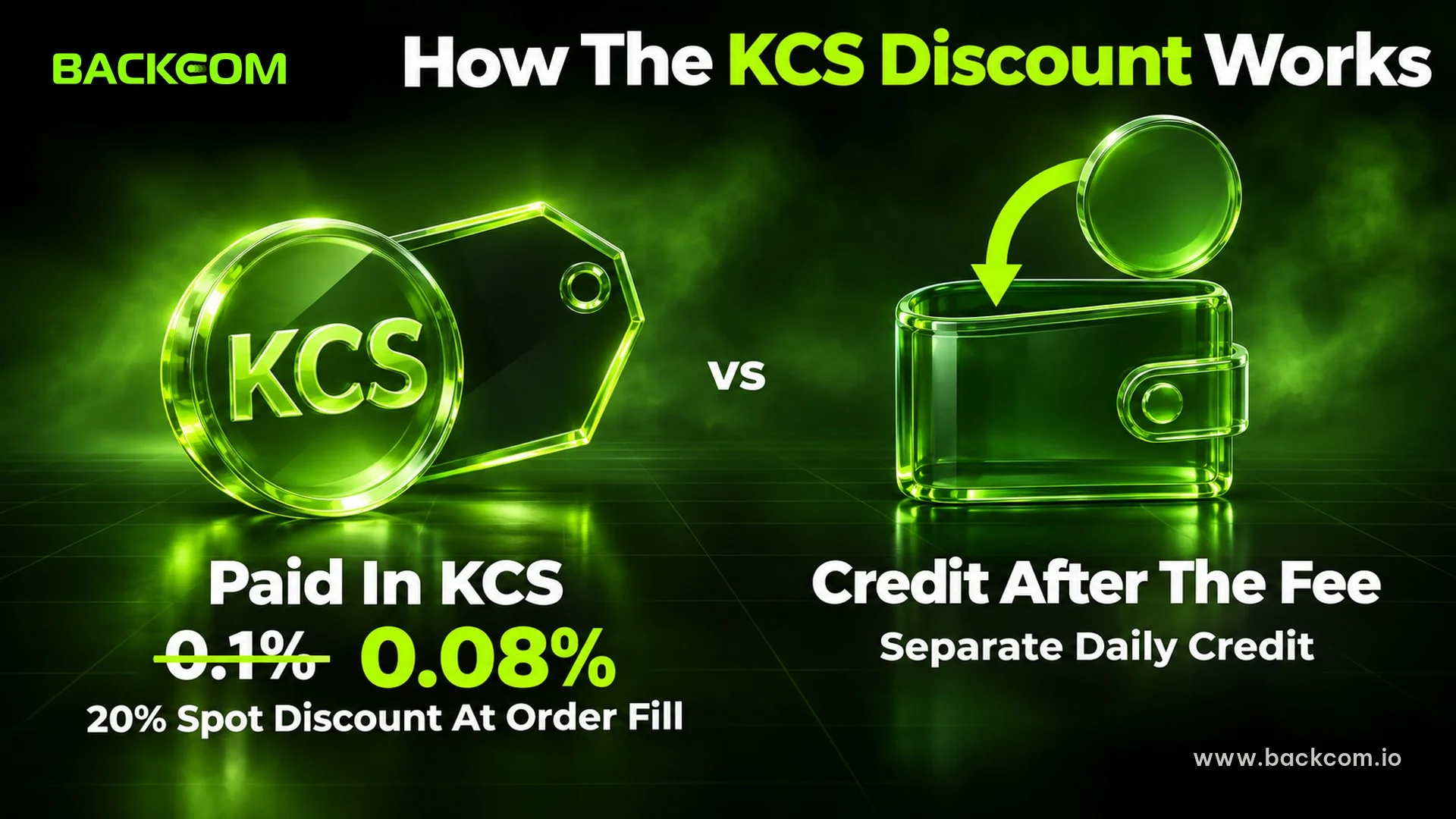
The KCS discount and the rebate answer different questions. The discount decides what the fee is when the order fills. The rebate decides how much of that fee returns later. They are not interchangeable, so read the terms of each before assuming both apply.
KuCoin's guide states that paying trading fees with KCS, the exchange's own token, gives a 20% discount on spot trading fees. On a 0.1% spot fee, that means 0.08% when the fee is paid in KCS. The guide describes the discount for spot, so check the live fee page for whether the same option covers futures before counting on it.
| Feature | KCS fee discount | Partner fee rebate |
|---|---|---|
| When it applies | At order fill | After the fee is charged |
| Where you see it | Lower fee on the trade record | Separate daily credit |
| What it is based on | Paying the fee in KCS | Fees actually paid |
| Main risk | Holding a volatile token just for the discount | Not being linked to the right account |
Do The KCS Discount And The Rebate Stack?
They can apply to the same trade, but the order matters. The rebate is a share of the fees you actually pay. On $100,000 of spot volume, the base fee is $100. If the fee is paid in KCS with a 20% discount, the fee falls to $80, and a 60% share of that is $48, leaving a net fee of $32. Without the KCS discount, the rebate is $60 on a $100 fee, a net fee of $40.
The gap is smaller than it looks, because a discount shrinks the base the rebate is calculated on. Check your own payout history to see which fee amount your credit was based on, and remember that holding KCS means holding a token whose price moves.
Is KuCoin Cashback The Same Thing?
KuCoin cashback is usually just another name for a rebate: money that returns after the fee is charged. Many pages advertising a "KuCoin referral code" quote different discount or cashback figures, and they contradict each other. None of them is an official KuCoin source, so treat those numbers as marketing until you can see the rate applied on your own account. The only figure worth trusting is the one that appears on your own fee records and in your own payout history.
Which Trades Count Towards The Rebate?
Only trades made on a linked account count. The rebate follows the account identifier (UID), not the person, so the linking step matters more than any other detail.
According to the published terms, the process works like this:
- Register a KuCoin account through the partner link before your first trade.
- Complete KYC (identity verification) on the new account.
- Link your UID in your rebate account dashboard.
- Trade as usual; the rebate accrues automatically and is credited daily.
Three details trip people up. First, the partner code normally cannot be added after you have signed up on the exchange, so an existing account may need a new registration with a new email. KuCoin allows one verified account per ID document, so a rejected KYC check is a question for KuCoin support. Second, each sub-account has its own UID and must be linked separately, because a new sub-account does not inherit the rebate. Third, trades made before the link is confirmed do not earn a rebate retroactively.
Availability also depends on your country, so check KuCoin's terms of service for restricted jurisdictions before registering. Our review of whether KuCoin is legit covers licensing, security and the regional entities in detail.
How Do You Check That Your Rebate Is Correct?
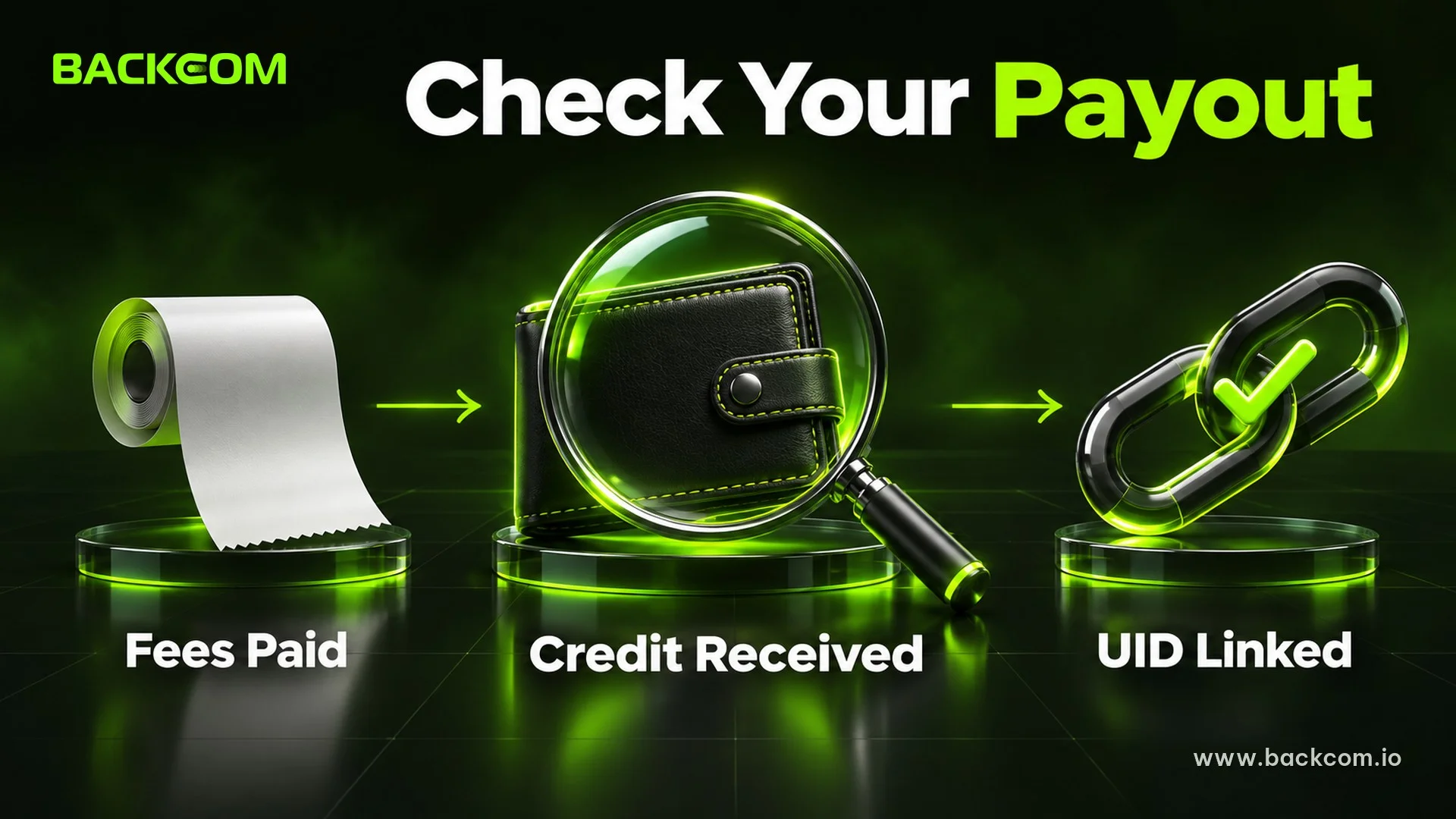
Verify the payout against your own trade records rather than trusting the headline rate. Three checks take a few minutes each month:
- Fees paid on KuCoin. Export or read your fee total for the period from the exchange, split by spot and futures.
- Rebate credited in your dashboard. Compare the credited amount with 60% of that fee total.
- UID status. Confirm every account and sub-account you trade on shows as linked.
If the credited amount is far below 60% of your fees, the most common causes are an unlinked sub-account, trades placed before the link was confirmed, or fees the programme does not cover. Ask support to explain the gap in writing and keep the answer.
The rebate also does not remove your trading risk. Fees are a small part of what a leveraged position can cost you, and a rebate on a losing month is still a loss. Size positions from your risk limits first, and treat the rebate as a lower cost per trade, not as a reason to trade more often.
When Is A KuCoin Rebate Worth Having, And When Is It Not?
A rebate is worth having when you already trade on KuCoin regularly and the saving is meaningful at your volume. It is not a reason to choose an exchange, open an account or increase your activity.
A short test helps:
- You trade often: monthly fees of $100 or more mean the rebate returns at least $60 a month.
- You mostly use maker orders: the fee base is small, so the rebate is small too.
- You trade rarely: the saving may not justify the extra linking step.
- You are comparing exchanges: compare the net fee after any rebate, not the headline rate. Our crypto exchange rebate comparison lists what to check before you compare programmes.
If you decide the saving is relevant, you can read the full KuCoin Rebates terms and the linking steps on the KuCoin exchange page. Backcom.io is an independent introducing broker (IB/affiliate) of KuCoin; rebates are paid from the commission the exchange pays Backcom.io. See the risk disclaimer for the full disclosure.
Frequently Asked Questions (FAQ) About KuCoin Fee Rebates
How Much Is The KuCoin Fee Rebate?
The partner terms published on the KuCoin exchange page state 60% of fees paid on spot and futures, credited daily with no minimum volume. The percentage applies to fees, not volume, so a $100,000 month of taker futures trading with $60 in fees returns about $36. Rates can change, so confirm the current figure on the live page.
Is A KuCoin Fee Rebate The Same As The KCS Discount?
No. The KCS discount lowers the fee at the moment an order fills when you pay it in KCS, while a rebate charges the full fee and returns a share afterwards as a separate credit. Both reduce your net cost, but they appear in different places. Check your fee records and your payout history separately.
Can I Add A Rebate To An Existing KuCoin Account?
Usually not. The partner code normally cannot be added after sign-up, so an existing account may need a new registration with a new email and fresh KYC. Confirm the current steps on the exchange page before you register, because the rules are set by KuCoin.
Does The Rebate Cover Funding Fees?
No. Funding is a payment between long and short holders, not a trading fee paid to the exchange. A rebate based on fees paid does not return funding costs, so count funding separately when you estimate the cost of a position.
Does Every Sub-Account Earn The Rebate?
Only if it is linked. Each sub-account has its own UID, and a new sub-account does not inherit the rebate from the main account. Link each UID separately and check the status before you trade on it.
Conclusion: Judge The Net Fee, Not The Headline Rate
A KuCoin fee rebate of 60% cuts the fees you pay on a linked account to 40% of the schedule, which means about 0.024% on taker futures and 0.04% on Class A spot at VIP 0. The saving scales with the fees you generate, so it matters for active traders and very little for occasional ones. Before relying on it, link every UID before trading, compare the credited amount with 60% of your fees each month, and treat funding and risk as costs the rebate does not touch.
Disclaimer: This content is compiled by Backcom.io for information only and is not investment advice. Crypto trading carries a high risk of loss, and rebate terms can change. Nothing here encourages you to open an account, deposit funds or trade more because of a rebate.
Was this article helpful?
Join The Backcom.io Community
Get the latest on trading rebates, trading tips, and broker deals — and connect with thousands of traders worldwide.

Backcom App
Track Your Rebates Every Day
Every rebate is visible by broker and by day. Manage your wallet and withdrawals in one place.
Open Backcom App