How To Calculate Profit In Forex: Pips, Lots And How The Spread Cuts Into Your Profit

Many forex traders focus on entries and strategy but skip one basic step: how to calculate profit in forex after costs. The profit you see on the chart is not exactly what reaches your account, because the spread, commission and other costs take their share first.
So what is the forex profit formula, and how does the spread cost eat into each trade? In this article, Backcom.io works through the calculation by pips and lots with EURUSD examples, then shows how the spread changes the result and how forex rebates can offset part of that cost.
How Is Forex Profit Calculated?
Learning how to calculate profit in forex comes down to two inputs: how many pips the price moved and how large the position was. Every other number, including the dollar value of each pip, follows from those two.
The Forex Profit Formula Using Pips And Lots
The forex profit formula multiplies the number of pips the price moved by the pip value and the trade size in lots:
Profit = Pips × Pip value per standard lot × Lots
The three terms mean:
- Pip: the standard unit of price movement, 0.0001 on EURUSD.
- Lot: the trade size, where 1 standard lot = 100,000 units of the base currency.
- Pip value: the money value of one pip, which depends on the currency pair and the lot size (what a pip is in forex).
A quick example: you trade 1 lot of EURUSD and the price moves 10 pips in your favour. The profit is about 10 pips × $10 × 1 lot = $100.
The examples in this article use EURUSD on an Exness account throughout. Pairs with a different pip structure, such as JPY pairs or gold, follow their own conversion.
The Factors Behind The Calculation: Pips, Pip Value And Lot Size
To read forex profit correctly, look at two core variables: pips and lots. They decide directly how much money you make or lose on a trade.
Pips: the size of the price move
The pip count reflects how far the price moved in your direction. EURUSD is quoted to five decimal places, in the form 1.abcde:
- Point: the fifth decimal (position e) is the point, the smallest step on the quote.
- Pip: the fourth decimal (position d) is the pip.
- Relationship: 1 pip = 10 points, so a move written as "d.e pips" equals "de points".
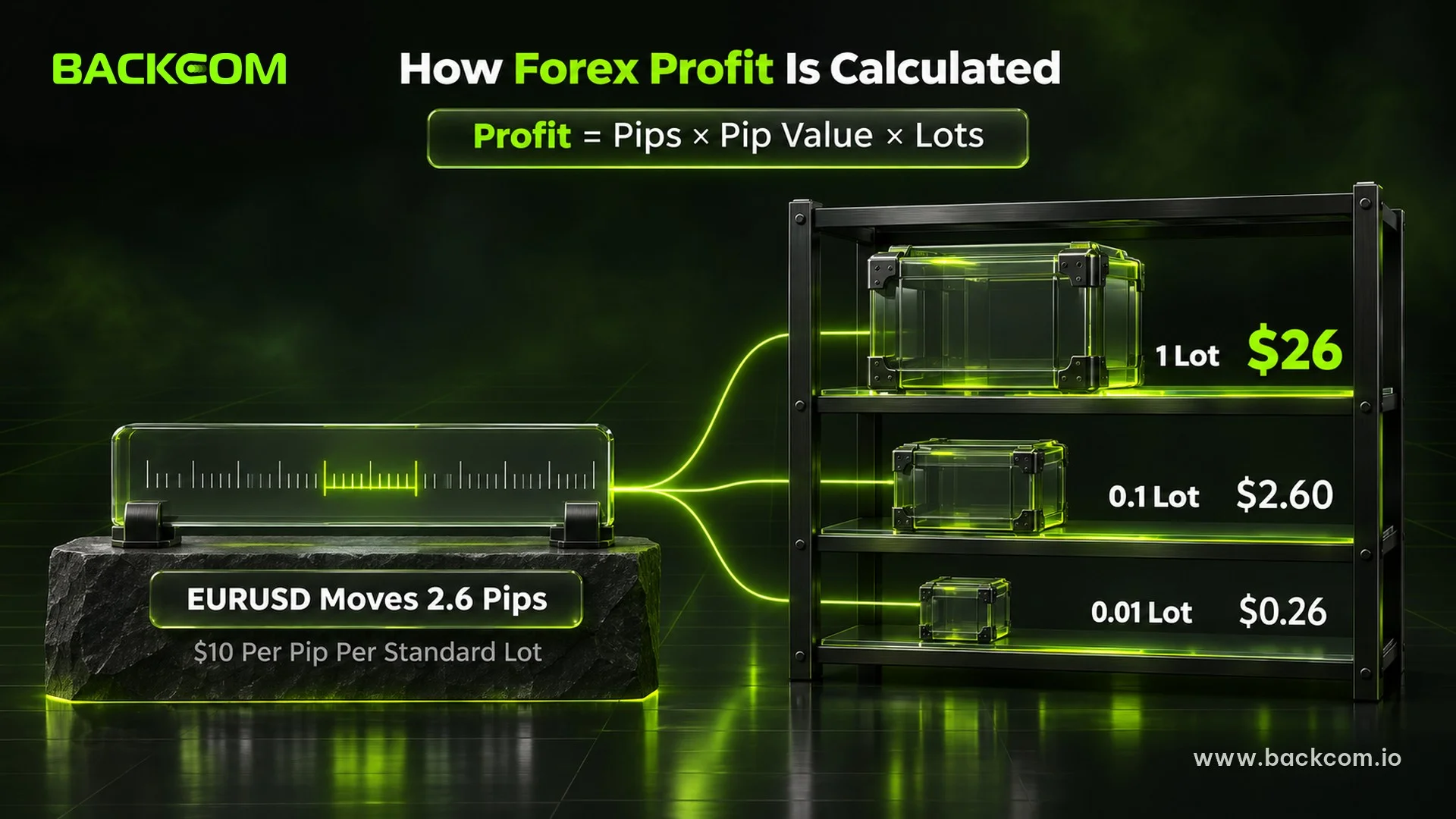
Suppose EURUSD is at 1.16754 and rises to 1.16780, a move of +0.00026. That is 2.6 pips, or 26 points.
Applying the formula on 1 lot:
- A Buy: 2.6 × $10 × 1 lot = +$26.
- A Sell: −2.6 × $10 × 1 lot = −$26, because the price rose against the position.
Lots: the money behind each pip
The lot size sets how much money each pip is worth. On EURUSD:
- 1 lot: about $10 per pip.
- 0.1 lot: about $1 per pip.
- 0.01 lot: about $0.10 per pip.
One standard lot of EURUSD (100,000 units) is worth $10 per pip. This follows from the convention that one pip equals 0.0001 on major pairs where USD is the quote currency: 100,000 × 0.0001 = $10. For a fuller explanation of lot sizes across pairs, see our guide to forex money management and lot size.
For a Buy on EURUSD where the price rises 2.6 pips, the full formula gives:
- 1 lot: profit = 2.6 × $10 × 1 = $26.
- 0.1 lot: profit = 2.6 × $10 × 0.1 = $2.60.
- 0.01 lot: profit = 2.6 × $10 × 0.01 = $0.26.
The shortcut is to multiply the pips by the pip value for your lot size directly: 2.6 × $10 = $26 on 1 lot, 2.6 × $1 = $2.60 on 0.1 lot and 2.6 × $0.10 = $0.26 on 0.01 lot. Once that is clear, the next step is the spread, which has a large effect on what you actually keep.
What Is The Spread Cost, And How Do You Calculate It?
The spread cost is the difference between the Buy (Ask) and Sell (Bid) prices, paid on every trade the moment it opens. It is the most direct cost in forex trading for most retail accounts.
How The Spread Works In Forex
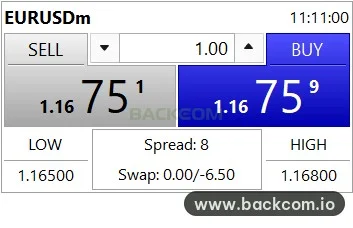
There is always a gap between the Ask and the Bid, called the spread. On an Exness MT5 quote for EURUSDm with a Bid of 1.16751 and an Ask of 1.16759, the spread shows as 8, meaning 8 points, or 0.8 pips.
MetaQuotes notes that buying is executed at the Ask and selling at the Bid, so a Buy opens at the higher price and a Sell at the lower one. See the source directly: the MetaTrader 5 help on order execution. In practice, a new position starts 0.8 pips in the red, exactly the size of the spread. This guide calls that amount the spread cost, the simplest form of a trading fee.
How To Calculate The Spread Cost On Each Trade
Using that quote:
- Bid: 1.16751.
- Ask: 1.16759, so the spread is 8 points = 0.8 pips.
Suppose you open a Buy of 1 lot. Your entry is 1.16759, the Ask. If you close immediately, you lose 0.8 pips:
Spread cost = 0.8 pips × $10 × 1 lot = $8
If you close the trade in profit instead, adding the spread back gives the profit before the spread was deducted. The MetaTrader 5 Market Watch help defines the spread the same way, as the difference between the Bid and Ask prices.
The spread therefore comes straight out of your real profit. It is revenue the broker earns on each trade, and part of it is paid to the broker's partners, the introducing brokers who referred the client.
Reducing Trading Costs With Forex Rebates
Forex rebates return part of that cost to you. When you trade, the broker earns the spread (or a commission) and pays a share to the introducing broker (IB) that referred you. A rebate service passes that IB commission back to the trader, see how a forex rebate is calculated per lot.
In practice:
- Your trading stays the same: orders, execution and account conditions do not change.
- No one intervenes in your account: the rebate is calculated from your traded volume.
- Registration is the only step: you open the account through the partner link or enter the partner code so the volume is recorded.
- What you receive: a share of the IB commission the broker pays on your trades, up to 100% of it.
A EURUSD example on Exness
Take the same trade on an Exness Standard account:
- Volume: 1 lot.
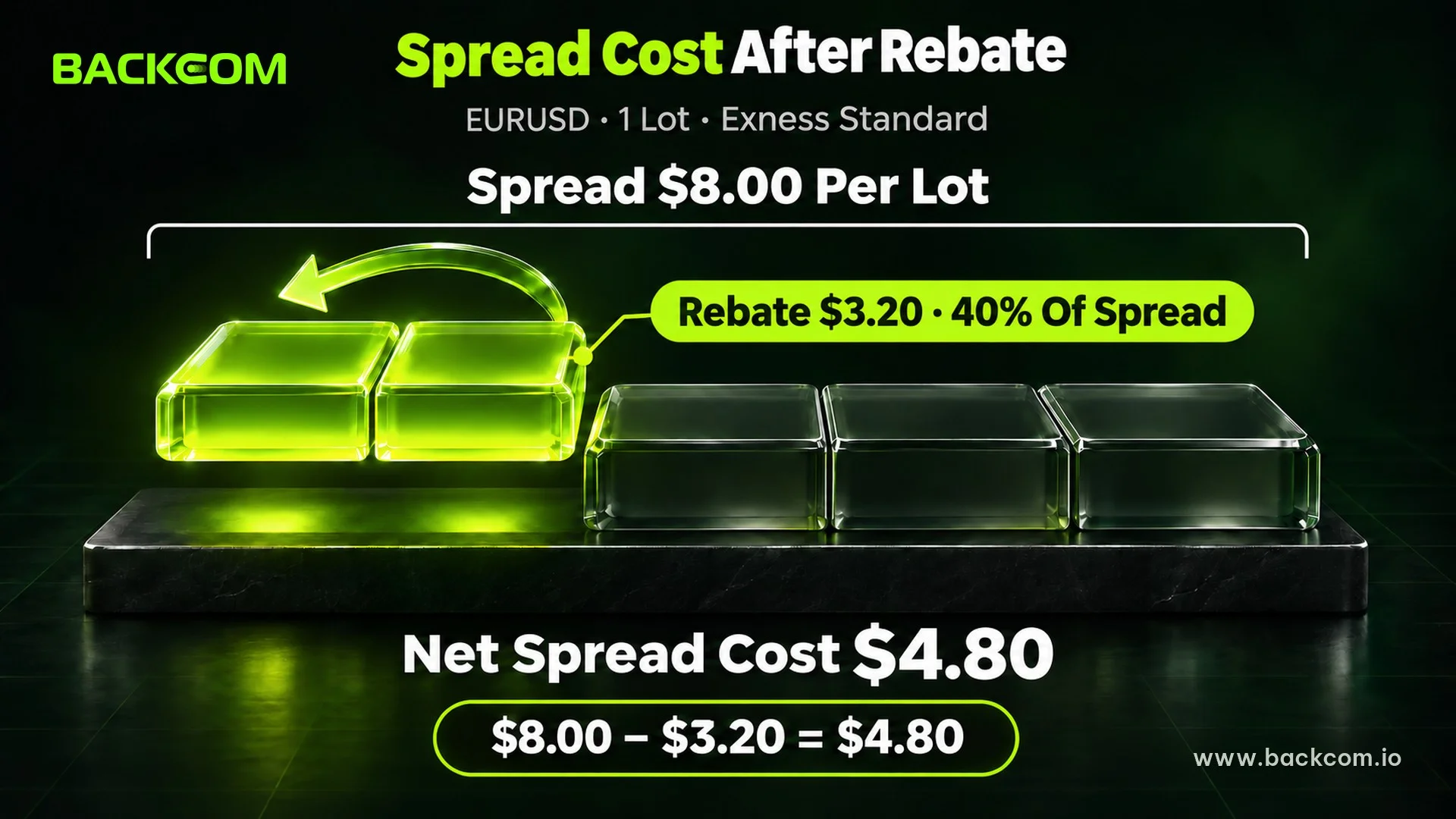
- Spread: 0.8 pips, or $8.
- Rebate: 40% of the spread, about $3.20 per lot.
On the Exness Standard account, the rebate is 40% of the spread, which the Exness Rebates page equates to 100% of the IB commission Exness pays. The live table showed EURUSD at $3.20 per lot on 20 November 2026. With the rebate, the net spread cost of this trade falls from $8 to $4.80 per lot.
Rates, conditions and the live per-symbol table are on the Exness Rebates page. Backcom.io is an independent introducing broker (IB/affiliate) of Exness; rebates are paid from the commission the broker pays Backcom.io — see the risk disclaimer.
Frequently Asked Questions (FAQ) About How To Calculate Profit In Forex
What Spread Is Good For Forex Trading?
There is no single number, but for EURUSD a rough guide is: under 1 pip is very good, usually on ECN or raw spread accounts; 1 to 1.5 pips is acceptable; above 2 pips is expensive. For short-term traders, the lower the spread the better, because it hits profit on every trade.
Is The Spread The Only Cost Of Trading Forex?
No. Besides the spread, you can also pay:
- Commission: depending on the account type.
- Swap: the overnight fee for holding a position past rollover.
- Slippage: when the market moves fast and your order fills at a worse price.
For most traders, though, the spread is the most common and most direct cost.
Does The Spread Matter More For Short-Term Trading?
Yes, a great deal. With a take profit of 5 pips and a spread of 0.8 pips, the spread takes about 16% of the profit. That is why scalpers in particular look for tight spreads or rebates.
How Can You Reduce Spread Costs?
There are three main ways:
- Choose a broker with low spreads on the pairs you trade.
- Use an ECN or raw spread account, comparing the spread plus commission.
- Add forex rebates, which lower the cost of every trade without changing how you trade.
Should Infrequent Traders Care About The Spread?
Yes. Even if you trade rarely, every trade still pays the spread and your profit is still reduced. Over the long run, the spread remains a meaningful factor in your trading performance.
Conclusion: Know Your Profit After Costs
Understanding how to calculate profit in forex tells you more than how much you are making: it shows what is left after costs, especially the spread cost. Costs are a common reason why a strategy that looks profitable on the chart earns less in the account.
Alongside improving your entries, it is worth managing costs: choosing a suitable broker and account type, keeping the spread low and using solutions such as forex rebates. Every dollar of cost you remove stays in your account.
Disclaimer: This content is compiled by Backcom.io for information only and is not investment advice or a trading recommendation. Spreads and rebate rates change over time, and the examples use prices quoted on specific dates. Leveraged forex trading can cause you to lose all of your capital.
Was this article helpful?
Join The Backcom.io Community
Get the latest on trading rebates, trading tips, and broker deals — and connect with thousands of traders worldwide.

Backcom App
Track Your Rebates Every Day
Every rebate is visible by broker and by day. Manage your wallet and withdrawals in one place.
Open Backcom App