7 Prop Firm Challenge Mistakes That Make Traders Fail, And How To Avoid Them

Many traders fail a challenge despite reading the trend correctly, because of one oversized position or a few minutes spent chasing a loss. Prop firm challenge mistakes that look small, such as moving a stop loss, trading too often or skipping a rule, can push you into a loss limit and leave you with a blown challenge account.
In this article, Backcom.io covers seven common mistakes and a short rule to avoid each one. Read it before paying the fee so you do not retake a challenge for the same error.
Why Do Nearly 90% Of Traders Fail A Prop Firm Challenge?

The "90% fail" figure is not an official rate for every firm. In data on more than 300,000 accounts from about 100,000 traders that FPFX Tech shared with Finance Magnates, about 14% of traders passed the challenge and received a funded account, so 86% did not reach that stage. Only about 7% of all traders reached a payout. This is one reference sample, not a market-wide rate, and splits such as "45% fail from oversized risk" have no reliable source.
To pass, you must hit the profit target while staying above both the daily floor and the overall floor. One breach can end the evaluation, even if the account was in profit. If the model is new to you, read our guide on what prop trading is. This article focuses on the behaviour that makes traders fail a prop firm challenge by wiping out their own safety margin.
A challenge tests discipline under pressure to make money. The seven mistakes below can happen in Phase 1, Phase 2 and on the funded account, so compare each one with your own trading journal.
Oversized Risk Per Trade To "Finish Early"
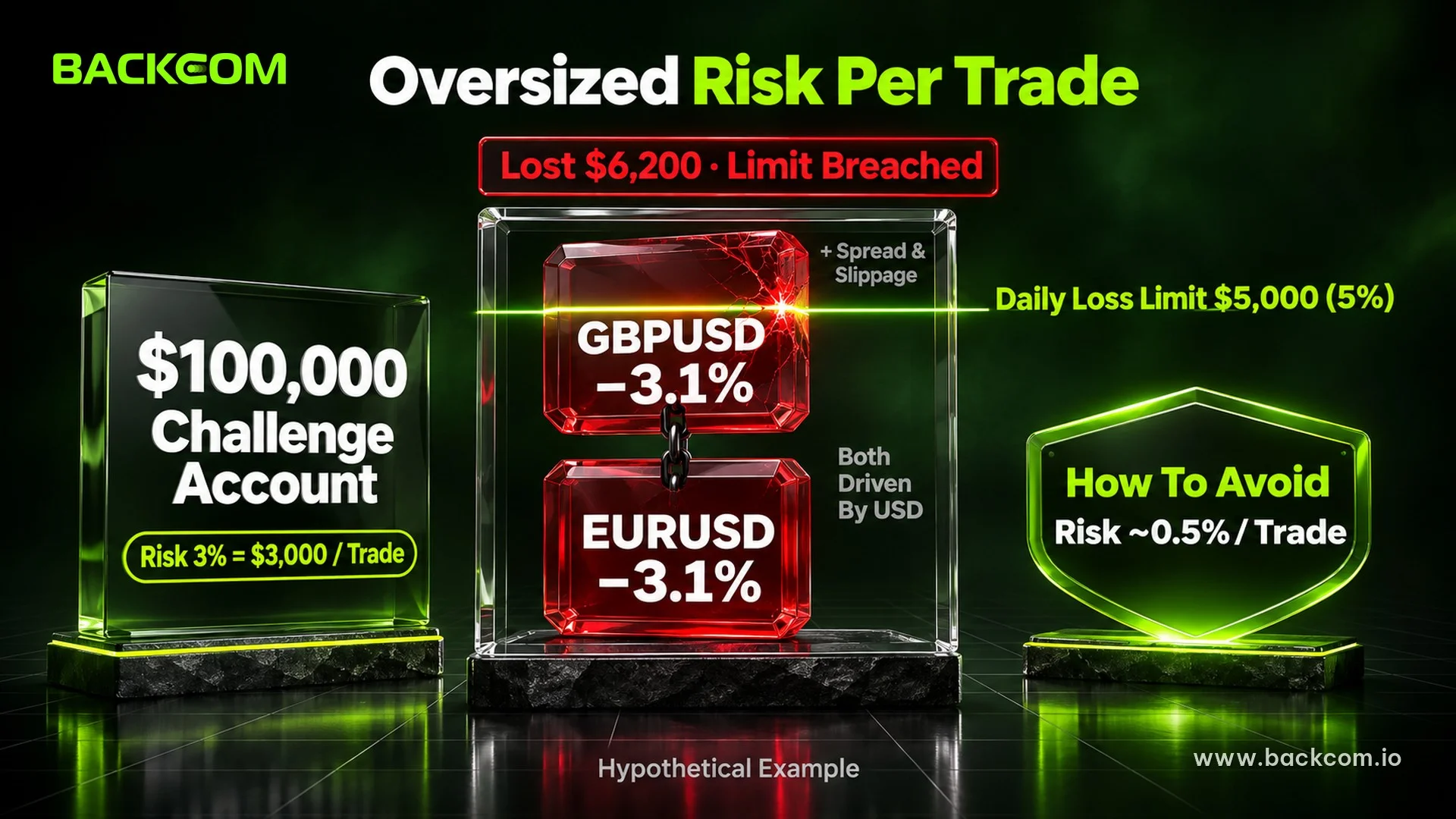
You buy a challenge on Monday and want to pass the same week. You raise risk to 3% per trade, and two losses in a row can exceed the 5% daily loss limit of a programme such as FTMO 2-Step. Trading big to finish early usually ends the challenge early instead.
A USD 100,000 account feels large, but your real loss budget is only the distance to the floor. If the daily loss limit is USD 5,000, a trade risking USD 3,000 uses more than half of it. Two pairs that both depend on the US dollar can lose at the same time, and spread and slippage make the real loss larger still.
How to avoid it:
- Set a budget per trade, for example 0.5% of the starting balance or less once your buffer is thin. Use a higher figure only if the total risk still fits inside the daily limit.
- Work out how much you can lose to the stop loss before choosing a lot size, and add the risk of any correlated positions.
- If a normal losing streak for your system could breach the daily loss, reduce size and accept a slower pass.
Lot sizing, buffers and tier limits are covered in our guide to prop firm risk management.
Revenge Trading: Trying To Win It Back Right After A Loss
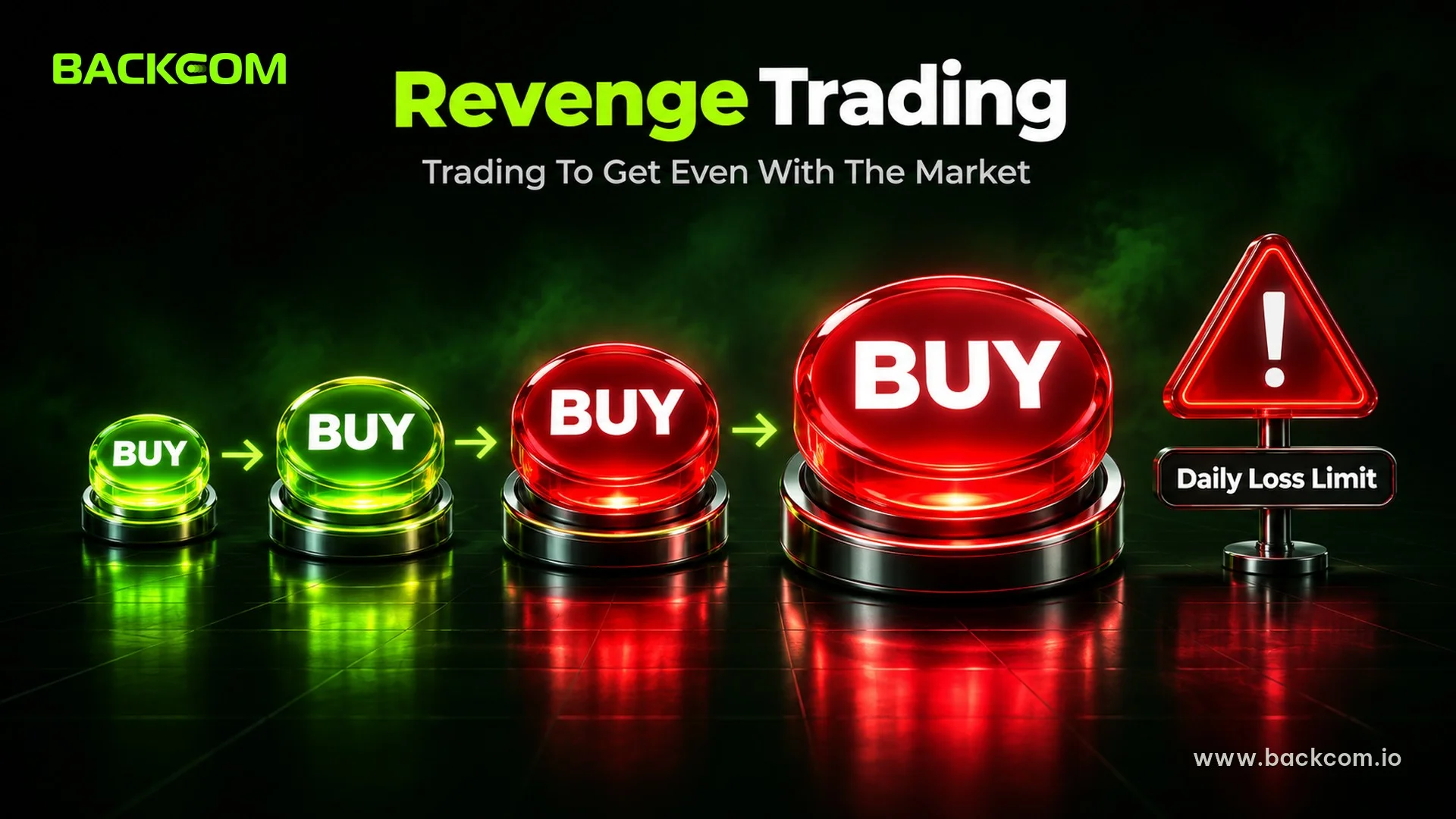
At 8 pm your first trade hits its stop loss. You immediately open a trade in the opposite direction at double the size to recover it. That trade also goes negative and pushes the account close to the daily loss limit. The market does not owe you a recovery trade.
Revenge trading replaces your entry criteria with urgency. You ask how much you need to win back instead of whether the setup fits your system. Each trade is bigger than the last, and the stop loss gets moved. The clearest warning sign is jumping back in before you can write down why the previous trade failed.
How to avoid it:
- Stop after two losing trades or when you hit your own daily budget, and close the platform until the next day.
- Log the losing trade and only re-enter on a fresh signal that meets your criteria. Never raise size to recover.
- If you tend to adjust trades on emotion, use alerts or a tool that locks trading for the day.
FTMO 2-Step sets no maximum time limit, so check your programme's deadline instead of forcing the challenge into one evening.
Overtrading On The Very First Trading Day
You have paid the fee, so you tell yourself you need to trade "to make it worth it". After the first trade you look for signals on five more pairs. By the end of the day you have eight trades, many in the same direction, even though only one clean setup appeared. More trades do not make the signals better.
Overtrading usually starts with the fear of missing out. Glancing at each signal for a few seconds makes it easy to miss news and correlation between pairs, while spreads and commissions add up. If you cannot say why the sixth trade beats the first five, you are chasing activity, not an edge. This is one of the prop firm challenge mistakes you can block before the first trade.
How to avoid it:
- Write down a maximum number of trades and your setup criteria. A limit of 2–3 trades a day is a personal rule, not a firm rule.
- Only watch the markets your system has been tested on, and do not add new instruments mid-challenge.
- Allow yourself a day with no trades when there is no signal, but check the rules on minimum trading days and inactivity.
Not Understanding How The Firm Calculates Daily Loss And Drawdown
A balance of USD 101,000 makes you feel safe. But an open trade is down USD 4,200, so equity is USD 96,800. If the daily floor is USD 97,000, the account has already breached the rule, even though the trade is still open. Balance is what has been booked; equity shows the risk that is running now.
According to FTMO's Trading Objectives, the 2-Step programme has a daily loss limit of 5% of the initial simulated capital. The floor is recalculated from the balance at 00:00 CE(S)T, and breaches are measured on equity, including open positions and costs. FTMO 1-Step uses different figures. Read the FTMO Challenge page and check the rules for the exact product you chose.
For futures firms, Topstep's explanation of the Maximum Loss Limit describes a trailing floor that rises with the end-of-day balance and never moves back down. A trader who is still above the starting balance can hit a floor that has been pulled up. Our comparison of futures and forex prop firms explains this trailing limit in more detail.
How to avoid it:
- Write down the daily floor, the overall floor and the reset time, and check them on the dashboard every day.
- Watch equity whenever you have open trades. Never judge your remaining buffer from the balance alone.
- Set your own stop above the firm's limit, for example 1% of the starting balance above the floor, as a personal buffer.
Switching Strategy Midway When The Target Is Close
You are 0.8% short of the target, so you open a large trade on a "sure thing" from a chat group. One stop loss pushes the account far back. Being close to the finish does not make a trade outside your system safe.
Or, after two flat weeks, you drop the system you tested and start copying someone else. Changing how you trade mid-challenge means your losing streaks, stops and sizes are no longer tested, and one winning trade does not prove the new approach has an edge. If your system does not fit the rules, fix that before the next attempt.
How to avoid it:
- Keep your entry conditions, stop loss and risk budget. Never go all-in to touch the target.
- Split the remaining target by week, but do not force yourself to trade every day.
- If your strategy clashes with the rules, pause. Before the next round, compare the reputable prop firms reviewed by Backcom.io on eligibility and drawdown.
Skipping The Banned-Practice Rules: A Profitable Account Can Still Fail

You hit the target, then discover you traded during a restricted news window for your account type. Or you hold a trade over the weekend after moving to a funded account because it was allowed during the evaluation. Profit on screen does not replace meeting the conditions.
News trading, weekend holding, copy trading, position limits, minimum trading days and consistency rules can differ by firm, product and stage. FTMO allows weekend holding during the evaluation, but funded Standard accounts have their own restrictions. FTMO 1-Step's 50% consistency rule (the Best Day Rule on older orders) is a condition to meet before a Reward, not an instant breach the moment one day goes over 50%. Our guide to prop firm news trading rules compares several firms, and our FTMO vs FundedNext comparison sets two rulebooks side by side, but always check the firm's own terms.
How to avoid it:
- Read the rules for the exact programme and stage before paying, then read them again when you move to funded.
- Write restricted news windows, position limits and completion conditions on a checklist next to your screen.
- When a term is unclear, ask support in writing and keep the answer.
Trading Psychology Slips After Phase 1
In Phase 1 you risked 0.5% per trade. In Phase 2 the target is lower, so you double your size, and a normal losing streak suddenly eats the whole buffer. Passing Phase 1 proves your rules work, so do not drop them straight after.
On FTMO 2-Step, the Verification target is 5%, lower than the 10% in the first round, but the daily loss limit still applies. Trading psychology also shifts once you are funded: the Reward feels closer, which brings FOMO or overconfidence after a winning run. Compare your journals from both phases. If the reasons for entering are the same but the lots keep growing, you have changed your rules without naming the change.
How to avoid it:
- Keep the same risk, trade count and setup conditions across both phases, and never change them out of excitement.
- Take one or two days off between the rounds to review your journal and the rules.
- After every trade, record the setup, risk, emotion and how well you followed the plan, and review it before increasing size.
Read our guide on how to pass a prop firm challenge to build a plan that runs through both rounds.
Checklist: 7 Prop Firm Challenge Mistakes To Rule Out Before You Buy
Tick each row before paying the fee:
| Mistake | Warning sign | Blocking rule |
|---|---|---|
| 1. Oversized risk | Raising lots to pass faster | Calculate the loss to the stop loss before entering |
| 2. Revenge trading | Raising lots after a loss | Stop when you hit your own daily loss limit |
| 3. Overtrading | Trading because you paid the fee | Cap the number of trades and take only clean setups |
| 4. Misreading drawdown | Watching only the balance | Check equity, the floors and the reset time |
| 5. Switching strategy | Going all-in near the target | Stick to the system you tested |
| 6. Skipping the terms | Unsure about news or weekend rules | Read the rules for the exact product and ask support |
| 7. Relaxing in Phase 2 | Raising risk after Phase 1 | Keep the same settings and review your journal |
Save it or share it with someone about to take a challenge.
Frequently Asked Questions (FAQ) About Prop Firm Challenge Mistakes
What Do You Lose Besides The Fee When You Fail A Challenge?
On a simulated challenge account, the direct cost is usually the fee you paid, and FTMO describes the financial risk of its evaluation as limited to that fee. Resets, subscriptions and retake terms vary by firm. You also lose preparation time, so fix the behaviour that made you fail on a practice account before buying again.
How Many Failed Attempts Before You Should Stop?
There is no fixed number. But if you fail twice because of the same mistake, do not buy a third attempt straight away. Review your journal, practise with the firm's exact limits and only return once you have followed your plan consistently over many sessions. Progress should show in your sizing, stop losses and setup selection, not in a promise to be more careful.
Is A Blown Challenge Account The Same As Blowing A Real Account?
The behaviour is the same: oversized trades, holding losers or chasing losses. The financial result is different. When a simulated challenge breaches a rule, you usually lose the fee and the right to continue that round, while losses on a personal account come out of your own capital. A blown challenge account is still a signal to fix your habits, but the simulated balance is not money you personally lost.
How Do You Build Trading Psychology Before A Challenge?
Start with rules you can check: risk per trade, maximum trades, a daily stop and a clear setup. Practise on a demo or small account with the same limits as the challenge, and log the trades you skipped for lack of a signal. Look for the moments you break your plan after a winning or losing streak. Stable trading psychology shows in following your rules over many sessions, not in feeling confident before the challenge starts.
Conclusion
A challenge rarely fails you on its own; more often, the same seven mistakes repeat themselves. Use the checklist before buying, and keep your risk budget, daily stop and the firm's rules in view every day.
If you have already failed a challenge, find the behaviour to fix before paying again. Continue with our guide on how to pass a prop firm challenge and the beginner's guide to prop trading to complete your plan.
Disclaimer: This content is compiled by Backcom.io for information only and is not investment advice or a guarantee of passing a challenge. Check the current rules of the exact programme before paying.
Was this article helpful?
Join The Backcom.io Community
Get the latest on trading rebates, trading tips, and broker deals — and connect with thousands of traders worldwide.

Backcom App
Track Your Rebates Every Day
Every rebate is visible by broker and by day. Manage your wallet and withdrawals in one place.
Open Backcom App