Futures Prop Firm Vs Forex Prop Firm: What Is Topstep And Which Path Should You Choose?

Browse any prop trading community today and, next to familiar forex prop firm names such as FTMO, FundedNext or The5ers, you will run into a second world: the futures prop firm, with Topstep, ES, NQ, the Trading Combine and trailing drawdown. So what are futures, how does this model differ from a forex prop firm, and what is Topstep, the name traders keep bringing up?
Both branches revolve around passing an evaluation to reach a funded account, but they differ in the market, the fees, the drawdown rule and the payout timing. In this article, Backcom.io separates the two branches, uses Topstep to show how a futures prop firm operates, and helps you choose the path that fits your style rather than the trend.
Futures Prop Firms And Forex Prop Firms: Two Branches Of The Same Model
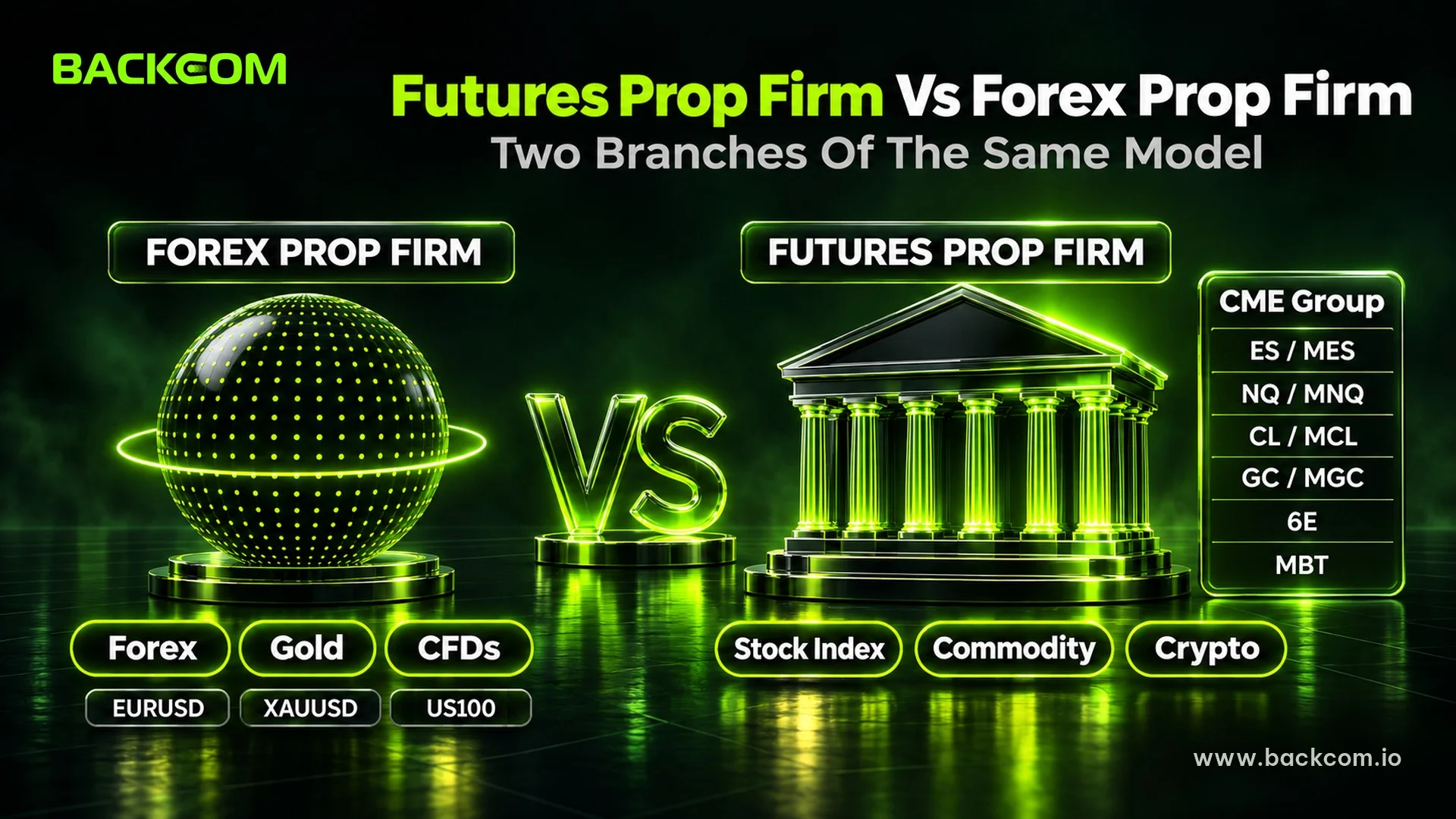
A futures prop firm and a forex prop firm both assess a trader's skill before granting access to a funded stage. The core difference is the market being traded: the forex branch centres on currency pairs, gold and CFDs, while the futures branch uses standardised contracts listed on centralised exchanges.
If the model is new to you, what prop trading is covers the path from challenge to payout.
What Are Futures? A Quick Explanation For Forex Traders
If you are used to XAU/USD, EUR/USD or a US100 CFD, the first question is usually what are futures in practice?
A futures contract is a standardised agreement to buy or sell an asset on terms set by the exchange. Unlike most retail forex, which is traded over the counter, futures trade on a central exchange and settle through a clearing house. CME Group, for example, operates the CME, CBOT, NYMEX and COMEX exchanges.
These are the symbols traders meet most often:
- ES / MES: E-mini and Micro E-mini S&P 500.
- NQ / MNQ: Nasdaq-100 futures.
- CL / MCL: WTI crude oil.
- GC / MGC: gold futures.
- 6E: Euro FX futures.
- MBT: Micro Bitcoin futures.
For a forex trader, the simple mapping is this: instead of XAU/USD you may trade GC or MGC, and instead of a Nasdaq CFD you trade NQ or MNQ. Technical analysis carries over, but tick values, contract size, fees and risk limits work quite differently.
Forex Prop Firm Vs Futures Prop Firm: Side-By-Side Table
| Criterion | Forex prop firm | Futures prop firm |
|---|---|---|
| Market | Forex/CFDs, mostly OTC | Futures contracts on a central exchange |
| Familiar products | EUR/USD, GBP/USD, XAU/USD, US100 | ES, NQ, CL, GC, MES, MNQ |
| Challenge fee | Usually a one-off payment | Usually a monthly subscription |
| Examples | FTMO, FundedNext, The5ers | Topstep, Apex Trader Funding, TradeDay |
| Platforms | MT4/MT5, cTrader or in-house platforms | TopstepX and dedicated futures platforms |
| Drawdown | Many models use a fixed overall loss limit | Trailing drawdown is common |
| Busiest hours | Forex runs across all four sessions | Index futures are most liquid in the US session |
Neither branch is "more advanced"; the structure differs. A trader used to lots, pips and a fixed maximum drawdown needs time to adjust to contracts, ticks and a trailing limit at a futures prop firm. The forex trading hours in UTC table shows where the US session falls in your day.
How Does A Futures Prop Firm Work Differently? 3 Concepts To Learn First
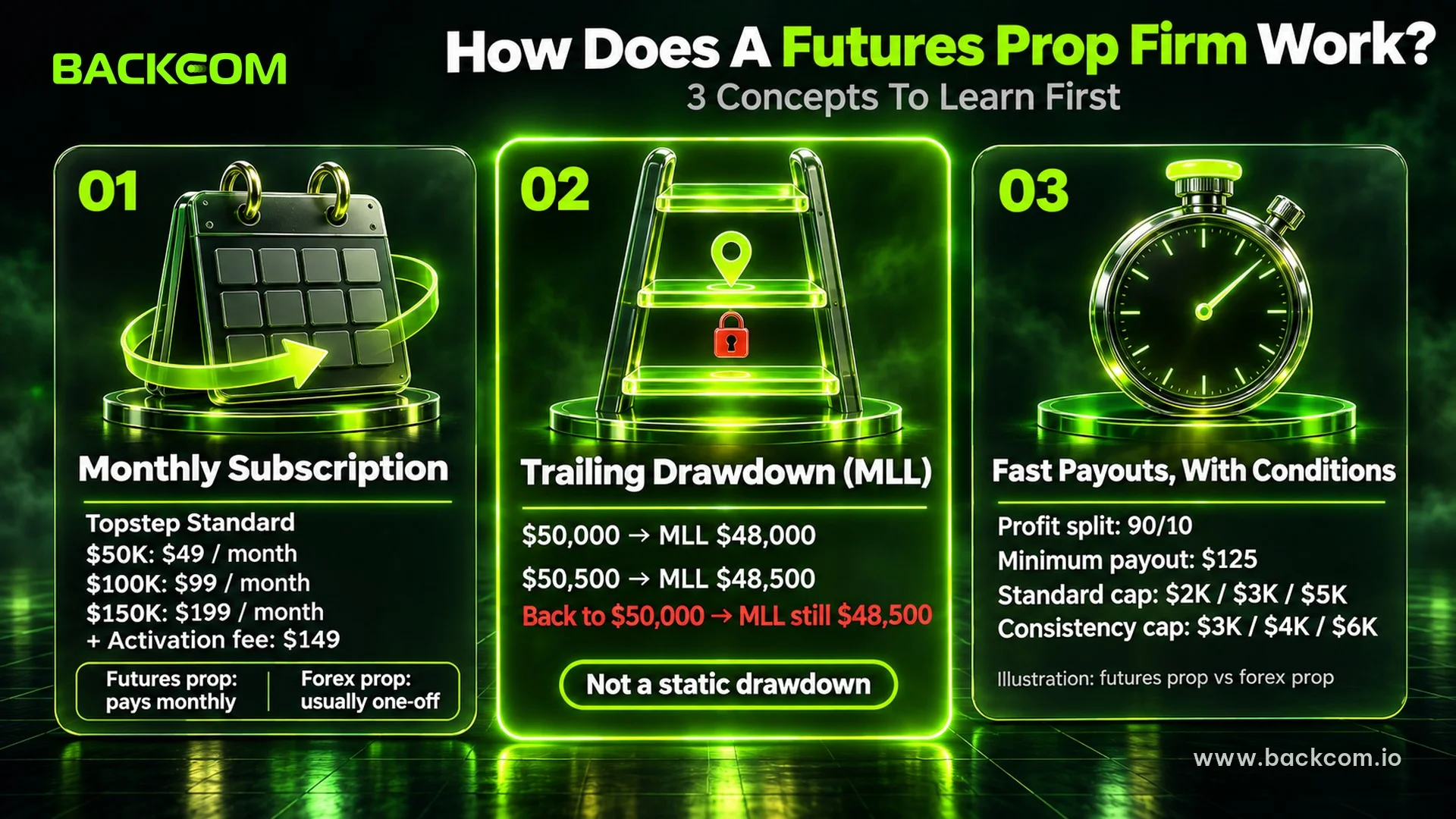
If you plan to move from a forex prop firm to a futures prop firm, do not look only at the low challenge fee. Three things decide how long the account survives: the subscription, trailing drawdown and the payout mechanism.
Monthly Subscription Fees Instead Of A One-Off Purchase
At many forex prop firms you buy a challenge once and trade until you pass or break a rule. FTMO's 2-Step is the classic example, with a one-off fee and an unlimited trading period.
Topstep instead charges a subscription for the Trading Combine. According to the Topstep pricing page, checked on 20 November 2026, the two paths cost:
- Standard Path: $49 a month for $50K, $99 for $100K and $199 for $150K, plus a $149 activation fee for each Express Funded Account you earn.
- No Activation Fee Path: $95, $149 and $229 a month for the same three sizes, with no activation fee.
Take a $50K Standard account as an example:
- Pass after 1 month: $49 subscription + $149 activation = $198.
- Pass after 3 months: $147 + $149 = $296.
- Pass after 6 months: $294 + $149 = $443.
By comparison, FTMO's listed price for the 2-Step $50K account was about €345, paid once, in September 2026. Prices vary by region and promotion.
So a subscription is not automatically "cheaper": it pays off when you finish the evaluation quickly.
Trailing Drawdown: The Biggest Shock When Moving From Forex To Futures
FTMO's 2-Step uses a fixed 10% Maximum Loss measured from the initial simulated capital. On a $100,000 account, the floor sits at $90,000, and it does not move up just because the account has made a profit.
Topstep uses a trailing Maximum Loss Limit (MLL). The MLL rises with the end-of-day balance whenever the account sets a new high, and it never moves back down. On a $50K Trading Combine:
- Start: balance $50,000 → MLL $48,000.
- End of day with a $500 profit: balance $50,500 → MLL rises to $48,500.
- Next day, a $500 loss: balance back at $50,000, but the MLL stays at $48,500.
Once the MLL reaches the starting balance, it locks there. Topstep monitors realised and unrealised P&L in real time, so touching the limit intraday liquidates the account at once. The Maximum Loss Limit help article walks through the same example.
That is why traders used to a static maximum drawdown slip up: an early profit does not become a full buffer you can lose again. Drawdown in trading explains static and relative drawdown.
A safer approach is to treat the MLL as the stop loss for the whole account:
- Do not trade the full contract allowance just because the platform permits it.
- Always know the current MLL before entering a trade.
- Size risk from the distance to the MLL, not from the "$50K buying power" headline.
- Reduce size after a big winning day instead of increasing it out of confidence.
Fast Payouts, But With Conditions And Caps
Payouts are what draw most attention to the futures prop firm model.
On Topstep's Express Funded Account (XFA), there are currently two payout paths:
| Path | Main condition | Payout |
|---|---|---|
| Standard | 5 winning days, each with Net P&L of $150 or more | Up to 50% of the balance, subject to a cap by account size |
| Consistency | At least 3 trading days, best day no more than 40% of total net profit | Up to 50% of the balance, with a higher cap than Standard |
Payout paths as listed in Topstep's payout policy on 20 November 2026. Caps and conditions can change, so check them before you request a payout.
The profit split is 90/10 in the trader's favour, and the minimum payout is $125. The base cap per request is $2,000/$3,000/$5,000 on the Standard path and $3,000/$4,000/$6,000 on the Consistency path for $50K/$100K/$150K accounts, according to the Topstep payout policy. The same page also describes a limited-time option that raises these caps when a Daily Loss Limit is added at checkout.
Many forex prop firms work differently. FTMO, for example, lets an eligible trader request a Reward from day 14 after the first trade on the FTMO Account, according to its reward withdrawal FAQ.
What Is Topstep? The Best-Known Futures Prop Firm
What is Topstep? It is a prop firm focused on futures, operating in Chicago since 2012. Traders pass the Trading Combine to receive an Express Funded Account, then build a trading and payout record before they may be moved up to a Live account if they qualify.
Before you sign up, check the latest rules directly on Topstep's official programme page.
Topstep Quick Facts
| Item | Reference information |
|---|---|
| Founded | 2012, Chicago |
| Market | CME Group futures |
| Evaluation | Trading Combine |
| Sizes | $50K / $100K / $150K buying power |
| Standard subscription | $49 / $99 / $199 a month |
| Profit target | $3,000 / $6,000 / $9,000 |
| Maximum Loss Limit | $2,000 / $3,000 / $4,500 |
| Combine consistency target | 55% |
| XFA profit split | 90/10 |
| Minimum payout | $125 |
| Main platform | TopstepX |
| Path | Combine → XFA → Live, depending on country eligibility |
Figures as listed on Topstep's help centre on 20 November 2026. Prices and rules can change, so check them again before you buy.
Topstep's marketing pages cite more than $1.4 billion paid out to traders, a figure published by Topstep itself rather than an independent audit.
Trading Combine Rules: How Do You Pass?
The Trading Combine has been simplified into one rule and two objectives:
- Do not hit the Maximum Loss Limit.
- Reach the profit target.
- Meet the consistency target.
The Combine consistency target is 55%, meaning your best trading day should stay below 55% of the profit target. On a $50K account with a $3,000 target, Topstep recommends keeping the best day under $1,650. If one day is larger, the target effectively rises: a $2,200 best day lifts the required profit to $4,000. You can pass in as few as two days, and the prop firm consistency rule guide compares similar limits elsewhere.
After passing, you activate an Express Funded Account (XFA). The XFA runs in a simulated environment but pays real payouts. Topstep may later move eligible traders to a Live Funded Account.
Country eligibility matters here. Topstep bases eligibility on both citizenship and permanent residency. Some countries are fully restricted, while others can earn XFA payouts but cannot reach the Live Funded Account. For that second group, Topstep's eligibility page caps total XFA payouts at $200,000 and mentions a possible Pro Account track. The list was updated on 17 November 2026, so check it on the day you buy.
Topstep Strengths And Points To Weigh
What stands out:
- Operating since 2012, a long record in futures prop trading.
- A single-stage Trading Combine.
- Entry cost from $49 a month on the $50K Standard path.
- Micro contracts such as MES, MNQ and MGC for smaller size.
- The XFA Consistency path can qualify for a payout after 3 days.
- TopstepX combines risk controls with futures data.
On the other hand, Topstep does not suit every trader:
- No spot forex or CFDs: Topstep confirms its programme is futures-only.
- The trailing Maximum Loss Limit takes time to get used to.
- The subscription keeps costing money if you pass slowly.
- XFA payouts are capped.
- Documentation and support are mainly in English.
- Some countries are limited to the XFA track, with no Live account.
Topstep Vs A Forex Prop Firm: Head-To-Head With FTMO
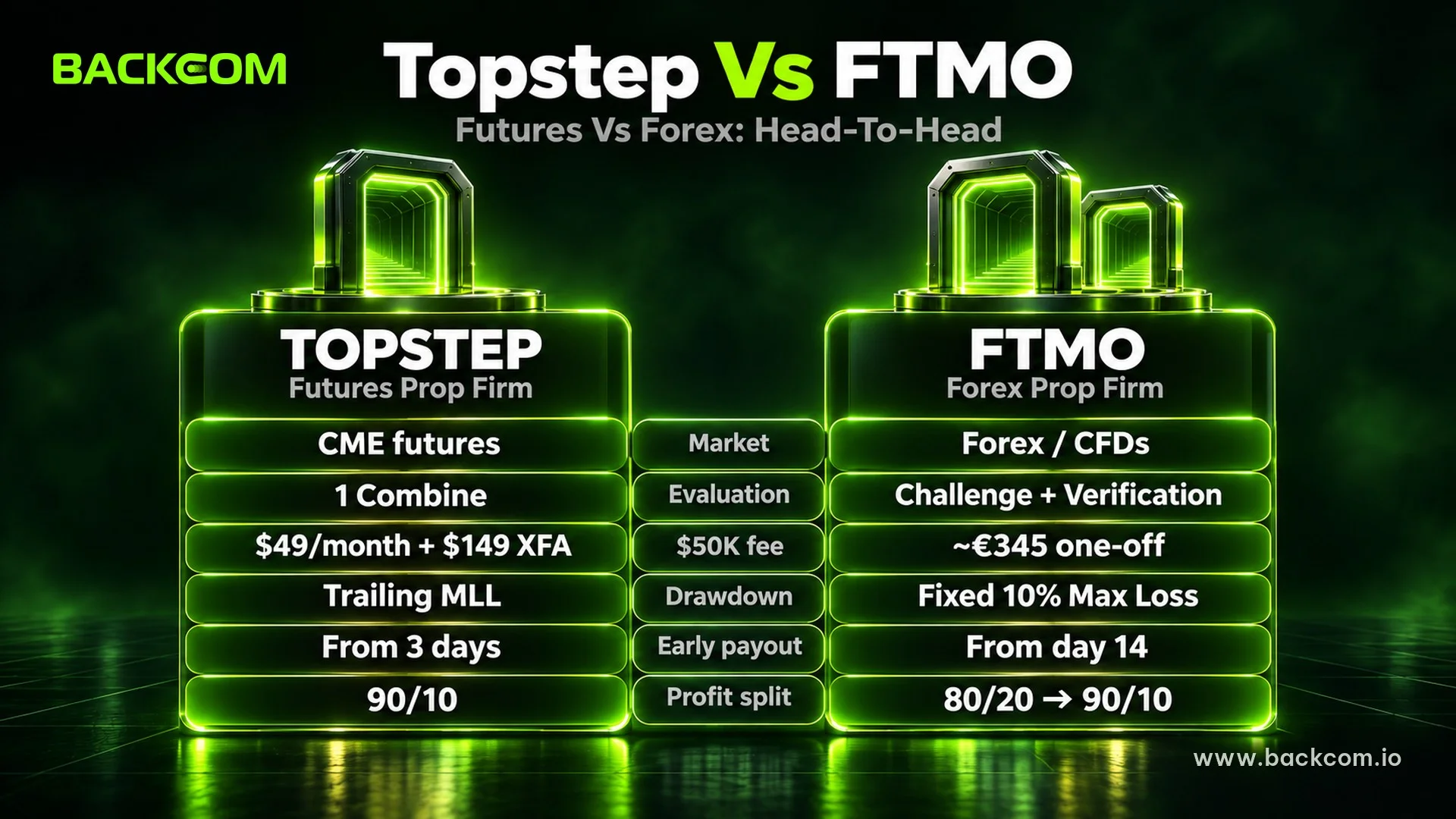
Here Topstep stands for futures and FTMO 2-Step for the forex prop firm model. This compares two models, not a full Topstep vs FTMO review.
FTMO rule figures come from the official FTMO 2-Step Challenge page. The reward split and timing come from FTMO's reward withdrawal FAQ, and the €345 fee was FTMO's listed price in September 2026. For FTMO's rules and payouts in depth, read the FTMO review.
| Criterion | Topstep | FTMO 2-Step |
|---|---|---|
| Market | CME Group futures | Forex, indices, commodities, stocks, crypto CFDs |
| Evaluation | 1 Trading Combine | Challenge + Verification |
| Fee | Monthly subscription | One-off fee |
| $50K | $49/month Standard + $149 XFA activation | About €345 one-off |
| Profit target | $3,000 on $50K | 10% Phase 1 + 5% Phase 2 |
| Drawdown | Trailing MLL | Fixed 10% Maximum Loss |
| Consistency | 55% in the Combine | No equivalent consistency rule on 2-Step |
| Early payout | XFA Consistency possible from 3 days | Reward request from day 14 |
| Profit split | 90/10 | 80/20, can rise to 90/10 under conditions |
| Platform | TopstepX | FTMO-supported platforms |
| Language support | Mainly English | Website available in many languages |
Topstep figures as listed on 20 November 2026; FTMO fee as listed in September 2026. Check both firms' official pages before you buy.
FTMO 2-Step also sets a 5% Maximum Daily Loss and at least 4 trading days per phase.
On cost: Topstep has a low entry cost if you pass quickly. If the process drags on for months, subscription plus activation fee can erase that advantage.
On rules: FTMO 2-Step is easier to picture for traders used to percentage drawdown. Topstep has fewer steps, but the trailing MLL demands tighter control of account equity.
On products: XAU/USD, EUR/USD or GBP/USD traders change less on the forex side, while Nasdaq, S&P 500 or US oil traders may find NQ, ES and CL futures more direct.
On payouts: Topstep offers an earlier first payout, but the XFA has caps plus qualifying-day and consistency rules. FTMO pays later and does not use XFA-style caps.
Topstep also publishes its own comparison of forex and futures trading. Since it comes from a futures company, read it as Topstep's point of view, not a neutral assessment.
The list of reputable prop firms shows other forex prop models to compare before you switch.
Which Path Should You Take? Choosing By Trader Profile
Once you know what Topstep is, the practical question is which branch fits you. There is no single right answer for every trader.
| Trader profile | Branch worth exploring | Why |
|---|---|---|
| Used to MT5, XAU/USD and forex pairs | Forex prop firm | Fewer changes to tools and risk calculation |
| Prefers the Nasdaq/S&P 500 and the US session | Futures prop firm | NQ/ES liquidity is strongest in the US session |
| Free to trade during US market hours | Futures prop firm | The busiest futures window fits your schedule |
| Small upfront budget and able to pass quickly | Futures | Low initial subscription |
| Usually needs several months to stabilise | Forex | A one-off fee removes subscription pressure |
| Dislikes trailing drawdown | Forex | Many models use a fixed maximum loss |
| Wants an early route to payouts | Futures | Some XFA paths qualify from 3 days |
| Relies on MT4/MT5 tutorials and community tools | Forex | The MT4/MT5 ecosystem is larger |
One caveat: Topstep's route to Live is not open in every country, so judge a futures prop firm on the XFA and payout terms for your country.
The branches are not mutually exclusive: you can trade gold and currency pairs on the forex side while learning futures with small MES or MNQ positions.
Whichever path you choose, prop firm risk management matters more than the firm's name, and the same daily loss discipline applies to both. If you are preparing for an evaluation, see how to pass a prop firm challenge.
Frequently Asked Questions (FAQ) About Futures Prop Firms
Does Topstep Allow Forex Or Gold Trading?
Topstep does not offer spot forex such as EUR/USD on MT5, only CME Group futures. You can still trade gold futures (GC) or Micro Gold (MGC), as well as FX futures such as 6E. GC futures and spot XAU/USD both track the gold price, but they are different products in contract structure, fees and how they trade.
Can Traders From Any Country Join A Futures Prop Firm Like Topstep?
Not every country. Topstep bases eligibility on both citizenship and permanent residency. Some countries are fully restricted, while others can buy the Trading Combine, earn an XFA and receive payouts of up to $200,000 in total without access to the Live Funded Account. The list changed on 17 November 2026, so check Topstep's eligibility page on the day you buy.
What Is Trailing Drawdown, In One Sentence?
If what are futures explains the market you trade, trailing drawdown explains the account's survival line: it is a maximum loss level that moves up with your balance high but does not move down when you give profit back. At Topstep, the MLL updates at the end of each day but is monitored live during the session.
Which Other Futures Prop Firms Are There?
Besides Topstep, the market includes Apex Trader Funding, TradeDay and many other futures prop firms. Their subscriptions, trailing drawdown, activation fees and payout rules differ considerably, so once you understand what Topstep is, do not assume its rules apply to the whole market.
Conclusion: Futures Prop Firm Or Forex Prop Firm Has No Universal Answer
A futures prop firm and a forex prop firm both assess traders before granting funded access, but they differ most in the market, the fee structure and the drawdown rule. Forex stays close to the MT4/MT5 setup many traders already know. Futures move you to standardised contracts, ticks and a trailing risk limit.
If Topstep interests you, look at the subscription, the MLL, the payout caps and the country eligibility list, not just the $49 entry price. If you already trade forex, revisit the basics of prop trading before deciding whether a switch to futures is worth it.
Disclaimer: This content is compiled by Backcom.io for information only and is not investment advice. It makes no promise that you will pass an evaluation or receive a payout. Futures and leveraged CFD trading carry a high risk of loss, and prop firm rules, prices and eligibility can change at any time.
Was this article helpful?
Join The Backcom.io Community
Get the latest on trading rebates, trading tips, and broker deals — and connect with thousands of traders worldwide.

Backcom App
Track Your Rebates Every Day
Every rebate is visible by broker and by day. Manage your wallet and withdrawals in one place.
Open Backcom App