What Is Prop Trading? A Beginner's Guide To Prop Firms, Challenges And Payouts

What is prop trading? The short answer is that it means trading with a firm's capital instead of your own, in exchange for a share of the profit. The longer answer is messier, because the word "prop" now covers two very different businesses. One is the traditional trading desk. The other is the retail prop firm that sells you a paid test. Most beginners searching today mean the second kind, and the gap between the two is where most confusion, and most lost fees, come from.
In this article, Backcom.io explains the questions beginners ask most often:
- What prop trading is, and how a retail prop firm differs from a traditional proprietary desk.
- How prop firms work, including where the money really comes from.
- How a prop firm challenge works, with the typical targets and loss limits.
- What a funded trader account is, how the profit split works and why a payout is never automatic.
What Is Prop Trading? A Plain-English Definition
Prop trading is short for proprietary trading: a firm trades financial markets using its own money rather than client money, and keeps the result. Investment firms and hedge funds have run proprietary desks for decades, hiring traders as employees, giving them a risk budget and paying salary plus bonus.
Traditional Prop Desks Versus Retail Prop Firms
A retail prop firm is a newer model aimed at individuals. You pay a fee, trade a test account under strict rules and, if you meet the conditions, the firm offers you a funded account with a profit share. The sources reviewed on 2 November 2026 describe the model in much the same way: a paid evaluation, a profit target, loss limits and a split of any profit.
| Item | Traditional prop desk | Retail prop firm |
|---|---|---|
| Who you are | Employee or contractor | Customer who buys an evaluation |
| Who pays first | The firm | You, through an evaluation fee |
| Capital at risk for you | None | The fee only |
| Typical entry route | Hiring and interviews | Online challenge |
| Typical reward | Salary plus bonus | Share of profit, if conditions are met |
This comparison is a general summary of how the two models are described publicly, not a statement about any single firm. Terms differ from firm to firm and can change, so check them before you pay.
Why So Many Traders Look At It
The attraction is easy to see. You can trade a larger account than you could fund yourself, and the most you can lose directly is the evaluation fee. That is a real advantage over blowing up a personal account. The catch is that the fee is also the firm's main product, as the next section shows.
How Do Prop Firms Work? Where The Money Actually Comes From
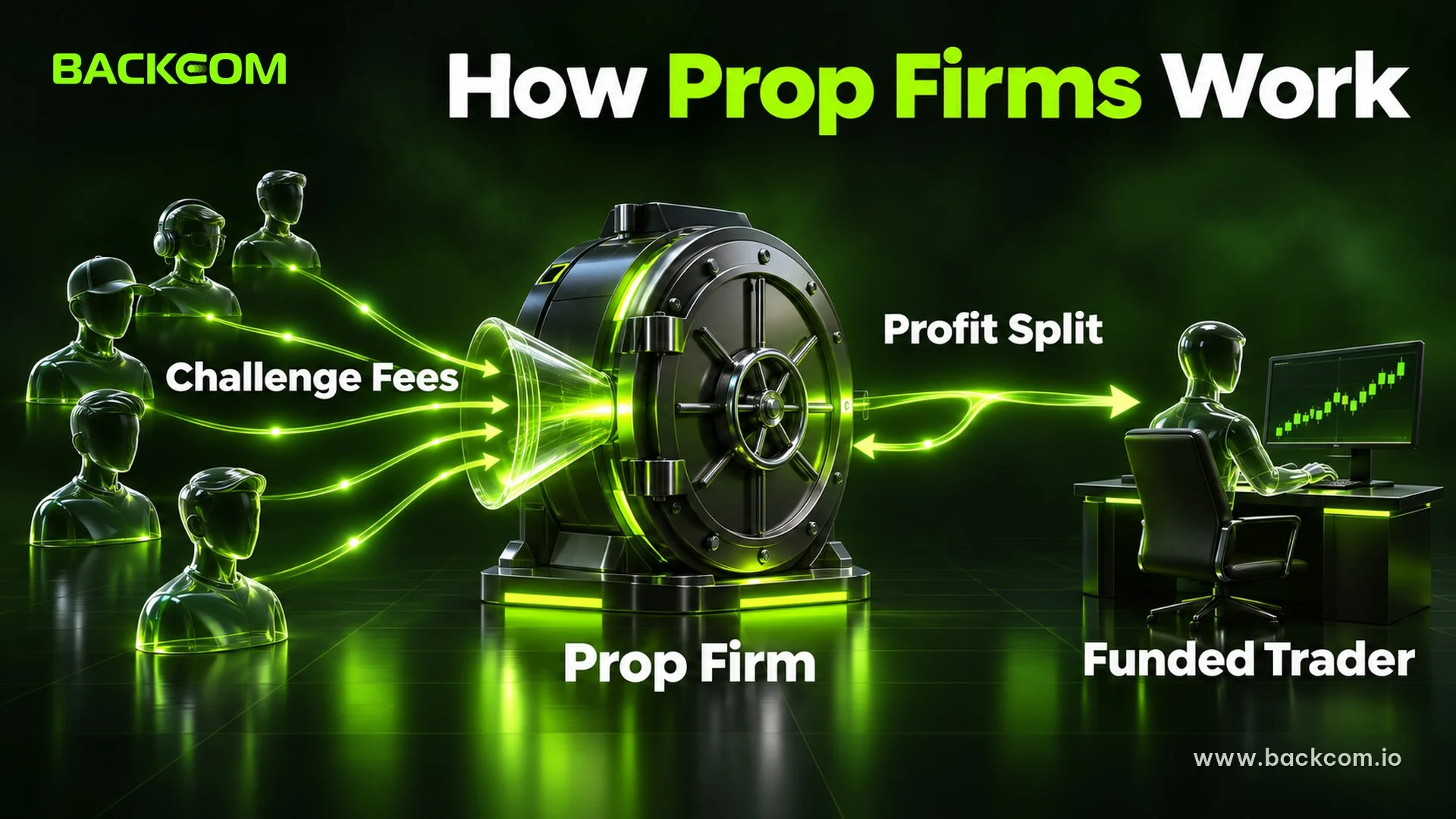
Prop firms work by selling evaluations and sharing profit with the few traders who pass. According to a Spotware article on whether prop firms use real money (13 October 2025), evaluation fees are the primary income stream for many firms, covering platform costs, payouts and staff. Spotware sells trading platform technology, so treat its view as an industry vendor's view.
Is The Money Real Or Simulated?
This is the question that surprises beginners most. The same Spotware article describes three models:
- Simulated with payouts from revenue: you trade a demo-style account, and any payout comes from the firm's own revenue rather than from live market trades.
- Hybrid or trade mirroring: the firm copies selected trades from consistent traders into a live account, usually in small amounts with position and loss caps.
- Direct real-money accounts: reserved for a small group of disciplined traders, and described as uncommon.
The practical lesson: a "funded" account may still be a simulated account, and your profits may still be paid in real money. Neither fact is wrong, but you should know which model your firm uses. Read the terms for words such as "simulated", "demo" or "virtual", and ask support in writing if the wording is unclear.
What This Means For Your Odds
The same article repeats an industry claim that more than 80% of traders never get past the evaluation. It is a self-reported figure that is not independently verified, so do not treat it as a precise statistic. It does point in a sensible direction: the model only works for the firm when most challenges fail, so go in expecting to need several attempts, not one.
Prop Firm Challenge Explained: Targets, Loss Limits And Trading Days
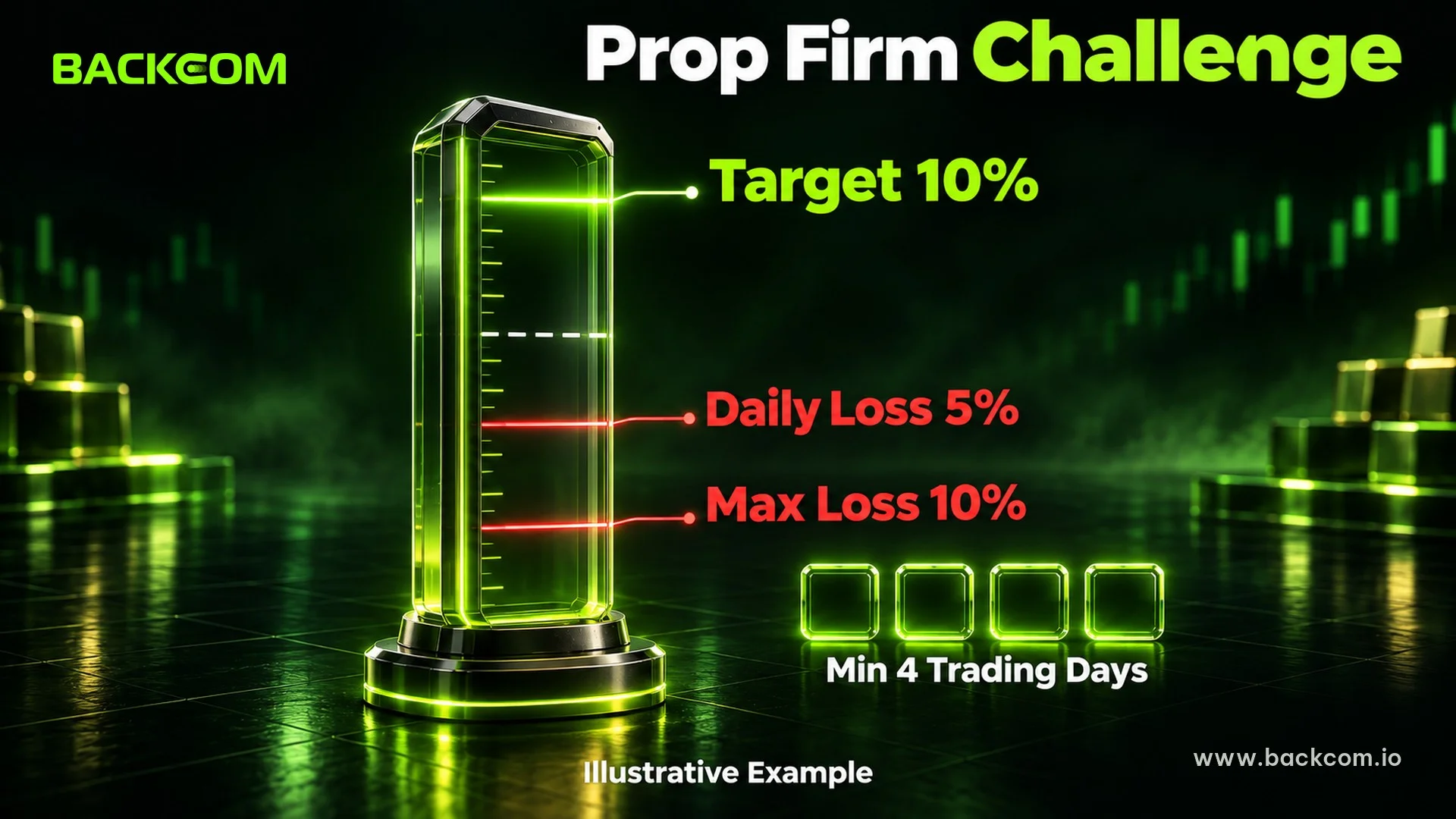
A prop firm challenge is a paid evaluation in which you must reach a profit target without breaking loss limits. The three numbers that matter are the profit target, the maximum daily loss and the maximum overall loss. Many firms add a minimum number of trading days.
A Real Example: The FTMO Two-Step Objectives
The clearest way to understand the rules is to read one set of them. As at 2 November 2026, the FTMO trading objectives page lists the following for its two-step programme, using a USD 100,000 account as the example:
| Objective | Challenge phase | Verification phase |
|---|---|---|
| Profit target | 10% (USD 10,000) | 5% (USD 5,000) |
| Maximum daily loss | 5% (USD 5,000) | 5% (USD 5,000) |
| Maximum overall loss | 10% (USD 10,000) | 10% (USD 10,000) |
| Minimum trading days | 4 | 4 |
Reference figures as at 2 November 2026 from the firm's own page. Rules, account sizes and prices can change, so check the current page before you buy. The same page explains that the daily loss limit is recalculated at 00:00 CE(S)T, based on the balance recorded at that time, while the overall loss limit is static: on USD 100,000 it sits at USD 90,000.
How The Loss Limits Really Bite
Percentages sound generous until you apply them. A 5% daily limit on USD 100,000 is USD 5,000, but that includes open, floating losses on the day, so a trade you are "sure will come back" can still end your attempt. Two habits help:
- Set your own stop well inside the limit. If the daily cap is 5%, plan around 1% to 2% so one bad day does not end the test.
- Risk a small, fixed amount per trade. Our guide to forex money management and the 1% rule shows how to turn a risk amount into a lot size.
If you want a structured plan for each phase, see our guide on how to pass a prop firm challenge. For the drawdown side in more depth, read prop firm risk management.
Rules Beyond The Headline Numbers
The headline targets are not the only way to fail. Firms commonly restrict trading around news, limit automated strategies and enforce consistency rules, such as capping how much of your total profit can come from one day. Each firm words these differently. Before you rely on a strategy, compare the details in our posts on prop firm news trading rules, EA trading rules and the consistency rule. You can also browse the full prop trading section, including the Maven Trading review and the E8 Markets review.
What Is A Funded Trader Account, And How Does Profit Split Work?
A funded trader account is the account a firm gives you after you pass the evaluation. On it you trade under the firm's ongoing loss rules, and you can request a payout of the eligible profit under the terms. It is the stage the whole model is built around, and it is also where beginners most often misread what they have been promised.
How Does A Prop Firm Profit Split Work?
The prop firm profit split is the percentage of eligible profit that goes to you, with the rest kept by the firm. Splits vary by firm and often by account stage, and advertised figures are frequently "up to" numbers rather than what every account starts at. This article does not quote any specific firm's split because it was not verified for this guide.
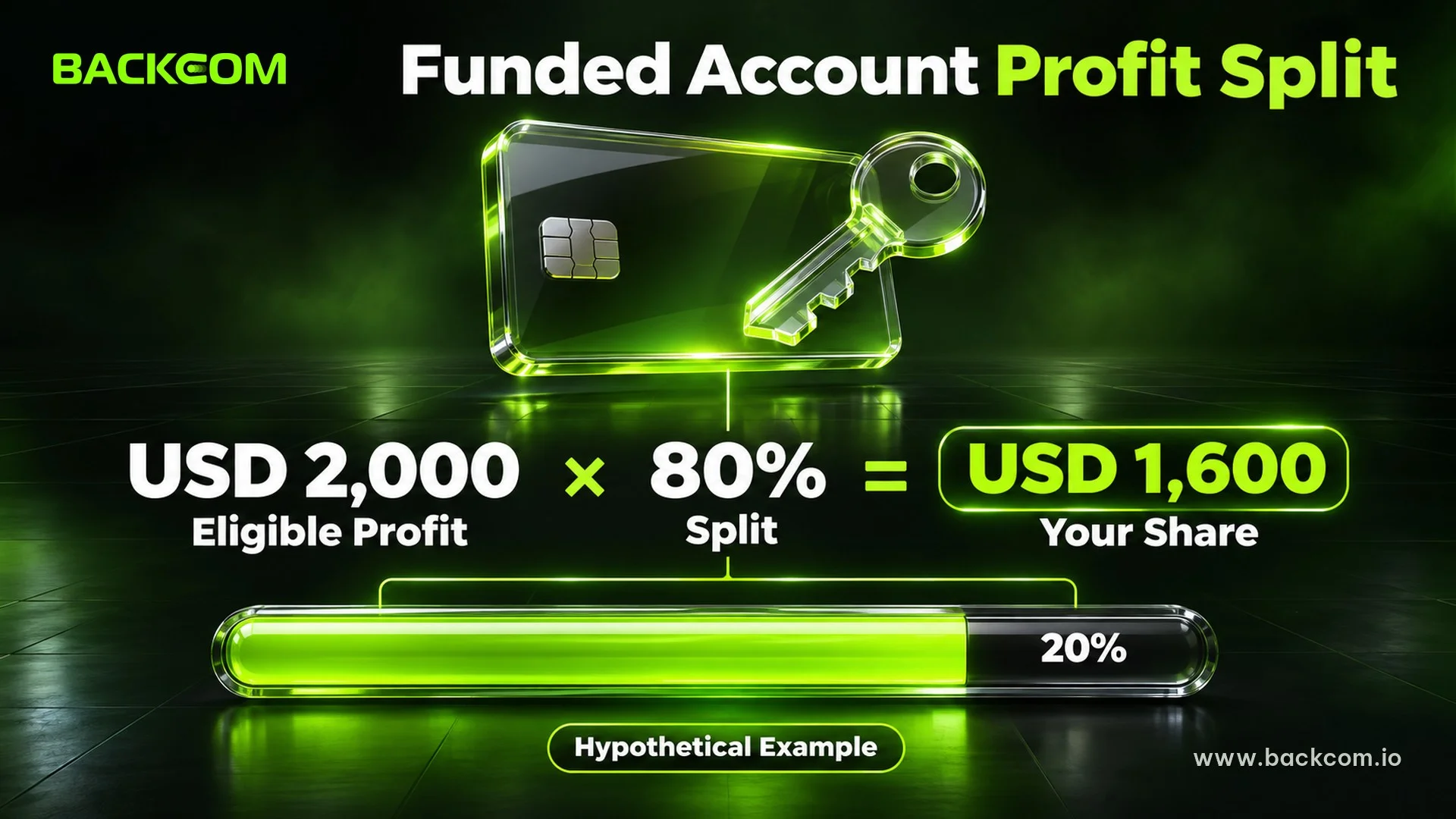
Here is a hypothetical calculation to show the mechanics. Suppose an account earns USD 2,000 of eligible profit and the split is 80%:
Your share = Eligible profit × Split percentage = USD 2,000 × 80% = USD 1,600
That is a worked example only. It does not mean any firm pays 80%, and the actual amount you receive can be lower after fees, minimum withdrawal rules and payment costs.
A Payout Is Not Automatic
Passing the challenge and getting paid are two separate steps. Before the first payout, expect to confirm identity (KYC), meet any minimum trading days or waiting periods, and comply with the firm's trading rules. A breach can void profit. Questions worth asking support before you buy:
- How long after funding can you request the first payout?
- What is the minimum withdrawal, and how often can you withdraw?
- Which payment methods work for your country?
- Which fees apply from the firm, the processor or your bank?
For a worked look at one firm's terms, see our The5ers review and FundedNext review.
Is Prop Trading Worth It? Costs, Risks And Who It Suits
Prop trading can be worth it for a trader who already has a tested, rules-based approach and treats the fee as a business cost. For everyone else it is closer to a paid exam with a low pass rate.
The Real Cost
Count more than the sticker price. Your total cost is the evaluation fee, plus any fee due at the funded stage, plus the cost of retries, plus withdrawal costs. A cheap entry that you need to buy three times is not cheap. Fees are often cited in the range of USD 100 to USD 1,000 or more depending on account size, but that comes from secondary sources and varies widely, so treat it only as a rough scale.
Who It Suits, And Who Should Wait
- It can suit a trader with a written plan, a journal of at least a few months and a habit of cutting losses early.
- It can suit a trader who can size positions from a small risk percentage and accepts that some attempts will fail.
- Wait if you still change your method every week, add to losing trades or have never kept a record of your results.
- Wait if the fee would come from money you cannot afford to lose.
Practise first on a demo or small live account. The position size calculator lets you test how much a stop loss costs at different lot sizes before it counts.
Check The Firm Before You Pay
The industry has no single global rulebook, and regulation varies by jurisdiction and business model. Spotware's article names examples such as the CFTC and NFA in the United States and MiFID in the EU. Protection for a prop firm customer is not the same as a regulated brokerage account. Our list of reputable prop firms explains the checks we apply. Save the terms on the day you buy, read recent reviews at every rating level and keep your own trade records.
Frequently Asked Questions (FAQ) About Prop Trading
What Is Prop Trading In Simple Terms?
Prop trading means trading with a firm's capital and sharing the profit, rather than using your own money. In the retail version, you first pay for an evaluation. If you pass, you get a funded account and a profit split under the firm's terms. The risk you carry directly is the evaluation fee, but passing and being paid are not guaranteed.
Do Prop Firms Use Real Money?
It depends on the firm. According to Spotware (13 October 2025), many retail firms run evaluations on simulated accounts and may keep funded accounts simulated too, paying profit from their revenue. Some mirror selected trades to live accounts, and a few give direct real-money access. Read the terms for the word "simulated" and ask support if you are unsure.
How Much Does A Prop Firm Challenge Cost?
Fees depend on the firm and the account size. Secondary sources often cite USD 100 to USD 1,000 or more, but this was not verified for any specific firm. Add any fee due at the funded stage and the cost of possible retries. Check the exact price and refund conditions on the firm's checkout page, and save them.
What Is The Prop Firm Profit Split?
It is the share of eligible profit paid to you after you reach the funded stage. Firms set their own percentages, and some advertise "up to" figures that not every account receives. The final payment can also fall after fees and minimum withdrawal rules. Confirm your split for the exact account in writing before you pay.
Is Prop Trading A Good Way To Get Started?
For most beginners, it is not the first step. A funded account does not teach you a strategy, and the loss limits are strict. Learn position sizing, keep a journal and test a plan on a demo account first. Once you have steady results, a challenge becomes a reasonable, low-capital way to test them.
Conclusion: Treat Prop Trading As A Test, Not A Shortcut
Prop trading gives you access to a larger account for the price of a fee, but it is a paid evaluation with strict rules, not free capital. Understand how the firm earns its money, read the loss limits as numbers in dollars, and treat a payout as something you earn under the terms, not something promised at purchase. If you decide to try, start small, keep risk per trade low and keep records of everything you agree to.
Disclaimer: This content is compiled by Backcom.io for information only and is not investment advice. Prop firm terms, fees and rules change often, and nothing here promises that you will pass a challenge or receive a payout. Trading involves risk of loss.
Was this article helpful?
Join The Backcom.io Community
Get the latest on trading rebates, trading tips, and broker deals — and connect with thousands of traders worldwide.

Backcom App
Track Your Rebates Every Day
Every rebate is visible by broker and by day. Manage your wallet and withdrawals in one place.
Open Backcom App