FTMO Vs FundedNext 2026: Detailed Comparison – Which Prop Firm Should You Choose?


If you have decided to try prop trading but are still weighing FTMO vs FundedNext, the hard part is no longer understanding how funded accounts work. It is deciding which prop firm to choose for the way you trade and the risk you can tolerate.
In this article, Backcom.io compares FTMO and FundedNext directly on the criteria that matter: challenge rules, drawdown, challenge fees, profit split and payout speed. Instead of picking the easiest prop firm to pass from the profit target alone, this guide puts the key conditions side by side to show how hard each model really is.
A table by trader type at the end shows which firm suits which style.
FTMO Vs FundedNext: The Head-To-Head Overview

Start by placing FTMO vs FundedNext in context. FTMO has operated since 2015 from Prague, Czech Republic, while FundedNext launched in 2022 in the UAE and has since built a wider range of challenge models.
Update, November 2026: FTMO offers 1-Step and 2-Step challenges, plus an Instant Account since 12 October 2026, and FundedNext offers Stellar Instant alongside Stellar 1-Step, 2-Step and Lite. To compare like with like, this article focuses on FTMO 2-Step against FundedNext Stellar 2-Step, and brings in the other models where they make a real difference.
| Criterion | FTMO | FundedNext |
|---|---|---|
| Founded | 2015 | 2022 |
| Headquarters | Prague, Czech Republic | UAE |
| Main challenges | 1-Step, 2-Step | Stellar 1-Step, 2-Step, Lite, plus Instant |
| Largest challenge size | USD 200,000 | USD 200,000 |
| Starting reward share | 2-Step: 80%; 1-Step: 90% | 80% on Stellar 1-Step, 2-Step and Lite |
| Maximum reward share | 90% | 90% through Scale-Up; 95% with an add-on |
| What stands out | Long history, analysis tools and a wider trading ecosystem | Many models, flexible payout options, a conditional reward from the challenge |
| Scaling | Up to USD 2 million | Up to USD 4 million under the current programme |
FTMO limits total allocation to USD 400,000 per trader or strategy before scaling, with a Scaling Plan up to USD 2 million. FundedNext caps a merged FundedNext Account at USD 300,000 (USD 600,000 with its Double Up add-on), while its Scale-Up programme can take simulated allocation to USD 4 million if you qualify.
To look at each firm on its own first, read our FTMO review and FundedNext review.
In short: FTMO's advantage is its history and a fairly standardised system. FundedNext stands out for the number of models and how much you can customise the conditions. The real differences only show once the rules sit side by side.
FTMO And FundedNext Rules: Which Is Easier To Pass?
This is the most important section if your goal is to find the easiest prop firm to pass rather than just a familiar brand.
To avoid a lopsided comparison, start with FTMO 2-Step against Stellar 2-Step. Then see how FundedNext 1-Step and Lite change the risk.
| Rule | FTMO 2-Step | FundedNext Stellar 2-Step | FundedNext 1-Step | FundedNext Lite |
|---|---|---|---|---|
| Phases | 2 | 2 | 1 | 2 |
| Profit target | 10% / 5% | 8% / 5% | 10% | 8% / 4% |
| Daily loss | 5% | 5% | 3% | 4% |
| Maximum loss | 10% | 10% | 6% | 8% |
| Minimum trading days | 4 per phase | 5 per phase | 2 | 2 per phase (bought or reset from 12 October 2026) |
| Time limit | None | None | None | None |
| News trading during the challenge | Allowed | Allowed | Allowed | Allowed |
FTMO confirms that 2-Step requires 10% in the Challenge, 5% in the Verification, a 5% daily loss, a 10% maximum loss and at least four trading days. Under the current FTMO and FundedNext rules, Stellar 2-Step uses an 8% / 5% target with 5% / 10% loss limits. Stellar 1-Step uses 10% but cuts the daily loss to 3% and the maximum loss to 6%, while Lite sits in between at 8% / 4% with 4% / 8% limits.
You can check the rules directly on the FTMO Challenge page and in FundedNext's Stellar 2-Step article.
The Easiest Prop Firm To Pass? Real Analysis Instead Of Marketing
Looking only at the profit target, Stellar 2-Step is gentler than FTMO 2-Step in Phase 1:
- FTMO needs 10%, FundedNext needs 8%.
- Phase 2 is around 5% at both.
- Daily loss and maximum loss are the same on these two models, at 5% and 10%.
- In return, FundedNext requires at least 5 trading days per phase, while FTMO requires 4.
So for a disciplined trader, Stellar 2-Step has a fairly clear advantage: you need less profit while the drawdown room stays the same.
That does not mean every FundedNext model is the easiest prop firm to pass.
Stellar 1-Step, for example, has a single round and a 10% target, which sounds much simpler. In exchange, the daily loss drops to 3% and the maximum loss is only 6%. A trader used to risking 1–2% per trade can lose the account very quickly, even though there is only one phase.
Stellar Lite lowers the target to 8% / 4%, but its drawdown also drops to 4% / 8%. It is a textbook case of one principle:
A lower target does not mean easier risk.
Another 2026 change to watch is the consistency rule. The current challenge rulebooks for Stellar 1-Step, 2-Step and Lite do not list a consistency rule as a condition to pass. However, a 40% best-day cap appears in the On-Demand Performance Reward option once you are on the FundedNext Account. Do not confuse that payout rule with a challenge rule, and see our prop firm consistency rule guide for how these caps work.
On news trading, FTMO allows trading through news during the evaluation. The ±2 minute restriction around selected releases only applies to a Standard FTMO Account after you pass, and Swing accounts are exempt. On a FundedNext Account, trades placed within 5 minutes of a high-impact release on a correlated pair fall under a News Profit Split Rule, so only 40% of that profit counts. Our prop firm news trading rules compare more firms.
Rules verdict: in a 2-Step against 2-Step matchup, FundedNext leans toward traders who want a lower Phase 1 target. FTMO suits traders who want the familiar 2-Step rulebook, fewer minimum trading days and a system that has run for many years. With 1-Step, do not choose just to pass one round. Drawdown is the variable to check first.
Whichever you choose, raising risk to "pass fast" is still the easiest way to break an account. Our guide on how to pass a prop firm challenge helps you build a risk plan for each phase.
Challenge Fees And Refund Policies Compared
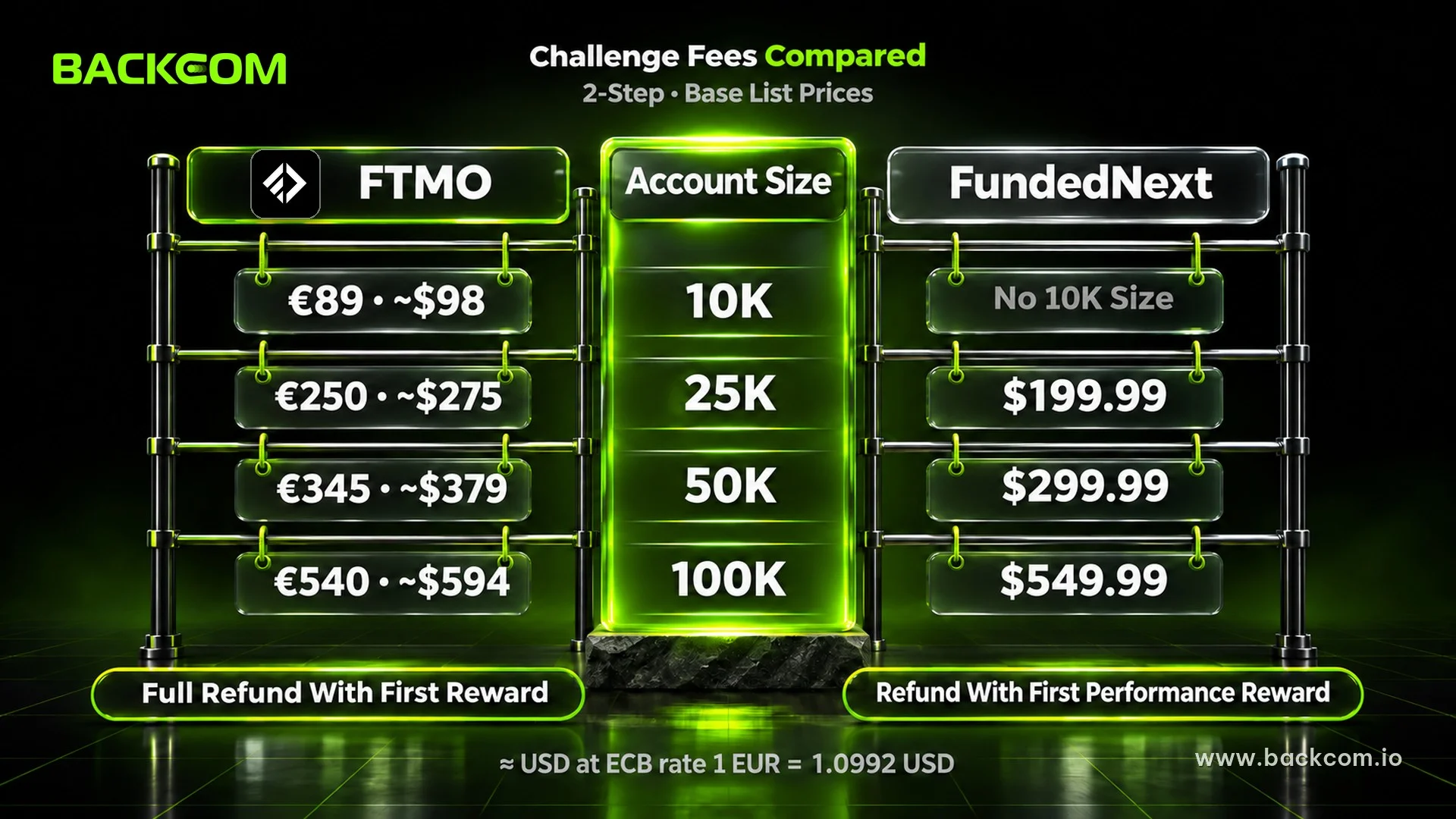
After the rules, challenge fees are the second biggest difference.
To keep short-term promotions out of the table, Backcom.io uses base list prices checked on 26 September 2026 and rechecked on 20 November 2026. FTMO prices in euros, so the USD column uses the ECB reference rate of 1 EUR = 1.0992 USD (19 November 2026, the latest rate published on 20 November).
| Size | FTMO 2-Step | About USD | FundedNext Stellar 2-Step |
|---|---|---|---|
| USD 10K | €89 | ~USD 98 | No 10K size |
| USD 25K | €250 | ~USD 275 | USD 199.99 |
| USD 50K | €345 | ~USD 379 | USD 299.99 |
| USD 100K | €540 | ~USD 594 | USD 549.99 |
FundedNext Stellar 2-Step currently starts at a USD 6,000 size for USD 59.99. If you specifically want a 10K size, Stellar Lite lists it at USD 59.99, but that is a different model, so do not compare its price directly with FTMO 2-Step rules.
On entry cost alone, FundedNext 2-Step is cheaper than FTMO at the 25K, 50K and 100K sizes on the base prices above.
But challenge fees are not just the amount you pay at checkout. The refund rules differ by model:
- FTMO 2-Step: the fee is refunded in full with your first Reward, after you pass and qualify for a payout.
- FTMO 1-Step: a different product, and its fee is not refundable.
- FundedNext Stellar 2-Step: the Refundable Fee can be requested with the first Performance Reward.
- Stellar Lite and Stellar 1-Step: the fee comes back with the third Performance Reward (on 1-Step, for purchases from 12 January 2026).
FundedNext also has a 15% reward from the challenge, and this is easy to misread. For challenges bought or reset from 12 January 2026, the 15%, based on the profit target, no longer pays out as soon as you pass. You have to move to the FundedNext Account and qualify for Scale-Up before you can receive it. Stellar Lite does not include this reward.
The 95% reward share at FundedNext also comes from the Lifetime Reward 95% Add-On. It is not the default for every account.
Fees verdict: if you want to spend less up front, FundedNext is more attractive at several matching sizes. If you compare the real cost after passing, add the timing of the refund, any add-ons you bought and whether you actually reach a payout. Do not judge on the checkout price alone.
Payout Comparison: Profit Split And Payout Speed
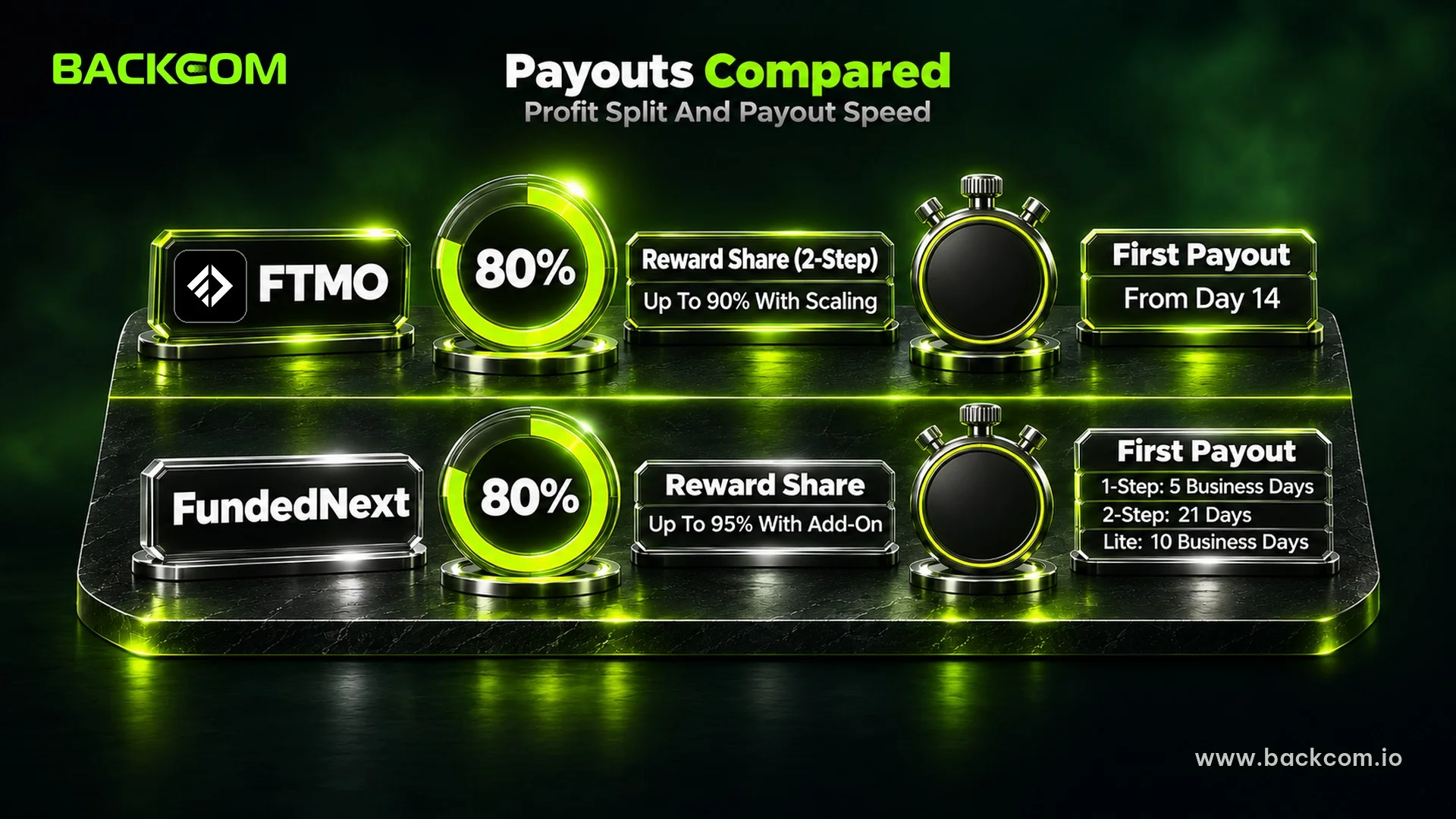
Once funded, the question becomes how soon profit turns into money you can withdraw, and this is where FTMO vs FundedNext differs clearly.
| Criterion | FTMO | FundedNext |
|---|---|---|
| Starting reward share | 2-Step: 80%; 1-Step: 90% | Stellar 1-Step, 2-Step and Lite: 80% |
| With scaling | Up to 90% | Up to 90% |
| Higher tier | — | 95% with the Lifetime Reward Add-On |
| First payout | Can request from day 14 | 1-Step: after 5 business days; 2-Step Standard: after 21 days; Lite: after 10 business days |
| Later payouts | Each eligible cycle | 1-Step: every 5 business days; 2-Step Standard: every 14 days; Lite: every 10 business days |
| Methods | Bank wire, Visa Direct / Mastercard Send, Skrill, crypto | USDT, USDC, RiseWorks, Confirmo, bank transfer, card, FNmarkets |
FTMO lets you request a Reward on day 14 or any later day after your first trade. After you request it, the account is usually reviewed within 1–2 business days and the money is sent once the invoice is approved. FTMO's payout FAQ also confirms that 2-Step starts at an 80% Reward ratio and can rise to 90%.
FundedNext is much faster if you choose Stellar 1-Step, where a trading cycle lasts 5 business days. Stellar 2-Step Standard pays the first time after 21 days and every 14 days after that.
Another 2026 detail is that Stellar 2-Step and Lite offer extra payout options:
- Standard: 21 days for the first payout on 2-Step, then 14 days, or 10 business days on Lite, at an 80% reward share.
- 3-Day Performance Reward: a short cycle, but the reward share drops to 60% and you need three profitable days of at least 1% each.
- On-Demand: you can request once the account has grown at least 2% and your best day is no more than 40% of total profit, at a 90% reward share.
With the Lifetime Reward 95% Add-On, FundedNext says the share can reach 95% whichever option you choose.
Once you qualify, FundedNext says payouts are usually issued within 24 hours, through stablecoins, RiseWorks, bank transfer and other methods depending on your country. FundedNext's withdrawal guide lists the current methods and the countries where some are unavailable.
Payout verdict: traders who need fast cash flow have a clear edge with FundedNext Stellar 1-Step. On Stellar 2-Step Standard, FTMO actually lets you request the first payout sooner. So you cannot say FundedNext always pays faster. It depends on the model.
How a Reward moves from a funded account to your own account depends on the method you choose and on your country of residence, so check both before you request it.
Which Prop Firm To Choose? A Verdict For Each Type Of Trader
After comparing FTMO and FundedNext on rules, challenge fees and payouts, which prop firm to choose depends mainly on your strategy.
| Trader type | Leans toward | Main reason |
|---|---|---|
| First-time challenge buyer | FundedNext Stellar 2-Step | 8% Phase 1 target with 5% / 10% drawdown |
| Fan of the classic 2-Step | FTMO | Clear rules, 4 minimum trading days and a longer track record |
| Wants a single round | FundedNext 1-Step or FTMO 1-Step | Both skip Phase 2, but check the drawdown first |
| Needs fast payouts | FundedNext 1-Step | 5-business-day cycle |
| News trader | Depends on the model | Both are fairly open during the challenge; read the funded rules |
| Tight budget | FundedNext | Lower entry cost at several sizes |
| Long-term scaling | Both worth a look | FTMO scales to USD 2M; FundedNext states USD 4M |
| EA user | Check each firm's rules | FundedNext does not allow EAs on accounts of USD 50,000 and above |
The table is a starting point, and four profiles deserve a closer look:
- Beginners: Stellar 2-Step means less pressure on the target, 8% instead of 10% in Phase 1, with the same 5% daily and 10% maximum loss.
- Traders who value track record: FTMO keeps its edge in history, analysis tools and the familiar 2-Step model.
- Scalpers and EA users: FundedNext allows EAs only on accounts below USD 50,000, while FTMO has its own Forbidden Trading Practices. A profitable broker EA is not automatically suitable for a prop firm, as our guide to prop firm EA trading rules explains.
- Tight budgets: FundedNext has more low entry points, but Stellar Lite's 4% daily and 8% maximum loss are tighter than the 5% / 10% of the standard 2-Step models.
So answer the question of which prop firm to choose in this order:
- How much drawdown does your strategy usually have?
- Do you need to hold through news or over the weekend?
- Do you want to pass one round or two?
- How soon do you need a payout?
- Which fee are you prepared to lose if the challenge fails?
Whichever you choose, prop firm risk management decides whether you last beyond one payout cycle.
If neither FTMO nor FundedNext fits your style, widen the search with our list of reputable prop firms.
Frequently Asked Questions (FAQ) About FTMO Vs FundedNext
Can You Trade FTMO And FundedNext At The Same Time?
Yes. FTMO and FundedNext are independent firms, so in principle you can join both, which also reduces your reliance on a single prop firm. Running several challenges at once, though, makes it easy to raise your total exposure or mix up the rules between accounts. If you trade the same strategy on several accounts, check each firm's copy trading, EA and maximum allocation policies first.
Which Is Easier To Pass, In Short?
Comparing the two 2-Step models, FundedNext Stellar 2-Step has the edge on the Phase 1 target, 8% against FTMO's 10%, with the same 5% daily loss and 10% maximum loss. For a disciplined trader, it can be the easier challenge to pass. Stellar 1-Step is not automatically easier, though, because its drawdown falls to a 3% daily loss and a 6% maximum loss.
Which Firm Has Cheaper Challenge Fees?
On base prices checked on 26 September and 20 November 2026, FundedNext Stellar 2-Step challenge fees are lower than FTMO 2-Step at matching sizes such as 25K, 50K and 100K. Compare the refund policy too. FTMO 2-Step and Stellar 2-Step both refund the fee with the first eligible payout, while FTMO 1-Step does not refund and Stellar 1-Step and Lite refund with the third payout.
Which Firm And Account Size Should A Beginner Start With?
Beginners do not need a large account. A size of about USD 10K–25K is usually enough to learn how the daily loss, maximum loss and payout process work without the fee becoming heavy psychological pressure. When deciding which prop firm to choose, pick the model whose drawdown fits your strategy first, then look at account size and reward share.
Conclusion
There is no single answer to FTMO vs FundedNext for every trader. Stellar 2-Step has the edge on the profit target and entry cost, and Stellar 1-Step stands out if fast payouts matter most. FTMO has the longer history, a clear 2-Step rulebook and an ecosystem built over many years.
If you are looking for the easiest prop firm to pass, do not just pick the model with the fewest phases or the lowest target. Drawdown, how the daily loss is calculated, the payout cycle and your own strategy decide whether the account survives long enough to pay out.
If you are still unsure which prop firm to choose, read our FTMO review, FundedNext review and the beginner's guide to what prop trading is before paying a challenge fee.
Disclaimer: This comparison is compiled by Backcom.io for information only and is not investment advice. FTMO and FundedNext rules and prices were checked on 20 November 2026 and can change. Read each firm's current terms before you pay.
Was this article helpful?
Join The Backcom.io Community
Get the latest on trading rebates, trading tips, and broker deals — and connect with thousands of traders worldwide.

Backcom App
Track Your Rebates Every Day
Every rebate is visible by broker and by day. Manage your wallet and withdrawals in one place.
Open Backcom App