Is Forex Rebate Worth It? Calculating 10 Lots A Month And When It Is Not


Most traders ask is forex rebate worth it only after they have settled on a broker, a sign-up link and a routine. For someone trading a few lots a month the rebate is small change, while for someone trading several dozen lots it can cover days of spread costs.
So there is no single yes or no. The answer depends on three variables: how many lots you trade each month, the rebate per lot your broker pays, and any extra cost you accept to receive it. Many traders also ask whether forex cashback is worth it when their account is already running well and they would rather not change links.
In this article, Backcom.io works through 10 lots a month across the most popular brokers, shows the lot volume at which a rebate starts to matter, and lists the cases where changing your IB is not worth the effort.
1. Is Forex Rebate Worth It At 10 Lots A Month?
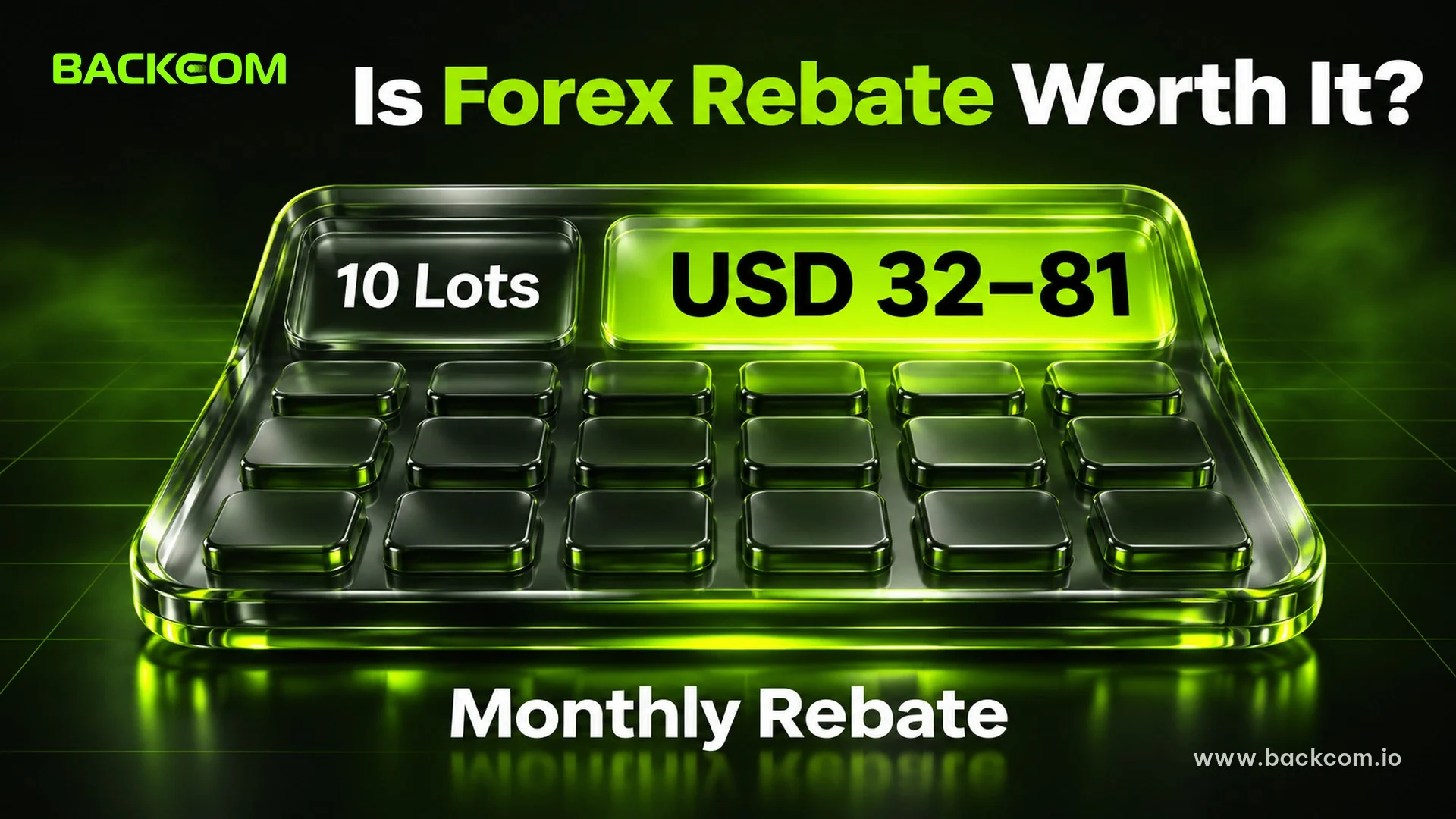
A forex rebate is a fixed amount paid per lot you close, funded from the commission a broker shares with its introducing broker (IB). At 10 lots a month the payout ranges from a few tens of dollars to more than eighty, and it does not depend on whether the trades win or lose.
The calculation fits on one line:
Monthly rebate = Lots traded × Rebate per lot
The mechanism is explained in what is a forex rebate.
The table below uses EURUSD rebates from the rebate calculator as at 6 November 2026:
| Broker | Account Type | Rebate Per Lot (USD) | 10 Lots A Month (USD) |
|---|---|---|---|
| Exness | Standard | 3.20 | 32.00 |
| XM | Standard | 8.10 | 81.00 |
| IC Markets | Standard | 4.00 | 40.00 |
EURUSD rebates as at 6 November 2026. Rebates can change by broker, account type and sign-up link, so check again before you decide.
The full six-broker table and the 1, 10 and 50 lot scenarios are in the forex rebate calculator guide.
Reading the table is simple. Ten lots on Exness Standard returns USD 32, while XM Standard returns USD 81. Gold pays more: according to the broker rebate page on 12 November 2026, XM Standard rebates USD 18 per lot of gold, which is USD 180 for 10 lots of XAUUSD.
Four points help when you read the table:
- Same broker, different account type: the rebate can differ, so pick the type you actually use.
- Payout schedules differ: Exness and XM pay daily, while IC Markets pays at the start of the month.
- Every closed lot counts: winning and losing trades are treated the same.
- Rebates differ by instrument: gold usually pays more than EURUSD at the same broker.
A bigger number is not automatically a better choice, though. Each broker has its own spread, commission and swap, so compare the net cost after rebate rather than the rebate alone.
2. How Many Lots A Month Make A Forex Rebate Worth It?

A lot threshold is the monthly volume at which the rebate is large enough to justify the effort of changing habits. There is no universal figure, but rebates grow in a straight line with volume, so the table below lets you find your own.
| Lots A Month | Exness Standard (3.20) | XM Standard (8.10) |
|---|---|---|
| 1 lot | 3.20 | 8.10 |
| 5 lots | 16.00 | 40.50 |
| 10 lots | 32.00 | 81.00 |
| 30 lots | 96.00 | 243.00 |
| 50 lots | 160.00 | 405.00 |
USD, based on EURUSD rebates as at 6 November 2026. No other fees deducted.
To judge whether a rebate is worth it, ask three questions:
- What share of my trading cost does it cover? If your average EURUSD spread is 1.5 pips, the cost is about USD 15 per lot (an illustrative assumption, with 1 pip on EURUSD equal to USD 10 per lot). A USD 3.20 rebate covers about 21% of that, and USD 8.10 covers about 54%. Replace the assumption with the spread on your own account.
- What share of my monthly result is it? In a break-even month, USD 81 may be the entire result. In a month with a USD 500 loss, it only offsets a small part.
- How long will switching take? A new account only needs the right link at sign-up, while an existing account may need an IB transfer or a fresh account.
A practical rule of thumb: below roughly 3–5 lots a month the rebate is usually a few dollars and is rarely worth changing a stable account. From 10 lots upward it becomes a meaningful cost offset. From 30 lots upward, ignoring it means skipping a saving that repeats every month.
This is a reference point, not an official threshold from any broker. Scalpers who open dozens of short trades a day reach these volumes faster than traders who hold positions for days; the guide to forex rebates for scalping covers that case separately.
3. Is Forex Cashback Worth It If Your Strategy Loses Money?
Forex cashback lowers your trading cost; it does not add an edge to a strategy. The rebate is paid on every closed lot whether the trade wins or loses, so it cannot turn a losing system into a profitable one.
Take a trader who closes 10 lots in a month and loses USD 300 before rebates. With USD 8.10 per lot, the result after rebate is a loss of USD 219. The loss is still there, only smaller.
For a trader whose strategy breaks even or earns a thin margin, cost per lot often decides the month. Cutting USD 3–8 per lot across hundreds of trades can make an equity curve noticeably steeper. That is why a rebate is best seen as a cost-management tool, not a source of income.
Two practical consequences follow:
- Do not raise your volume just to earn more rebate, because the risk of larger positions outweighs a few extra dollars.
- Do not pick a broker only for a high rebate per lot if its spread, swap or execution is worse.
Whether a rebate provider can be trusted is a separate question, covered in is forex cashback legit. Position sizing remains the foundation, so read forex money management and the 1% rule before optimising a few dollars of rebate.
4. When Is A Forex Rebate Not Worth It?
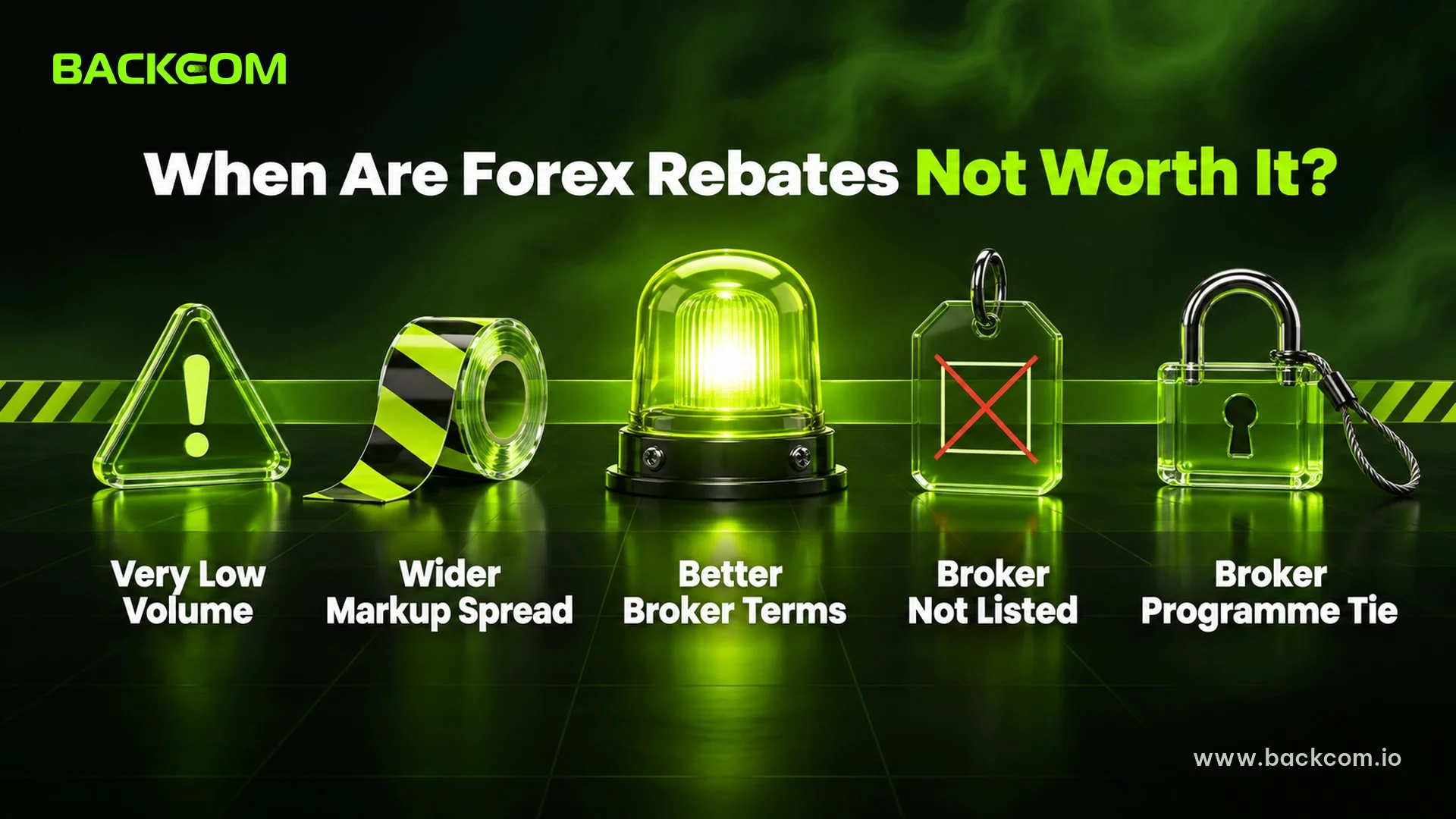
A rebate is not worth it when the cost or risk of getting it is larger than the money you receive. Five cases deserve a second look before you change IB or link.
- Very low volume: trading 1–2 lots a month returns a few dollars, and the paperwork and waiting can cost more than that.
- A markup link whose extra rebate does not cover the wider spread: a markup link widens the spread on every trade. Section 5 has the break-even formula.
- A broker whose conditions beat the rebate: if your current account has tight spreads, good execution or broker offers of its own, compare total cost rather than rebate alone.
- A broker outside the rebate list: the list of supported brokers is limited. VT Markets and Ultima Markets, for example, have been discontinued since 29 October 2026, so do not open an account at either broker for rebate reasons.
- An account tied to a broker programme: an older account may be linked to a promotion the broker runs. Read the broker's own terms before moving.
For all five cases the safe approach is to compare numbers, not impressions. Write down your average monthly lots over three months, your actual trading cost and the estimated rebate, then compare them.
Rebates in the tables are reference figures with a stated date, and brokers can change terms. Before you decide, open the rebate comparison page to see current rates.
5. Forex Rebate Markup Link: Is It Worth It? The Break-Even Formula
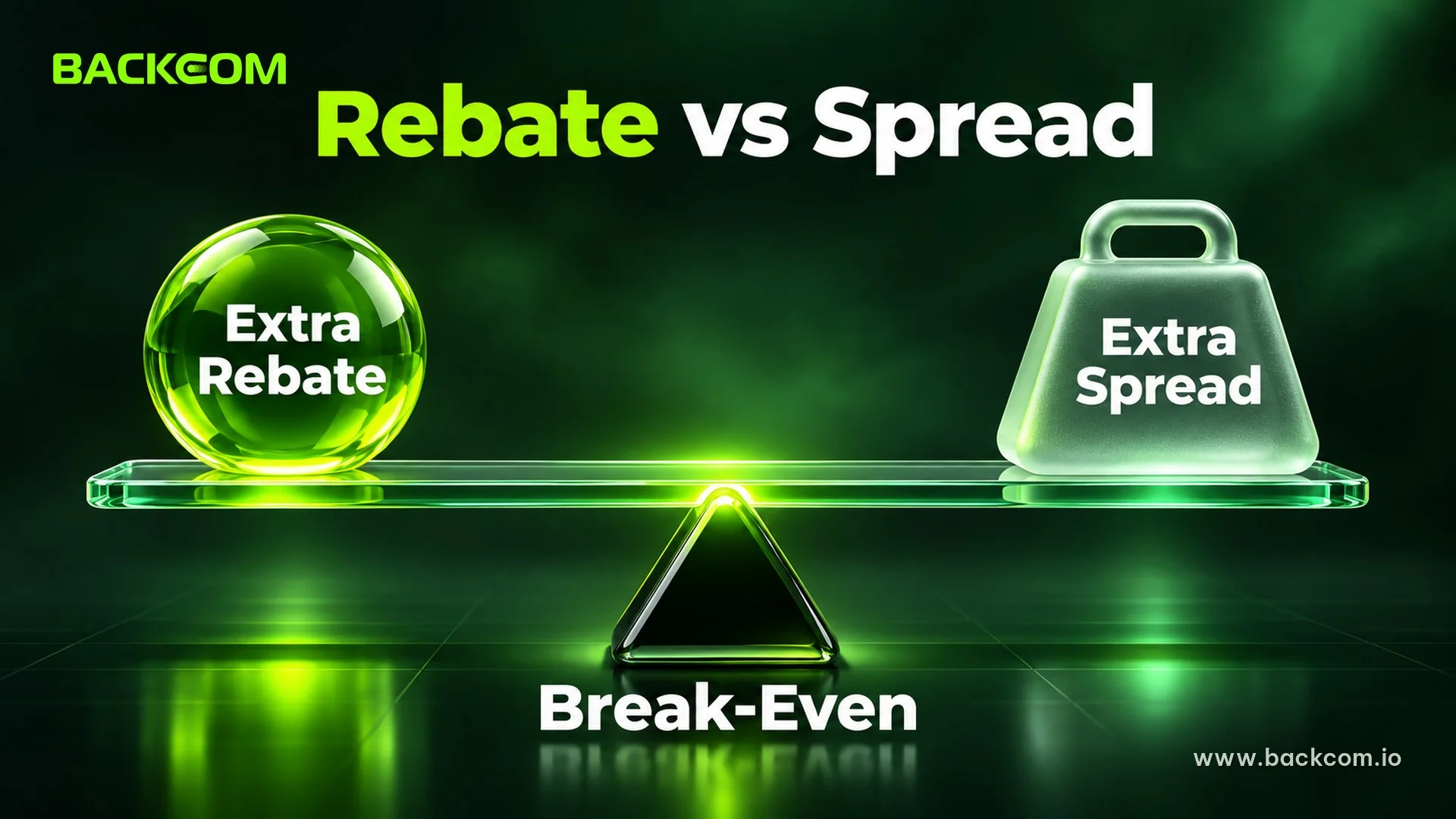
A forex rebate markup link is a sign-up link where the broker adds a small amount to the spread and pays a higher rebate per lot in return. It only pays off when the extra rebate exceeds the extra spread you bear.
The break-even formula is:
Net gain per lot = Extra rebate per lot − (Extra pips × Pip value per lot)
Illustrative examples on EURUSD, where 1 pip equals USD 10 per lot:
| Scenario | Extra Rebate | Extra Spread | Net Gain Per Lot | 10 Lots A Month |
|---|---|---|---|---|
| Extra rebate USD 3, spread +0.2 pip | 3.00 | 2.00 | +1.00 | +10.00 |
| Extra rebate USD 1.50, spread +0.2 pip | 1.50 | 2.00 | −0.50 | −5.00 |
| Extra rebate USD 3, spread +0.5 pip | 3.00 | 5.00 | −2.00 | −20.00 |
The numbers are illustrative assumptions to show the formula, not the real spread or rebate of any broker.
A real example appears on the broker page: according to the rebate page on 12 November 2026, the EC Markets STD-PXX link adds 2 pips on gold and rebates USD 38 per lot, while the regular STD link rebates USD 18. The extra rebate is USD 20 per lot. Compare that USD 20 with the cost of two extra pips at the broker's own gold pip value, multiplied by your real lot volume. Gold has no single pip convention, so check the broker's contract specification; the guide to what a pip is explains pip value.
Before choosing a markup link, check four things:
- Round trips: each closed lot bears the extra spread exactly once, whether you enter with a market order or a pending order.
- Your real volume: net gain scales with lots, so low volume means a small difference.
- Measured spread: compare the spread of both links at the hours you normally trade.
- Cost of switching: moving funds and reinstalling bots or indicators also cost time.
A markup link suits only the trader whose extra rebate per lot exceeds the extra spread at the pip value of the pair traded. Entry style does not change this arithmetic; the pair (pip value) and total lots do. If you are unsure, the regular link without markup is usually the safer choice.
6. What Conditions Make A Forex Rebate Pay Off? A 4-Step Checklist
A forex rebate pays off when the net monthly figure (lots × rebate − extra spread if you use a markup link − cost of switching accounts) is above zero and large enough to matter to you. The four steps below work that figure out from your MT4 or MT5 history and the rebate table.
Step 1: Count your average lots over the last three months
Open your trade history in MT4 or MT5 (see what is a lot), add up the lots closed each month and take the average. Use the average rather than a single unusual month so your estimate does not run too high.
Step 2: Multiply by the rebate for your exact account type
Apply the formula from section 1 with the right broker, account type and link. The same broker can pay different rebates on different links.
Step 3: Subtract extra costs
If you use a markup link, apply the break-even formula in section 5. If you need a new account, add the time to move funds and reconfigure your setup.
Step 4: Decide against your own threshold
If the net monthly rebate feels worth it, go ahead. If it is only a few dollars, keep your account and revisit the question when your volume grows.
Traders who have not yet opened an account, or are about to open a new one, benefit most easily because they only need the right link at sign-up. Details are on the rebate registration page.
Backcom.io is an independent introducing broker (IB/affiliate) of the forex brokers it lists; rebates are paid from the commission the broker pays Backcom.io — see the risk disclaimer.
Frequently Asked Questions (FAQ) About Whether A Forex Rebate Is Worth It
How Many Lots A Month Before A Forex Rebate Is Worth Taking?
There is no official threshold, but from about 10 lots a month a forex rebate usually reaches tens of dollars and starts to matter. Below 3–5 lots it is only a few dollars, so there is little reason to change a stable account. Multiply your three-month average lots by the rebate for your account type to get a concrete figure.
How Much Is A Forex Rebate Per Month?
For 10 lots of EURUSD, the table dated 6 November 2026 shows about USD 32–81 depending on broker and account type. The rebate grows in a straight line with volume: 50 lots on XM Standard is about USD 405. Rates can change, so check them again before calculating.
Is A Forex Rebate For Small Traders Worth It?
It can be, if claiming it costs no extra effort, for example when you open a new account. Small traders should not switch brokers or choose a markup link just for a rebate. At low volume the rebate is small, so spread and trading conditions matter more.
Should I Take A Forex Rebate If My Account Already Works Well?
Yes, provided it does not force you to change broker or accept a wider spread. First ask whether the IB on your current account can be changed. If you need a new account, work out the net monthly rebate before deciding.
Does A Rebate Raise My Trading Costs?
With a regular link, no. With a markup link the spread is wider, so each trade costs more in return for a higher rebate. Use the break-even formula in section 5 to see whether the markup link pays off.
Conclusion
Whether a forex rebate is worth it depends on your monthly lots, your broker's rebate and any extra cost you take on. Traders at 10 lots or more usually receive a meaningful amount, while those trading only a few lots are better off prioritising a stable account and good trading conditions.
The steps are to count your three-month average lots, multiply by the rebate for your exact account type, subtract any extra spread if you use a markup link, and compare the result with the cost of switching. If the figure is large enough, check current rates on the rebate comparison page, or read what a forex rebate is and how to calculate cashback per lot to understand the mechanism.
The foreign exchange market turns over about USD 9.6 trillion a day according to the April 2025 survey by the Bank for International Settlements. In Europe, ESMA has capped retail CFD leverage at 30:1 on major currency pairs since 2018, a reminder that leverage risk matters more than a few dollars of rebate.
Disclaimer: This content is compiled by Backcom.io for information only and is not investment advice, a trading recommendation or tax/legal advice. Trading forex and CFDs with leverage carries a risk of losing your capital, and a rebate does not offset trading losses. Broker rebates and conditions can change over time, so check official sources before you decide.
Was this article helpful?
Join The Backcom.io Community
Get the latest on trading rebates, trading tips, and broker deals — and connect with thousands of traders worldwide.

Backcom App
Track Your Rebates Every Day
Every rebate is visible by broker and by day. Manage your wallet and withdrawals in one place.
Open Backcom App