EC Markets Trading Fees 2026: Spread, Commission And Swap By Account Type


EC Markets trading fees are more than the "spreads from 0.0 pips" headline on the broker's marketing pages, because the real cost of a trade is spread, commission and overnight financing added together. Each account type sets those three costs differently, so picking the wrong one can leave a trader paying more per lot than expected.
This guide checks three official EC Markets pages directly on 11/11/2026: the account types page, the leverage page and the Pricing page. Where the broker publishes no specific number, the article says "not verified" instead of guessing.
In this article, Backcom.io walks through:
- A side-by-side table of EC Markets spread and commission on the STD, ECN and PRO accounts.
- How to convert EC Markets commission from dollars into pips so it can be compared with spread.
- EC Markets swap fees: rollover time, the triple-swap day and what the broker has not published.
- The real cost of one lot after a rebate, for each registration link.
EC Markets Account Types: Trading Fees Compared In One Table
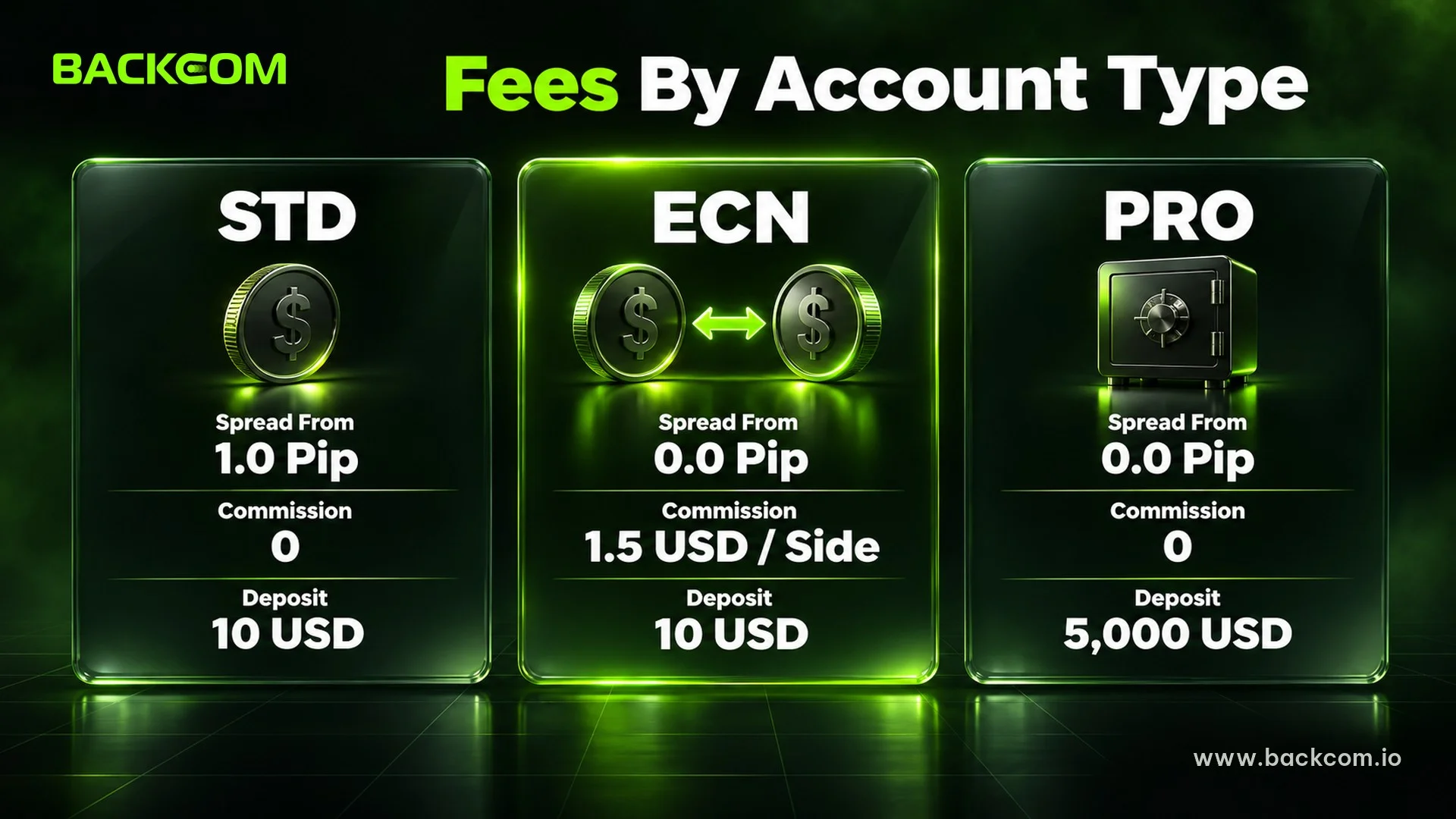
EC Markets trading fees depend first on the account type, because the broker splits its offer into three groups: STD has no commission, ECN charges a separate commission and PRO asks for a much larger minimum deposit. According to the official account types page, all three use market execution, maximum leverage of 1:1000 and the MT4 and MT5 platforms.
| Account type | Spread from | Commission per lot | Minimum deposit | Margin call / Stop out |
|---|---|---|---|---|
| STD | 1.0 pip | 0 | 10 USD | 50% / 30% |
| ECN | 0.0 pip | 1.5 USD per side | 10 USD | 50% / 30% |
| PRO | 0.0 pip | 0 | 5,000 USD | 50% / 30% |
Reference as of 11/11/2026. Account terms can change, so check the broker's official page again before opening an account.
All three types have a minimum trade size of 0.01 lot, a 50-lot maximum per open order and a USD account currency. Direct reference: the official EC Markets account types page.
Traders should read three points carefully before comparing:
- "Spread from" is a floor, not an average. It only shows how low the spread can go under the best conditions.
- The official page has no account called "Raw". The closest match to a raw spread plus commission model is ECN.
- The page does not mention Cent or swap-free accounts. The rebate table on the broker page does include a Cent line, so traders should ask the broker's support before choosing that type.
For a comparison with a broker in the same group, traders can also read the IC Markets trading fees guide, or the IC Markets Rebates page if both brokers are on the shortlist.
EC Markets Spread: How To Read "From 0.0 Pips"
EC Markets spread is the gap between the Ask price and the Bid price, and it is the first cost a trader pays the moment an order opens. Spread is not fixed: it widens around major news or in thin liquidity, so "from 0.0 pips" is only true in the most favourable moments.
The broker's Pricing page gives only a general figure for major forex pairs, "as low as 0.0 pips". It has no average spread table by pair, no separate figure for gold, indices or oil, and no update date. For that reason, this article does not publish an average spread for EC Markets, since that would mean inventing a number the broker has not released.
The reliable way to learn the real spread is to measure it:
- Open Market Watch in MT5 and switch on the Spread column through the right-click Columns menu.
- Measure the same symbol (for example EURUSD or XAUUSD) on a demo account of each type, in the same time window.
- Record at least three moments: the Asian session, the European session and a high-impact news release.
- Convert the result to dollars per lot before comparing account types.
On EURUSD, 1 pip is worth about 10 USD per standard lot. A 1.0 pip spread therefore costs roughly 10 USD to open and close one lot. For gold, traders can see the conversion method in the Exness gold spread guide, because a gold pip differs from a forex pip. The article on what bid and ask mean refreshes the underlying concept.
Direct reference: the EC Markets Pricing page.
EC Markets Commission: What The ECN Account Charges Per Lot
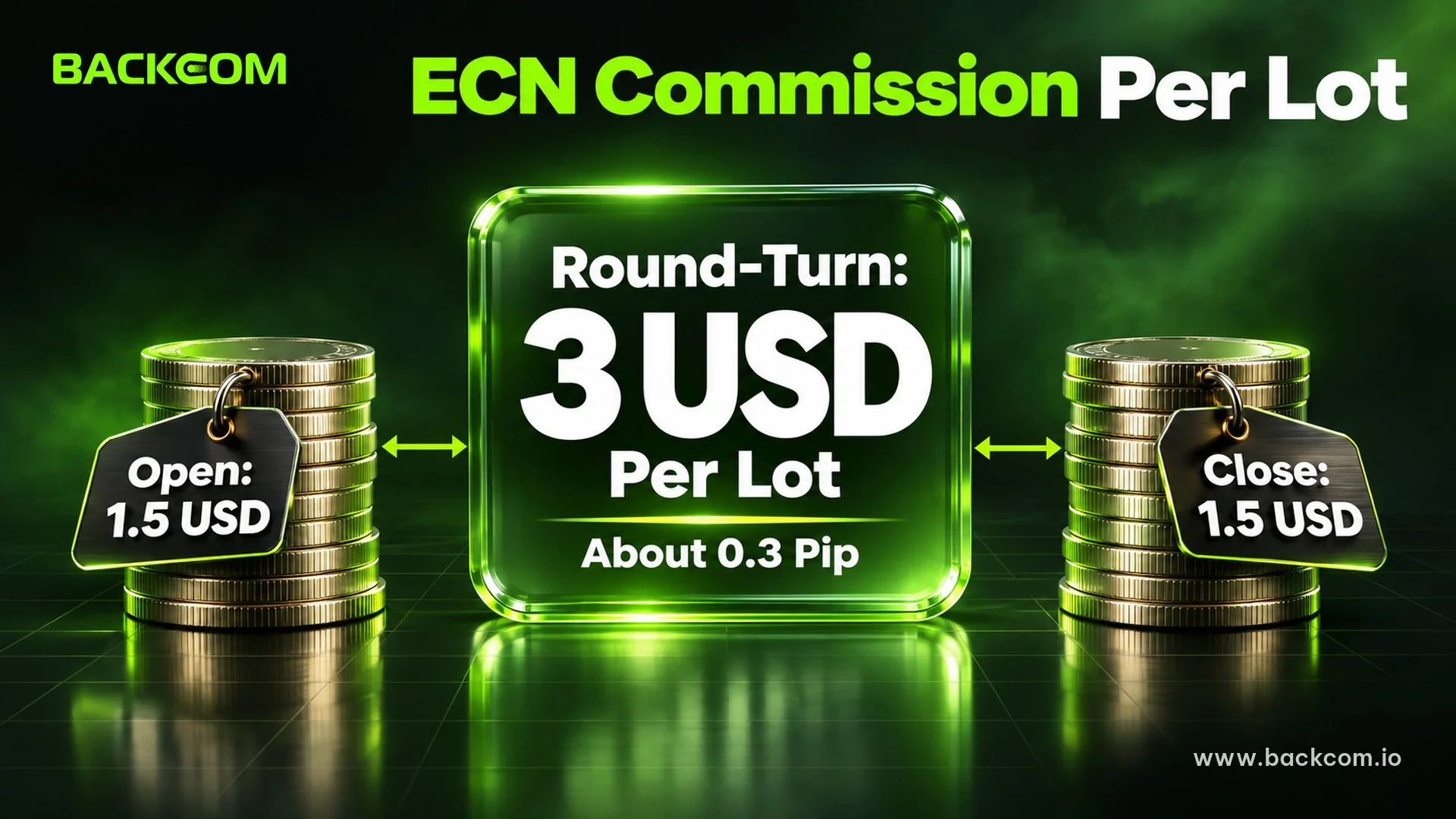
EC Markets commission only applies to the ECN account, at 1.5 USD per lot per side. A full trade has an opening order and a closing order, so the round-turn commission is 3 USD per lot.
This is the conversion traders should do before comparing ECN with STD:
Commission in pips = Round-turn commission (USD) ÷ 10 (USD per pip on 1 lot)
At 3 USD round-turn, the ECN commission equals about 0.3 pip on a pair where 1 pip is worth 10 USD. ECN is therefore cheaper than STD only when the real ECN spread plus 0.3 pip is still lower than the STD spread.
The illustration below uses assumed numbers to show the method, not measured broker data:
- STD: assumed spread of 1.0 pip, zero commission, total about 1.0 pip or 10 USD per lot.
- ECN: assumed spread of 0.2 pip plus 0.3 pip commission, total about 0.5 pip or 5 USD per lot.
- PRO: spread varies by moment, zero commission, but a minimum deposit of 5,000 USD applies.
If the real ECN spread rises to 0.8 pip, the total becomes 1.1 pips and is higher than STD. Traders should therefore measure the live spread before deciding which account costs less. The guide on raw spread versus standard account cost explains this comparison method in more detail.
EC Markets Swap Fees: Rollover Time, Triple Swap And What Is Not Verified
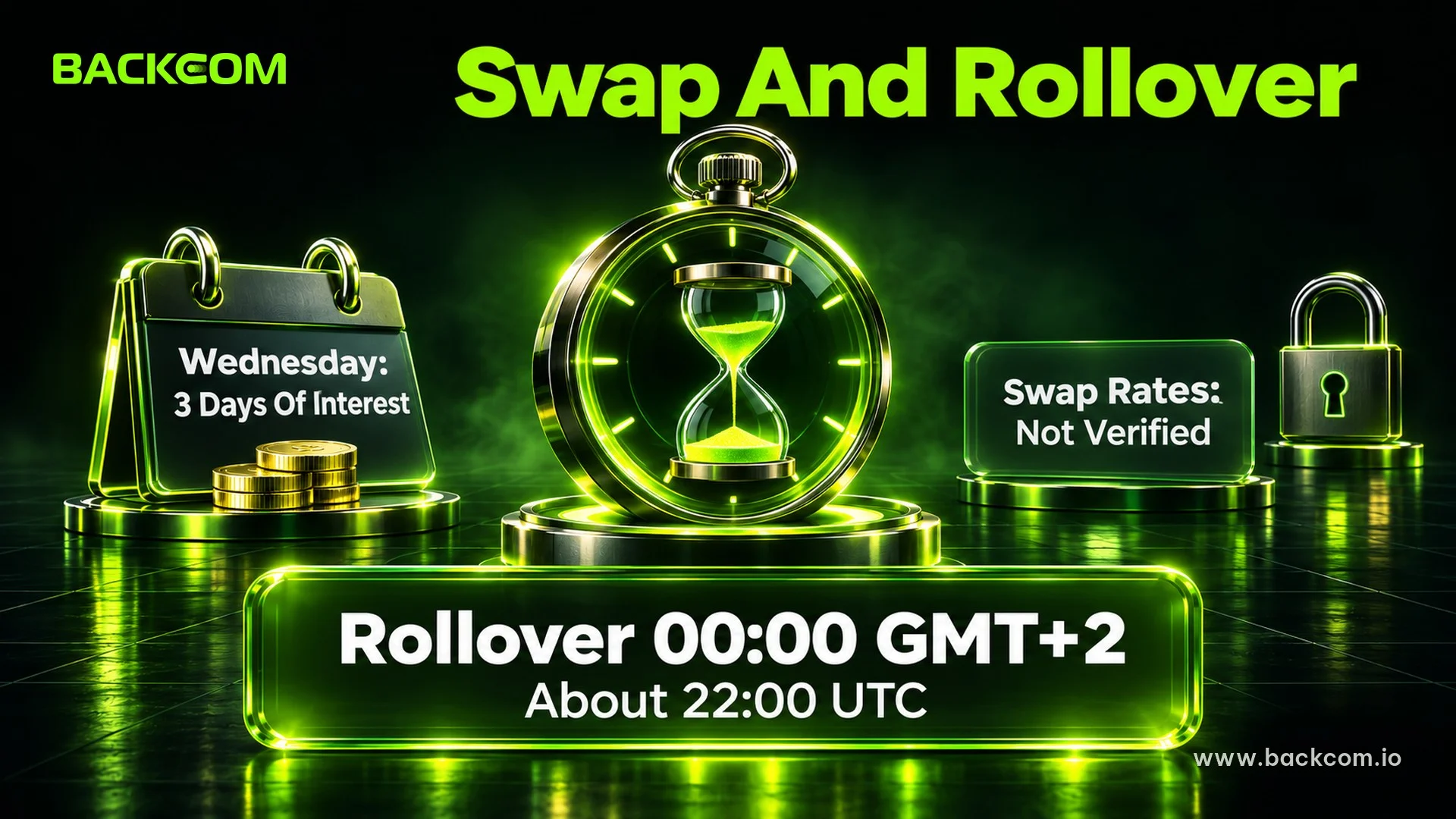
EC Markets swap fees are the credits or charges applied when a trader holds a position through the daily rollover point. According to the Pricing page, swap reflects the difference between the spot price and the interest rates of the two currencies in the pair.
What the broker publishes:
- Rollover happens at 00:00 GMT+2, with a note about daylight saving time.
- A position held from Wednesday to Thursday is charged three days of interest to cover Friday through Sunday, settled on Monday.
In UTC terms, that rollover point falls at 22:00 UTC when daylight saving is not in effect and at 21:00 UTC when it is. This is a conversion made for this article, not a figure the broker states directly, so traders should confirm it on MT5.
What the broker has not published, and what this article marks as not verified:
- The specific swap rate for each forex pair, gold and index.
- Whether a swap-free (Islamic) account exists.
- Any inactivity fee.
To find the real swap, a trader opens Market Watch, right-clicks the symbol, chooses Specification and reads the Swap Long and Swap Short lines. These values move with interest rates, so they need rechecking regularly, especially for positions held several days.
Leverage, Margin Call And Stop Out: How They Affect Cost
Margin call and stop out are not fees, but they decide whether a position is closed by force, and a position closed while spread is wide raises the real cost. According to the account types page, STD, ECN and PRO all have a margin call at 50% and a stop out at 30%.
According to the official leverage page, the maximum leverage depends on the product group, not on the account type:
| Product group | Leverage |
|---|---|
| FX Majors, FX Minors | Up to 1:1000 |
| FX Exotics | Up to 1:100 |
| Metals | Up to 1:1000 |
| Indices | Fixed 1:500 |
| Energies | Fixed 1:400 |
| Crypto | Fixed 1:200 |
Reference as of 11/11/2026. Leverage can change, so check again before trading. The broker also reserves the right to apply a maximum of 1:30 at its own discretion. Direct reference: the EC Markets leverage page.
High leverage means low margin, and low margin makes it easy for a trader to open a position that is too large for the account. Traders should read the guide on margin call versus stop out to learn how to keep the margin level well above the 50% threshold.
On other fees, the Pricing page states that the broker charges no deposit fees and credits withdrawals within 2 hours. These are the broker's own claims, so traders should check them against the payment method they use, because banks and payment processors can still add their own charges.
The Real Cost Of One EC Markets Lot After A Rebate, By Link
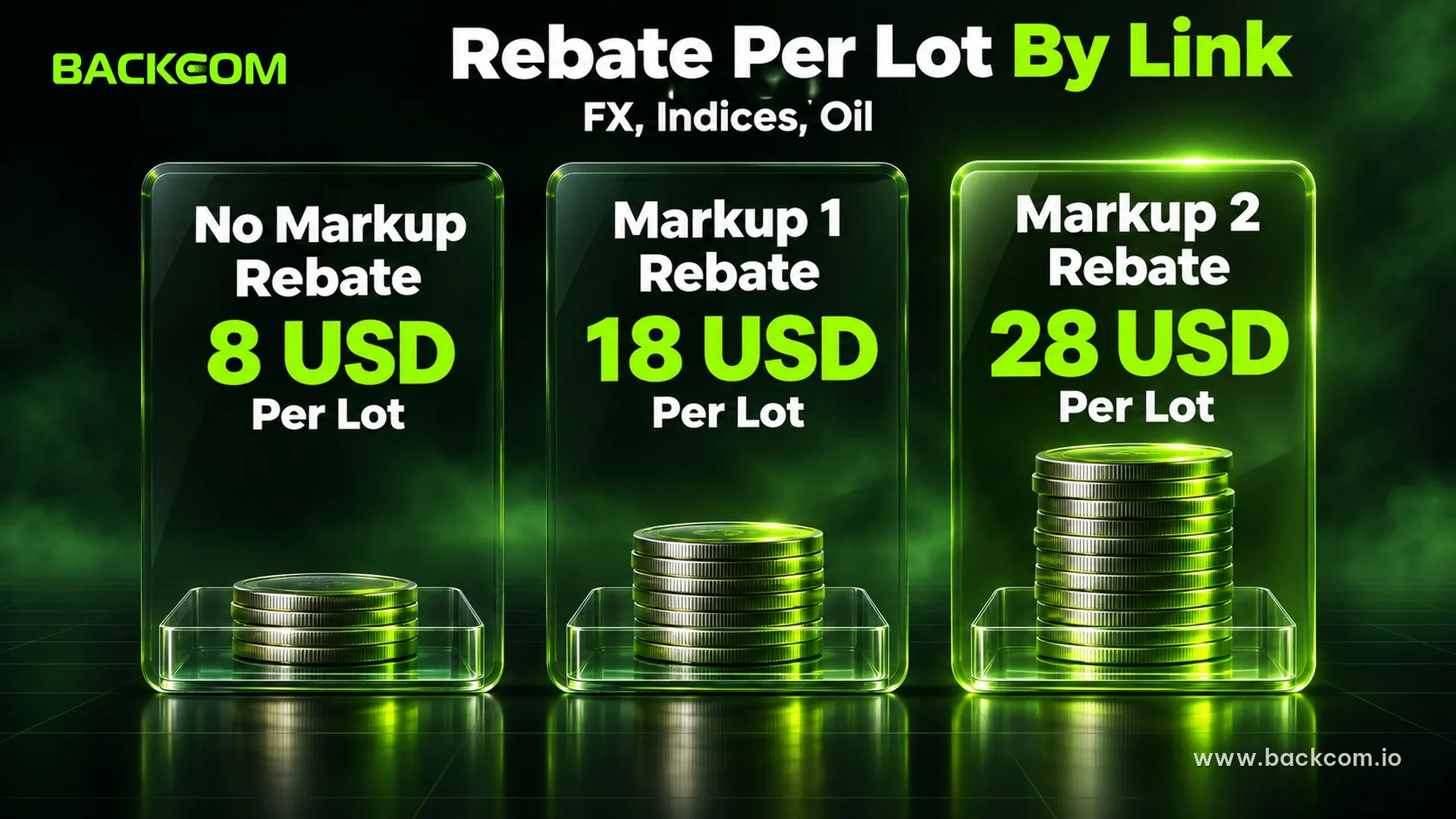
The real cost of one lot is spread plus commission minus the rebate, and it is the number that should drive the choice of how to open an account. EC Markets offers three referral links that differ in spread markup and rebate level.
| Registration link | Spread per the broker page (described on gold) | FX, indices, oil rebate | Gold, silver rebate |
|---|---|---|---|
| No Markup | Normal | 8 USD/lot | 18 USD/lot |
| Markup 1 | Plus 1 pip | 18 USD/lot | 28 USD/lot |
| Markup 2 | Plus 2 pips | 28 USD/lot | 38 USD/lot |
Rebate reference as of 11/11/2026 from the EC Markets broker page on the site, effective from 1 October 2026. Rebates can change, so check again before opening an account.
The broker page only describes the spread markup on gold (XAUUSD), so the example below uses one gold lot. Assume 1 gold pip equals 10 USD per lot, and call the base spread of the No Markup link S (traders measure it on MT5):
Real cost = Spread cost + Commission − Rebate
- No Markup: spread S, minus an 18 USD rebate, so the real cost is S − 18 USD.
- Markup 1: spread S plus 10 USD, minus a 28 USD rebate, so the real cost is still S − 18 USD.
- Markup 2: spread S plus 20 USD, minus a 38 USD rebate, so the real cost is still S − 18 USD.
All three give almost the same result, because the rebate rises by 10 USD at each markup step, exactly the cost of one extra pip of spread. The markup on forex pairs is not described on the broker page, so the same comparison on EURUSD is not verified. Traders should not pick a markup link only because the rebate figure looks larger.
The 8, 18 and 28 USD figures in the table apply to the STD account. The rebate table also has an ECN-UV line at 2.5 USD/lot and no separate line for the PRO account, so the PRO rebate is not verified. The rebate is paid out of the IB commission that EC Markets pays to the introducing partner, not a refund of the broker's own trading fee, and it is calculated on closed lots whether the trade wins or loses. The guide to trusted gold trading brokers adds criteria for comparing gold spreads across brokers.
To see the rebate currently applied, traders can open the EC Markets Rebates and trading conditions page, or use the EC Markets registration link when opening a new account. Backcom.io is an independent introducing broker (IB/affiliate) of EC Markets; rebates are paid from the commission the broker pays Backcom.io — see the risk disclaimer.
Frequently Asked Questions (FAQ) About EC Markets Trading Fees
Does EC Markets Have A Raw Spread Account?
There is no account named Raw on the official page. The equivalent is ECN, with spreads from 0.0 pip plus a commission of 1.5 USD per side. Traders used to Raw accounts elsewhere should compare the 3 USD round-turn commission per lot, not just the spread.
Which EC Markets Account Is The Cheapest?
There is no single answer for every trader. STD has no commission but spreads from 1.0 pip, ECN is cheaper when the live spread is low enough to absorb the 0.3 pip commission, and PRO needs 5,000 USD as a minimum deposit. The reliable method is to measure demo spreads on each type and convert them into dollars per lot.
What Time Does EC Markets Charge Overnight Swap?
The broker states rollover at 00:00 GMT+2, which equals about 22:00 UTC outside daylight saving time. Positions held from Wednesday to Thursday are charged three days of interest. Exact swap rates are not published on the pages checked here, so traders need to read them in the MT5 Specification window.
Does EC Markets Charge Deposit Or Withdrawal Fees?
The Pricing page states no deposit fees and withdrawals credited within 2 hours. This is the broker's own information. Banks or payment processors may still charge their own fees, so traders should check before depositing a large amount.
Conclusion: Measure The Real Spread Before Choosing An Account
EC Markets trading fees are best read in three layers: spread, the 1.5 USD per side ECN commission and overnight swap. Traders need to weigh the account type, the spread measured live on MT5 and the rebate together, rather than relying on the "from 0.0 pips" headline.
Before depositing, a trader should open a demo, measure spread in the same time window on each type, read the swap in Specification and convert everything to dollars per lot. For the broker's entities and licences, traders can read Is EC Markets legit.
Disclaimer: This content is compiled by Backcom.io for information and reference only. It is not investment advice, a trading recommendation or financial advice. CFD trading carries high leverage risk and traders can lose all the capital they deposit. Spreads, commissions, swap and rebates change over time, so traders should check the broker's official pages before trading.
Was this article helpful?
Join The Backcom.io Community
Get the latest on trading rebates, trading tips, and broker deals — and connect with thousands of traders worldwide.

Backcom App
Track Your Rebates Every Day
Every rebate is visible by broker and by day. Manage your wallet and withdrawals in one place.
Open Backcom App