1-Step Vs 2-Step Challenge: Targets, Drawdown, Fees And How To Choose A Prop Firm Package


At the same USD 100,000 account size, a 1-step vs 2-step challenge can mean two very different rule sets. A single evaluation round usually comes with tighter loss limits, while two rounds can give you more room before a breach.
So what is a 1-step challenge, what is trailing drawdown, and why do many single-round packages rely on it? You also need to separate a challenge from instant funding, which skips the evaluation but carries its own fees and rules.
In this article, Backcom.io compares profit targets, drawdown types, minimum days and list prices for representative packages, using data checked on 15 October 2026 and updated on 20 November 2026 where firms have changed their rules.
What Is A 1-Step Challenge? How It Differs From 2-Step, 3-Step And Instant Funding
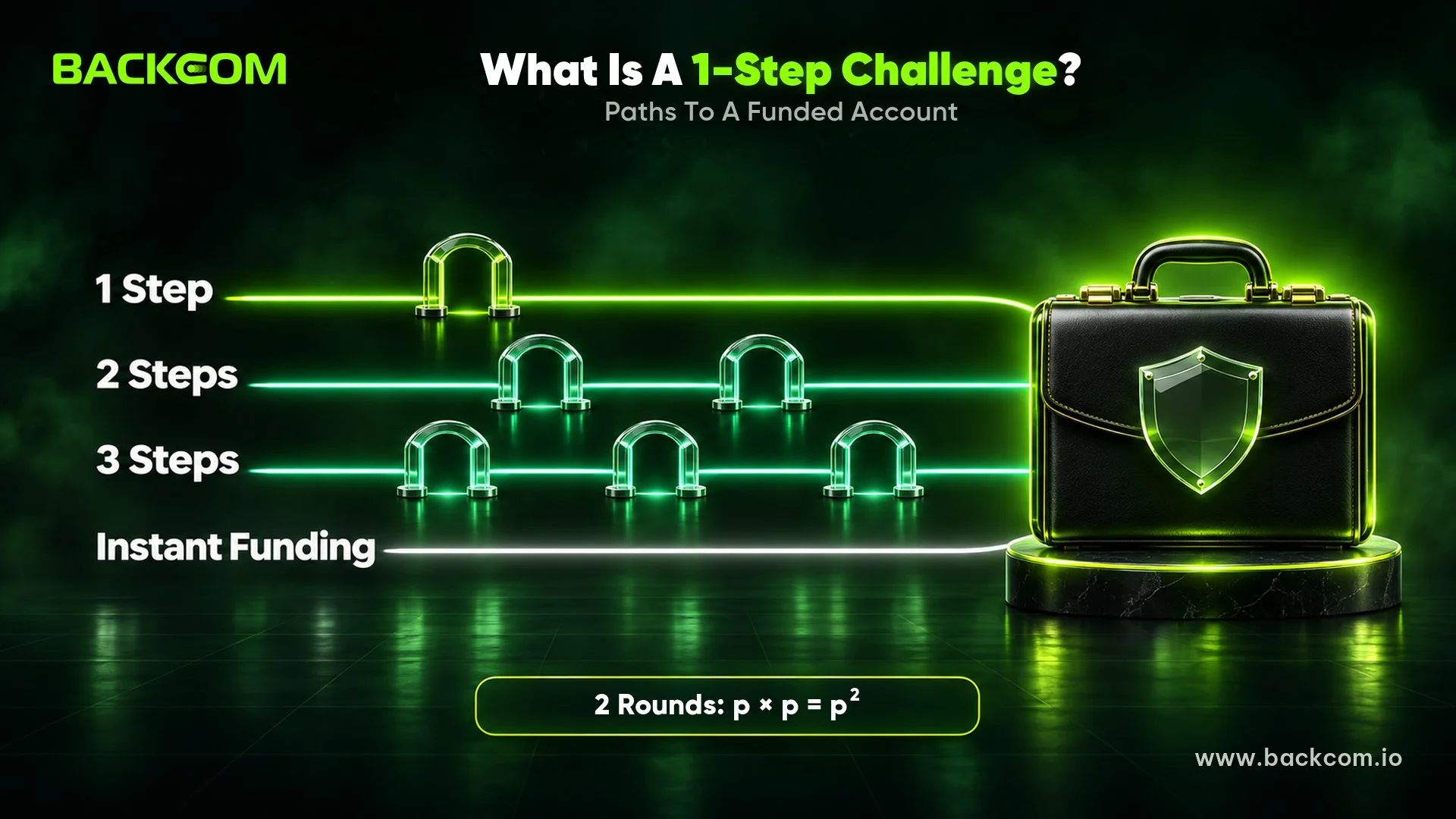
What is a 1-step challenge? It is an evaluation with a single round. The trader has to reach the profit target without breaching the loss limits or other rules to be considered for a funded account.
The three common structures are:
- 1-step challenge: the trader passes one evaluation round.
- 2-step challenge: the trader passes Phase 1, then Phase 2. FTMO 2-Step sets targets of 10% and 5%.
- 3-step challenge: each round can have a lower target, but the trader must pass three separate evaluations.
If you are new to the model, read our guide on what prop trading is and how prop firms work before comparing packages.
The number of rounds changes the fee and the rules in three ways:
- Challenge fees: E8 states that fees for access to its simulated environment are one of its revenue sources.
- More rounds to pass: if your chance of passing each independent round is p, your chance of passing two rounds in a row is p².
- Loss control: some single-round and instant packages use a narrow daily limit, trailing drawdown or a consistency rule to keep results in check.
Instant Funding (No-Challenge Prop Firms): Paying More For An Account Now
Instant funding removes the challenge: you pay a fee and go straight to an account that can earn Rewards under the firm's terms.
- FTMO Instant: launched on 12 October 2026, priced from USD 189 to USD 3,399 by size according to FTMO's announcement. The fee is non-refundable, with a 3% daily loss, a 10% intraday balance-based trailing limit and a 30% consistency rule.
- FundedNext Stellar Instant: no daily loss limit, but a 6% trailing limit that stops rising at the initial balance. The 20,000 account lists at USD 599.99, and the reward share starts at 70%.
1-Step Prop Firm Packages Vs 2-Step And Instant Funding At 100,000 USD
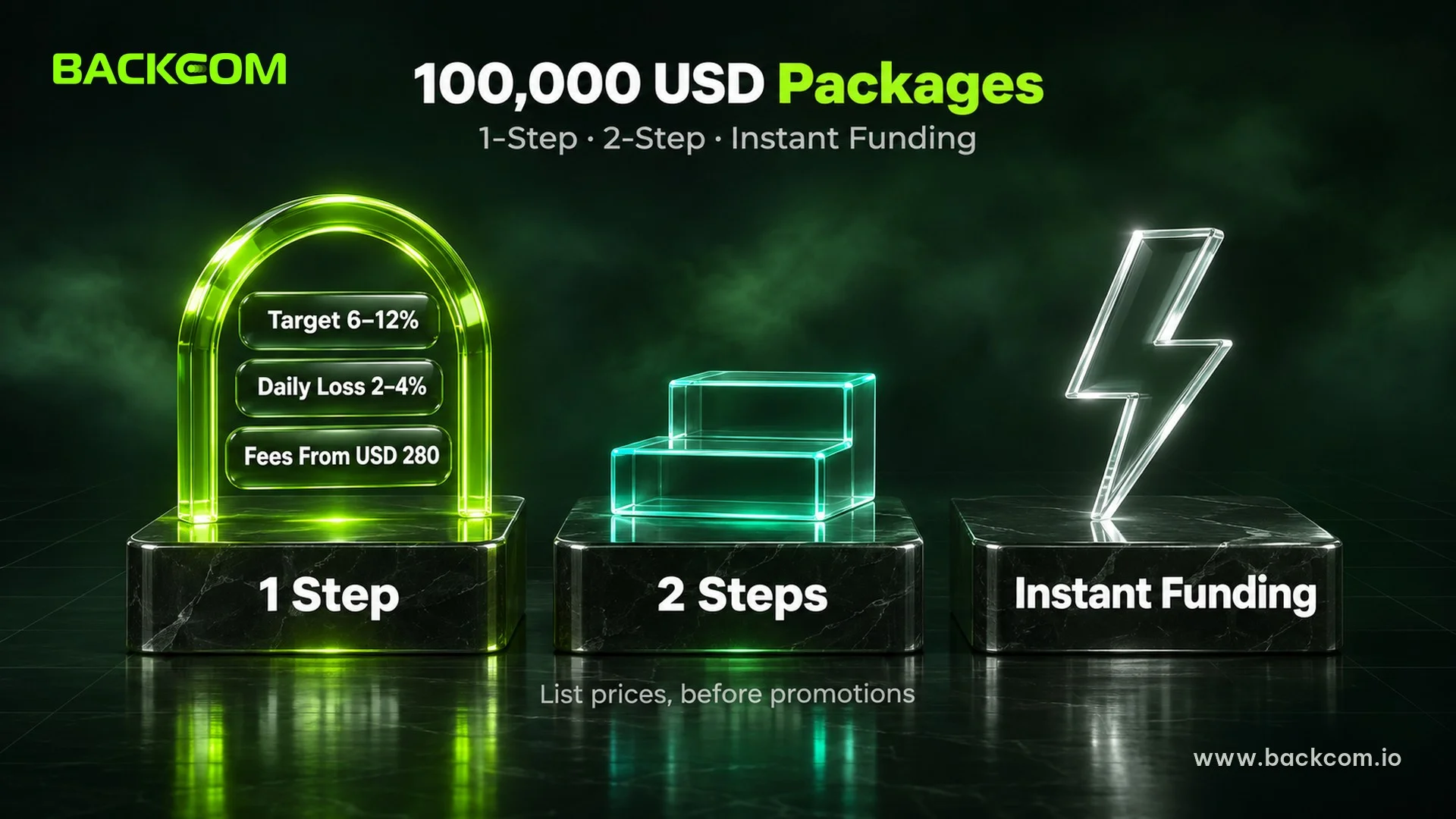
The two tables compare 1-step prop firm packages with two-step packages at 100,000 USD. Fees are list prices, before promotions or add-ons.
| 1-Step package | Target | Daily loss | Overall loss | Minimum days | 100K fee |
|---|---|---|---|---|---|
| E8 One, 80% preset | 9% | 4% | 6% dynamic, locks at the starting balance | 0 | USD 488 |
| E8 Pro | 8% | 2.5% | 8% static | 0; 2% daily profit cap | USD 488 |
| E8 Signature | 6% | 2% Daily Pause in Performance | 3–4% EOD dynamic | 0 | USD 280 |
| FTMO 1-Step | 10% | 3% | 10% EOD trailing; 50% consistency on orders from 12 October 2026 | None | €499 |
| FundedNext Stellar 1-Step | 10% | 3% | 6% static | 2 | USD 569.99 |
| FundingPips 1 Step Flex | 12% | 2–3% by setting | 12% static | 0 | — |
| 2-Step package | Target P1 → P2 | Daily loss | Overall loss | Minimum days | 100K fee |
|---|---|---|---|---|---|
| FTMO 2-Step | 10% → 5% | 5% | 10% static | 4 per phase | €540 |
| FundedNext Stellar 2-Step | 8% → 5% | 5% | 10% static | 5 per phase | USD 549.99 |
| FundedNext Stellar Lite | 8% → 4% | 4% | 8% static | 2 per phase on accounts bought or reset from 12 October 2026 | USD 399.99 |
| FundingPips 2 Step Standard | 8% → 5% | 3% or 5% by setting | 10% static | 0–3 by setting | — |
| FundingPips 2 Step Pro | 6% → 6% | 3% | 6% static | 0 | — |
| FundingPips 2 Step Flex | 10% → 8% | 4% | 12% static | 1 or 3 by split | — |
Reference data as at 15 October 2026, with FTMO and FundedNext rules rechecked on 20 November 2026. FTMO prices are its global euro list. FundingPips prices depend on the settings you choose at checkout.
The5ers also offers one-step and two-step routes, covered in our The5ers review. E8 details are in our E8 Markets review, and our Maven Trading review covers another firm with one-, two- and three-step routes.
See the source rules in FundedNext's Stellar 2-Step article and E8's product overview.
What Is Trailing Drawdown? How It Differs From Static And EOD Drawdown
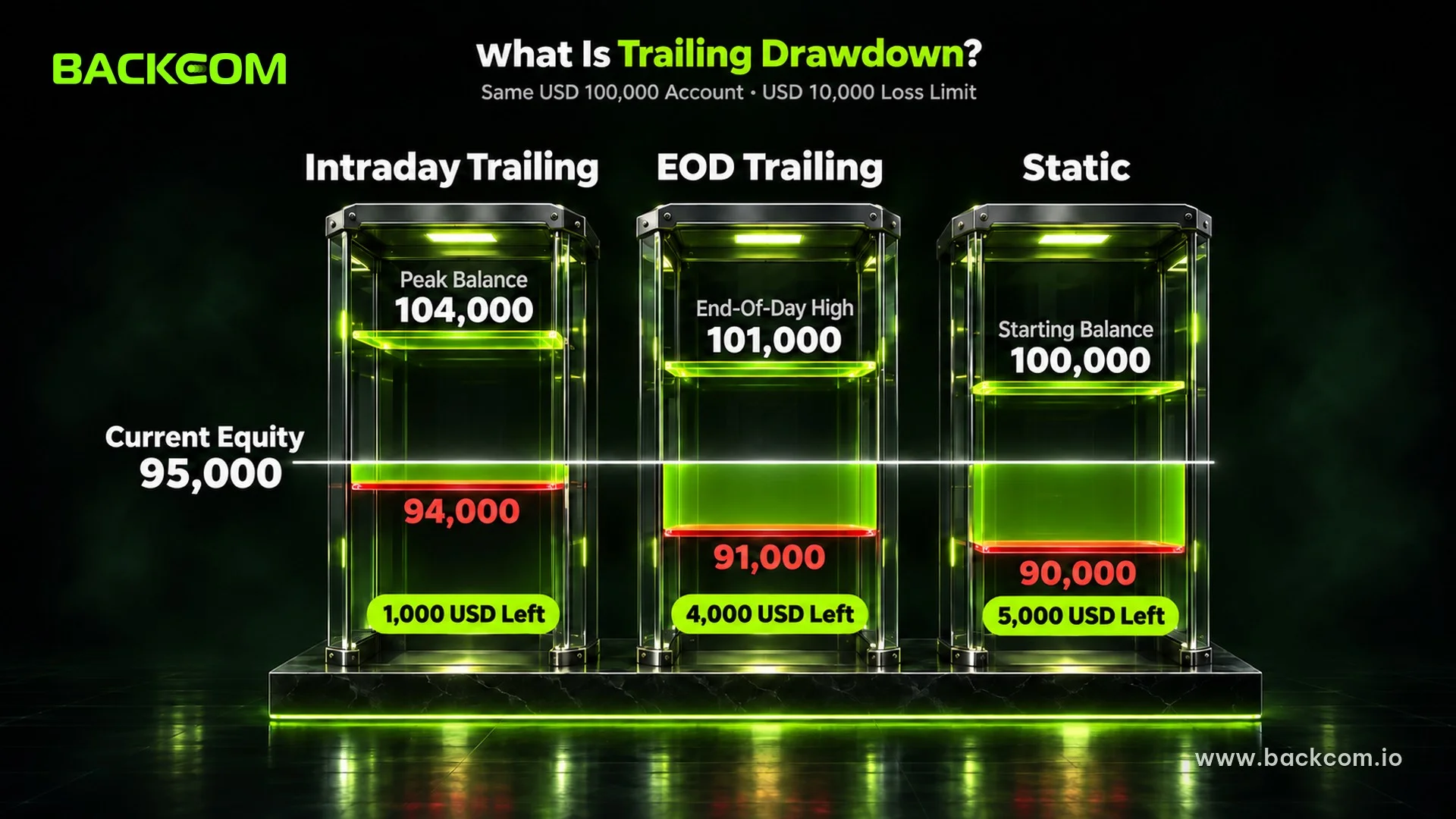
What is trailing drawdown? It is a loss limit that rises as the account reaches new highs and never moves back down when the account falls. Depending on the firm, the high is taken from the balance during the session or at the end of the day. With static drawdown, the floor stays fixed to the initial balance, so profit you have made becomes extra buffer.
- Static drawdown: the floor never moves with profit.
- Intraday trailing: the floor rises whenever the balance sets a new high.
- EOD trailing: the floor only updates at the end-of-day snapshot.
You can read the original definitions on FTMO's Trading Objectives page.
A Worked Example: Same Trades, Three Different Loss Floors
Assume a USD 100,000 account where all three packages allow a USD 10,000 overall loss. The trader closes profit during the session and the balance reaches USD 104,000, then ends the day at USD 101,000. A few days later, equity drops to USD 95,000.
- Intraday trailing: the USD 104,000 peak lifts the floor to USD 94,000. At USD 95,000 equity, only USD 1,000 of room is left.
- EOD trailing: the highest end-of-day balance is USD 101,000, so the floor is USD 91,000, leaving USD 4,000.
- Static: the floor stays at USD 90,000, leaving USD 5,000.
Reset times, converted to UTC:
- FTMO: 00:00 CE(S)T, which is 22:00 UTC during European summer time and 23:00 UTC in winter.
- E8: 00:00 server time, according to E8's Daily Drawdown article. Server time can shift with daylight saving, so read the server clock in your terminal and convert it to UTC.
Which Costs More? Expected Total Fees Once You Count Retakes
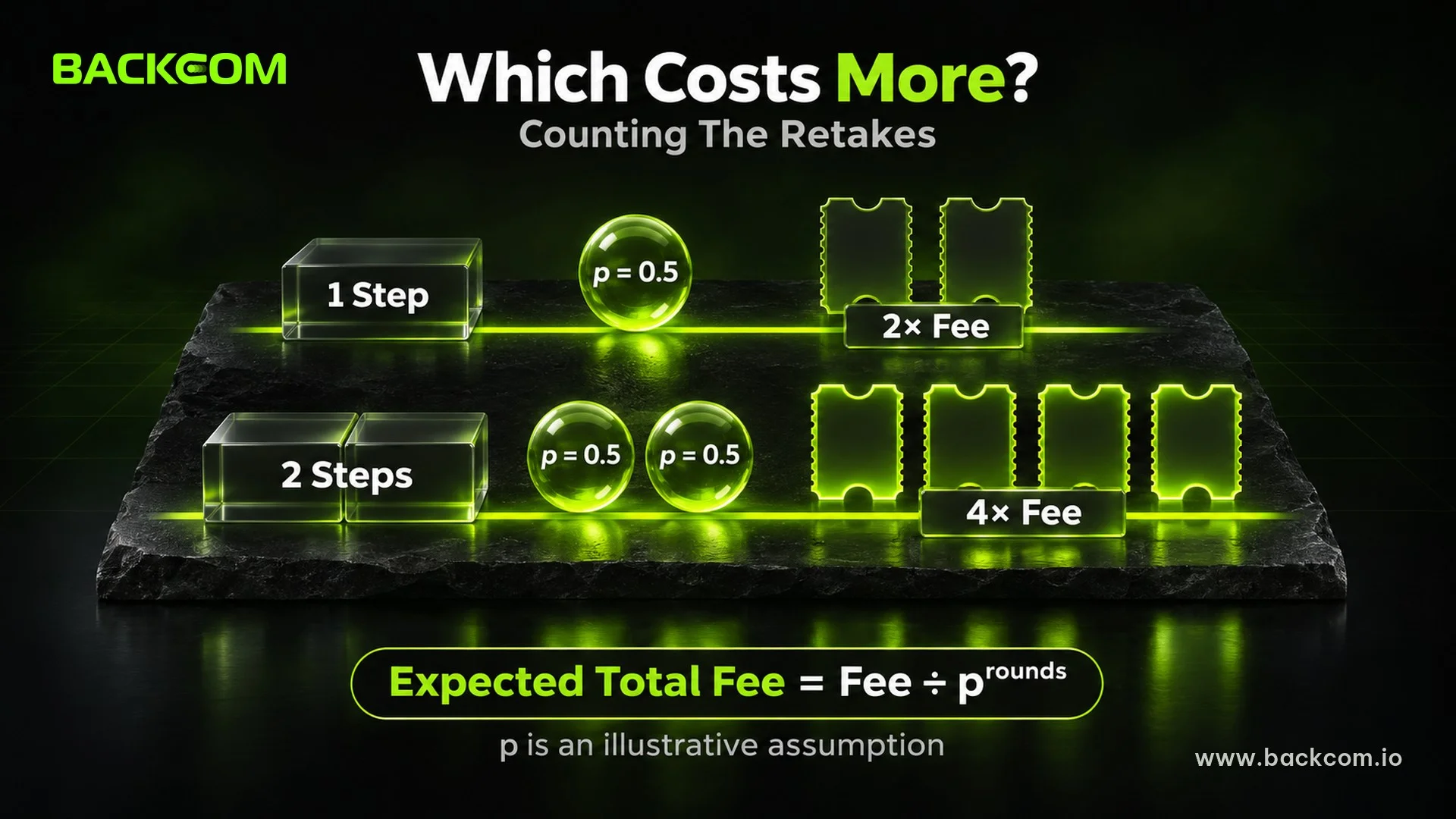
The price of one purchase does not show what you spend if you fail and start again.
Illustrative assumption: the chance of passing each round is p, the rounds are independent, and every retake costs the same list price. p is an assumption for illustration, not the real pass rate of any trader.
Expected total fee until funded = Fee per purchase ÷ p^(number of rounds)
With p = 0.5, the expected number of purchases is 2, 4 and 8 for one, two and three rounds. With p = 0.4, it is 2.5, 6.25 and about 15.63.
| 100K package, list price | Fee per attempt | Total with p = 0.5 | Total with p = 0.4 |
|---|---|---|---|
| FTMO 1-Step | €499 | €998.00 | €1,247.50 |
| FTMO 2-Step | €540 | €2,160.00 | €3,375.00 |
| FundedNext Stellar 1-Step | USD 569.99 | USD 1,139.98 | USD 1,424.98 |
| FundedNext Stellar 2-Step | USD 549.99 | USD 2,199.96 | USD 3,437.44 |
| FundedNext Stellar Lite | USD 399.99 | USD 1,599.96 | USD 2,499.94 |
A two-step package only has an equal or lower expected cost under this condition:
2-step is cheaper in expectation only when: 2-step fee ≤ p × 1-step fee
At p = 0.5, the break-even for FTMO 2-Step is €249.50 against the €499 1-Step, while the 2-Step lists at €540. On FTMO US, which serves US residents only, the same challenges cost USD 579 and USD 619, with a break-even of USD 289.50. For FundedNext Stellar, the break-even is about USD 285.00, while the 2-Step lists at USD 549.99. FundedNext now refunds the Stellar 1-Step fee with the third Performance Reward on purchases from 12 January 2026, which lowers its net cost for traders who reach that point.
Estimate p from your own journal. Our guide on how to pass a prop firm challenge covers keeping discipline through each round. An industry-wide pass rate cannot replace your own number, because its method and sources are rarely published.
| Package | Fee per 1,000 USD of capital |
|---|---|
| E8 Signature 100K | USD 2.80 |
| FundedNext Stellar Lite 100K | USD 4.00 |
| E8 One / E8 Pro 100K | USD 4.88 |
| FTMO 1-Step / 2-Step 100K | €4.99 / €5.40 |
| FundedNext Stellar 2-Step / 1-Step 100K | USD 5.50 / 5.70 |
| FundedNext Stellar Instant 20K | USD 30.00 |
| FTMO Instant 100K | USD 33.99 |
Fee per 1,000 USD ignores payout caps, the number of rounds and drawdown. This table therefore cannot rank firms or prove that instant funding always carries a fixed premium.
Which 1-Step And 2-Step Packages Can You Buy From Your Country?
Which packages you can buy depends on your country of residence, and every firm in this comparison publishes its own rules.
A firm appearing in these tables is a comparison of package structures, not an invitation to sign up. Using a VPN or someone else's documents to get around a country restriction can breach the terms and cost you the account and any payout.
- FundedNext: its Help Center lists the countries whose residents and citizens cannot use the service. Our FundedNext review gives more background on each programme.
- FundingPips: its Get Started page lists the countries of residence it does not accept.
- E8 Markets: its country list can limit which products and account sizes are available, based on the country on your KYC documents.
- FTMO and The5ers: US residents use FTMO US, Australian residents go to an affiliated entity, and The5ers publishes a list of excluded countries.
1-Step Vs 2-Step Challenge: Choosing By Trading Style
To settle the 1-step vs 2-step challenge question, compare each rule with your own trading history:
- Scalpers and day traders: with many trades, the daily loss limit becomes the main constraint. FTMO 1-Step sets it at 3%, and 2-Step at 5%.
- Swing traders: check how drawdown is calculated and whether overnight holding is allowed. Static limits give a buffer you can predict, and at FundingPips, holding on a Master account also depends on the Swing add-on.
- EA users: check the daily limit, any consistency rule and whether the firm allows bots. Our guide to prop firm EA trading rules covers these conditions.
Before paying, answer four questions:
- Is the overall loss static, intraday trailing or EOD, and what time does it reset in UTC?
- Is the daily loss calculated on balance or equity, and how large is it?
- How does your expected total fee change when you use pass rates from your own journal?
- Do the eligibility rules accept your country and documents and allow the way you trade?
Note: FTMO replaced its Best Day Rule with a 50% consistency rule on 1-Step orders from 12 October 2026, and FundedNext Stellar Lite cut its minimum days for accounts bought or reset from the same date.
Frequently Asked Questions (FAQ) About 1-Step Vs 2-Step Challenges
Is A 1-Step Or 2-Step Challenge Easier To Pass?
There is no single answer. The 1-step vs 2-step challenge choice depends on how well you hold your losses and reach targets. FTMO 1-Step has one round but a 3% daily loss and an EOD trailing overall limit. 2-Step has two rounds, a 5% daily loss and a static overall limit. Test both rule sets against your own trade history.
Is A 2-Step Package Cheaper Once You Count Retakes?
Not necessarily. One purchase price does not tell you how often you will start again. If your chance of passing each independent round is 0.5, a two-step package must cost half the one-step price to break even on expected fees. Two-step rules can also change your pass rate per round, so put your own numbers into the formula.
How Does FTMO 1-Step Differ From FTMO 2-Step?
1-Step has a 10% target, a 3% daily loss, a 10% EOD trailing overall limit and a 50% consistency rule on orders from 12 October 2026, with a 100K price of €499. 2-Step targets 10% then 5%, with a 5% daily loss, a 10% static limit, at least four trading days per phase and a €540 price. FTMO US, for US residents, prices them at USD 579 and USD 619.
Is Instant Funding Worth The Higher Fee?
It depends on what you need and how well you follow the rules. Instant funding skips the evaluation, but FTMO Instant costs up to USD 3,399 at the 100K size according to FTMO's 12 October 2026 announcement, is not refundable and uses trailing drawdown plus a 30% consistency rule. Work out the fee per account size and check how much room is left after a profit or a withdrawal.
How Do I Know Which Packages Are Open In My Country?
Each firm publishes its own restricted-country list, and some limit products or sizes by the country on your KYC documents. Read the list for your country of residence, then ask support in writing about the exact package before paying. Never use a VPN or another person's documents, because that can void the account and any payout.
Conclusion: Estimate Your Own Pass Rate Before You Choose A Package
The answer to the 1-step vs 2-step challenge question lies in how each rule set interacts with your trading system. Look at drawdown, reset times, expected total fees and eligibility in your country together.
For next steps, read our guide on how to pass a prop firm challenge and our list of reputable prop firms.
Disclaimer: This content is compiled by Backcom.io for information only, using data checked on 15 October and 20 November 2026. It is not investment advice or a recommendation to buy a challenge. FTMO US figures apply to US residents only. Rules, fees and country lists can change.
Was this article helpful?
Join The Backcom.io Community
Get the latest on trading rebates, trading tips, and broker deals — and connect with thousands of traders worldwide.

Backcom App
Track Your Rebates Every Day
Every rebate is visible by broker and by day. Manage your wallet and withdrawals in one place.
Open Backcom App